Some have proclaimed that modern versions or their Greek texts deny the deity of Jesus Christ. Certainly there are some, such as the New World Translation (published by the Jehovah’s Witnesses), that seek to diminish Christ’s deity. It is also true that some versions are stronger regarding Christ’s deity than others. While most translations clearly and strongly proclaim this basic biblical truth, the Traditional Text does present a stronger Christology regarding His deity (Matthew 19:16-17; Romans 14:10, 12; Philippians 2:6; 1Timothy 3:16; 1John 5:7; and Revelation 1:8, 11).

Additionally, other aspects of Christology are more strongly presented in the Traditional Text. For example, in Luke 2:33, 43 the Traditional Text calls the stepfather of Christ by his name and separates him from the person of Mary. We read, “Joseph and his mother marvelled” and “Joseph and his mother knew not of it.” However, the Critical Text changes “Joseph” to “father,” making the texts read “his father and mother marveled” and “his father and mother knew not of it.” Such readings do not in themselves deny the virgin birth of Christ; still the reading found in the Traditional Text upholds this doctrine and removes any possible confusion in this regard.

The same may be said of Christ’s redemption. Again, the truth of salvation is found in all Greek texts and English translations. Yet, certain aspects are presented more forcefully in the Traditional Text and the KJV in certain places. We are told that we have redemption “through his blood” in Colossians 1:14. The Critical Text does not contain this phrase at this place, though it does appear in all texts in Ephesians 1:7. This raises two questions. First, why would the phrase be found in Paul’s letter to the Ephesians and not in his letter to the Colossians? Second, how is it possible to have redemption without divine payment for that redemption? Clearly the phrase should remain in regard to this doctrine. The Greek manuscripts are evenly divided as to its inclusion or omission. This can be demonstrated with the two editions of the Majority Text. The internal evidence, based on Ephesians 1:7, would argue for its inclusion in that the phrase is used by Paul elsewhere and is consistent with what he would have written. Overall, when we consider other textual sources, the reading must remain because it is biblical and in character with Paul’s other writings.

An additional example concerns 1Peter 2:2. We are told in the Traditional Text that as newborn babies in Christ we should “desire the sincere milk of the word that ye may grow thereby.” The Greek phrase found in the Traditional Text reads ina en auto auxethete (that ye may grow). The Critical Text adds eis soterian (to salvation) at the end of the phrase, suggesting that salvation is something we grow to. This is why the NRSV renders the phrase as “that by it you may grow into salvation.” Certainly the reading of the Traditional Text omits the confusion and provides a stronger Christology here regarding redemption.

In regard to Christ, Paul reminds us that “in all things he might have the preeminence” (Colossians 1:18). If Christ is to have the preeminence in all things, this would include Bible translations. Just as one can use a modern version to prove the deity of Christ, so modern versions proclaim the person of Jesus Christ. Though this may not be in question, divine names are not always as strongly proclaimed in the Critical Text. Instead of phrases such as “Lord Jesus Christ” we might find “Jesus Christ” or “Jesus.” In fact, there are about two hundred such examples found in the New Testament where the expanded title is found in the Traditional Text.

Sometimes a simple omission has profound impact. 1John 1:7 is a good illustration of this. The Traditional Text reads, “But if we walk in the light, as he is in the light, we have fellowship one with another, and the blood of Jesus Christ his Son cleanseth us from all sin.” Modern versions based on the Alexandrian textual line read “Jesus” instead of “Jesus Christ.” The difference seems small on the surface, but we must remember that John wrote this epistle to confront the heresy of Gnosticism. The Gnostics taught that Jesus and Christ were two separate entities. Jesus, they said, was born of Joseph and Mary and was physical. At his baptism the Christ, who was spiritual, was said to have entered into him. At this point, according to the Gnostics, Jesus became Jesus Christ. At his crucifixion, the Gnostics claimed that the Christ left, leaving only Jesus to die. At the resurrection, the disciples saw the spirit Christ, but the mortal Jesus remained dead. Once we understand the heresy John was confronting, the differences between the two readings becomes abundantly clear. If John had written “the blood of Jesus” he would have been making a statement that the Gnostics would have been in agreement with. After all, they believed that it was Jesus who shed his blood. But by writing “the blood of Jesus Christ,” John was making a direct assault on this Gnostic heresy.

~ from Dr. Thomas Holland’s book, “Crowned With Glory”
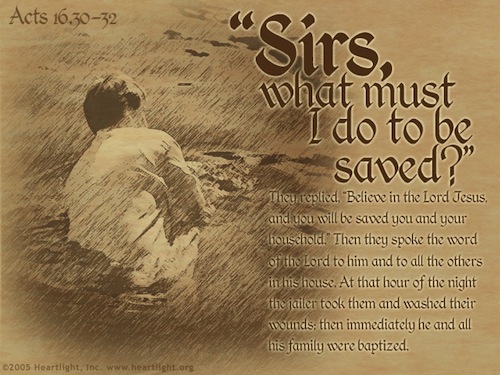
1. Admit that you are a sinner and that you cannot save yourself.

Romans 3:23 says, “For all have sinned and fall short of the glory of God…” This means that even though you try to do your best, you still fall short because you are a sinner. Romans 6:23 says, “The wages of sin is death, but the gift of God is eternal life in Christ Jesus our Lord.” Salvation is the gift of God to you. That’s the way He planned it.

2. Repent or change the attitude of your mind and your conduct toward God.

Acts 2:38 teaches, “And Peter said to them, repent and be baptized, each of you on the name of Jesus Christ to remission of sins. And you will receive the gift of the Holy Spirit.” Acts 3:19 says, “Therefore, repent and turn back, so that your sins may be blotted out.” Acts 8:22-23 declares, “Therefore repent of this wickedness of yours, and pray to the Lord that the intent of your heart may be forgiven. For I see that you are poisoned by bitterness and bound by iniquity.” Jesus warns in Revelation 2:5; 16; 21, “Remember then how far you have fallen; repent, and do the works you did at first. Otherwise, I will come to you and remove your lamp stand from its place —unless you repent”; “Therefore, repent! Otherwise, I will come to you quickly and fight against them with the sword of My mouth”; I gave her time to repent, but she does not want to repent of her sexual immorality.”

3. Confess that Jesus Christ is Lord, He is the Son of God, and that He alone can save you.

“Salvation is found in no one else, for there is no other name under heaven given to men by which we must be saved” (Acts 4:12). “For there is one God and one mediator between God and men, the man Christ Jesus, who gave himself as a ransom for all men–the testimony given at its proper time” (1 Timothy 2:5-6). Isaiah 53:6 says that “We all, like sheep, have gone astray, each of us has turned to his own way; and the Lord has laid on Him the iniquity of us all.” Jesus took our sins upon Himself when He died on the cross. He paid the penalty for our sins so that we would not have to. He was raised from the dead, showing that He has victory of sin and death. Romans 10:9 says, “If you confess with your mouth, ‘Jesus is Lord,’ and believe in your heart that God raised Him from the dead, you will be saved.”

4. Acknowledge that salvation will be yours if you put your faith in Jesus Christ.

Ephesians 2:8 says, “For it is by grace you have been saved, through faith–and this not from yourselves, it is the gift of God–not by works, so that no one can boast.” This clearly indicates that God gives the gift of faith first. Then you take the faith He has given you and place it in Christ you will be saved by faith alone–there is nothing for you to do, except believe.

5. Receive Jesus Christ into your life to be your Savior and Lord from this day forward and forever.

2 Corinthians 5:17 says, “Therefore, if anyone is in Christ, he is a new creation; the old has gone, the new has come!” This is what is known as “new life in Christ,” or as John 3:3 puts it, being “born again.”

Receiving Christ is the beginning. As we learn in Colossians 2:6-7, “Just as you received Christ Jesus as Lord, continue to live in him, rooted and built up in him, strengthened in the faith as you were taught, and overflowing with thankfulness.”

After receiving Him, be obedient by following Him in baptism and by uniting with the Church. When you do, you will find that life truly does have new purpose and meaning.

Ephesians 6:13-18

Wherefore take unto you the whole armour of God, that ye may be able to withstand in the evil day, and having done all, to stand.

Stand therefore, having your loins girt about with truth,

and having on the breastplate of righteousness;

And your feet shod with the preparation of the gospel of peace;

Above all, taking the shield of faith, wherewith ye shall be able to quench all the fiery darts of the wicked.

And take the helmet of salvation,

and the sword of the Spirit, which is the word of God:

Praying always with all prayer and supplication in the Spirit, and watching thereunto with all perseverance and supplication for all saints…”

God reveals Himself as the divine Warrior who fights on behalf of or against the people who profess to bear His name, depending on their faithfulness to His covenant. While this truth was known under the old covenant (see, for example, Ex. 15:3; Dan. 10:10–14), now under the new covenant we have a clearer perspective on spiritual warfare, especially insofar as we are called to fight on the Lord’s side against the Enemy and his minions.

Paul explains how we are to equip ourselves for this spiritual warfare. In Ephesians 6: 10–12, he reminds us that our struggles with sin and with those people who hate the living God are not battles against flesh and blood but against the Evil One. Before we knew Christ, we were in Adam and enslaved to the powers of sin and death. Having been reconciled to God through Jesus, we no longer have the Devil as our captain but now serve in the army of the Lord (Rom. 5:12–21). Still, the influence of sin does not disappear at once, for the world, the flesh, and the Devil strive to make us forget whose side we are on as servants of the cross (Romans 7:7–25; 1 Peter 5:8–9).

The only effective way to keep us from going against the way of Jesus and acting as traitors to His cause is to continually put on the uniform that identifies us as His soldiers (Eph. 6:13–17). Paul uses the analogy of a soldier’s armor to describe the armor of faith. While it is possible to draw some inferences as to the reason why each particular piece of armor is linked to its specific spiritual characteristic, it is more important to see that the roots of Paul’s thinking go back to the Old Testament. In Isaiah 59:15b–17, the prophet speaks of God wearing the same kind of armor as we are to wear in battle against Satan. Putting on spiritual armor simply means that we continually clothe ourselves in the Lord, relying on His gifts and graces to resist temptation and to enable us to risk even our own well-being for the sake of the kingdom.

Continual prayer in the Spirit both for ourselves and for the needs of fellow believers is the means by which we wear this armor (Eph. 6:18–20). Praying in the Spirit is not a mystical experience but rather an alertness to pray, along with a quickness to pray, because, knowing the Holy Spirit gives us power to pray, He intercedes with and for us as we pray, we recognize that power in acknowledging our dependence on God (Rom. 8:26–27).

John Calvin comments on this passage, reminding us that we should not let the “injurious treatment” of others provoke us to revenge, for those who bother us are merely darts from Satan’s hand. “While we are employed in destroying those darts, we lay ourselves open to be wounded on all sides.” Instead, “we must go straight to the enemy, who attacks and wounds us from his concealment — who slays before he appears.”

Expository

Some of you may have little or no experience with what I mean by preaching. What I mean by preaching is expository exultation. (This is how I preach – took it right out of my mouth!)

Preaching Is Expository

Expository means that preaching aims to exposit, or explain and apply, the meaning of the Bible. The reason for this is that the Bible is God’s word, inspired, infallible, profitable—all 66 books of it.

The preacher’s job is to minimize his own opinions and deliver the truth of God. Every sermon should explain the Bible and then apply it to people’s lives.

The preacher should do that in a way that enables you to see that the points he is making actually come from the Bible. If you can’t see that they come from the Bible, your faith will end up resting on a man and not on God’s word.

The aim of this exposition is to help you eat and digest biblical truth that will make your spiritual bones more like steel, double the capacity of your spiritual lungs, make the eyes of your heart dazzled with the brightness of the glory of God, and awaken the capacity of your soul for kinds of spiritual enjoyment you didn’t even know existed.

Preaching Is Exultation

Preaching is also exultation. This means that the preacher does not just explain what’s in the Bible, and the people do not simply try understand what he explains. Rather, the preacher and the people exult over what is in the Bible as it is being explained and applied.

Preaching does not come after worship in the order of the service. Preaching is worship. The preacher worships—exults—over the word, trying his best to draw you into a worshipful response by the power of the Holy Spirit.

My job is not simply to see truth and show it to you. (The devil could do that for his own devious reasons.) My job is to see the glory of the truth and to savor it and exult over it as I explain it to you and apply it for you. That’s one of the differences between a sermon and a lecture.

Preaching Isn’t Church, but It Serves the Church

Preaching is not the totality of the church. And if all you have is preaching, you don’t have the church. A church is a body of people who minister to each other.

One of the purposes of preaching is to equip us for that and inspire us to love each other better.

But God has created the church so that she flourishes through preaching. That’s why Paul gave young pastor Timothy one of the most serious, exalted charges in all the Bible in 2 Timothy 4: 1-2: “I charge you in the presence of God and of Christ Jesus, who is to judge the living and the dead, and by his appearing and his kingdom: preach the word.”

What to Expect from My Preaching and Why

If you’re used to a twenty-minute, immediately practical, relaxed talk, you won’t find that from what I’ve just described.

I preach twice that long;

I do not aim to be immediately practical but eternally helpful;

and I am not relaxed.

I standing vigilantly on the precipice of eternity speaking to people who this week could go over the edge whether they are ready to or not. I will be called to account for what I said there.

That’s what I mean by preaching. Amen!

~ John Piper

baptism

1 Peter 3:20-21, “which aforetime were disobedient, when the long suffering of God waited in the days of Noah, while the ark was a preparing, wherein few, that is, eight souls, were saved through water: which also after a true likeness doth now save you, even baptism, not the putting away of the filth of the flesh, but the interrogation of a good conscience toward God, through the resurrection of Jesus Christ…”

Baptism – the water of baptism, symbolizing the regeneration of the Holy Spirit, is the means of salvation to all those who receive the Holy Spirit in His quickening, cleansing efficacy. Now as the waters of the flood could not have saved Noah and his family, had they not made use of the ark; so the water of baptism saves no man, but as it is the means of his getting his heart purified by the Holy Spirit through faith in Jesus Christ, and illustrates to him that purification.

John 3:5, “Jesus answered, “Truly, truly I say to you, unless someone is born of water and spirit, he is not able to enter into the kingdom of God.”

Jesus asserted the obligation of (baptism) the outward rite, He asserted likewise, as its necessary complement, the presence and creating and informing energy of the Spirit with which John had promised that the coming one should baptize (Matthew 3:11). That as John’s baptism had been unto repentance, for the remission of sins, so the new life must include the real no less than the symbolic cleansing of the old, sinful life, and the infusion by the Spirit of a new and divine principle of life. Thus Jesus’ words included a prophetic reference to the complete ideal of Christian baptism – “the washing of regeneration and the renewing of the Holy Ghost” (Tit. 3:5; Eph. 5:26); according to which the two factors are inseparably blended (not the one swallowed up by the other), and the new life is inaugurated both symbolically in the baptism with water, and actually in the renewing by the Holy Spirit, yet so as that the rite, through its association with the Spirit’s energy, is more than a mere symbol: is a veritable vehicle of grace to the recipient, and acquires a substantial part in the inauguration of the new life. Baptism, considered merely as a rite, and apart from the operation of the Spirit, does not and cannot impart the new life. Without the Spirit it is a lie. It is a truthful sign only as the sign of an inward and spiritual grace. ~ M. R. Vincent

Titus 3:4-5, “But when the goodness and loving kindness of God our Savior appeared, he saved us, not because of works done by us in righteousness, but according to his own mercy, by the washing of regeneration and renewal of the Holy Spirit…”

“The washing of regeneration and renewal of the Holy Spirit,” literally means “the laver of regeneration and the renewal of the Holy Spirit.” It does not mean the act of bathing, but the bath, the laver. The phrase laver of regeneration distinctly refers to baptism, in connection with which and through which as a medium regeneration is conceived as taking place. It is true that nothing is said of faith; but baptism implies faith on the part of its recipient. It has no regenerating effect apart from faith; and the renewing of the Holy Spirit is not bestowed if faith be wanting. ~ M. R. Vincent

Ephesians 5:26, “having cleansed her by the washing of water with the word…”

“To be connected with having cleansed it by the laver of water: with the word describes that which accompanies the sacrament and which is the peculiar element of baptismal purification. Compare John 15:3, “You are already clean because of the word that I have spoken to you.” St. Augustine says: “Take away the word, and what is the water but water?” ~ M. R. Vincent

When someone desires baptism, they are asked whether or not they have repented of their sins and placed their faith and trust in God through Jesus Christ. This is the “inquiry” spoken of in 1 Peter 3:21, and the answer is given, “I do repent of my sins, and I have placed my faith and trust in God through Jesus Christ…I believe that Jesus Christ is my Savior and Lord.”

Therefore, it is clarified of what St. Peter said in Acts 2:38-39, “And Peter said to them, “Repent and be baptized, each one of you, in the name of Jesus Christ for the forgiveness of your sins, and you will receive the gift of the Holy Spirit. For the promise is for you and for your children, and for all those who are far away, as many as the Lord our God calls to himself.”

“Behold, the days are coming…that I will send a famine on the land, not a famine of bread, nor a thirst for water, but of hearing the words of the Lord. They shall run to and fro, seeking the word of the Lord, but shall not find it.” Amos 8:11–12

“In spite of multitudes running about looking for spiritual food, those who truly desire God’s Word comprise only a remnant (see Micah 7:14, 18). This is certainly as true today as it was in ancient Israel. Few Christians today truly hunger to hear the pure word of the Lord. Instead, the majority fatten themselves on Sodom’s apples, feeding on the straw of perverted gospels.” ~ David Wilkerson


Who can endure on the day of Your coming?
Who will be able to stand?
You will return like refiner’s fire.
Who will be saved by Your hand?

You made a way by the blood of Your sacrifice,
Poured out on Calvary’s tree;
Now, in Your presence, Your glory, and righteousness
Stir up a passion in me.

Though You were blameless, You laid down Your life for us,
Bearing the weight of our sin;
Come, with the power that raised You, victorious,
Pour out Your presence again.

The fire of Your love is burning within me,
Consuming my heart, restoring my soul;
My only desire, to abide in Your holiness,
Here in the fire of Your love, here in the fire of Your love.

~ Paul Baloche & Ed Kerr

The Passions: A Spiritual Disease

Posted: October 24, 2011 in Biblical, catholic, Charismatic, Christian, Church, Evangelical, Liturgical, Orthodox, Pentecostal, Reformed, Renaissance, Repentance, Sacramental, Scriptural, universal
Tags: , , , , , , , , , , , , , , , , , , , , , , , , , , , , , , , , , , , , , , , , , , , , , , , , , , , , , , , , , , , , , , , , , , , , , , , , , , , , , , , , , , , , , , , , , , , , , , , , , , , , , , , , , , , , , , , , , , , , , , , , , , , , , , , , , , , , , , , , , , , , , , , , , , , , , , , , , , , , , , , , , , , , , , , , , , , , , , , , , , , , , , , , , , , , , , , , , , , , , , , , , , , , , , , , , , , , , , , , , , , , , , , , , , , , , , , , , , , , , , , , , , , , , , , , , , , , , , , , , , , , , , , , , , , , , , , , , , , , , , , , , , , , , , , , , , ,

Passions

A passion is a spiritual disease that dominates the soul. When one repeatedly falls into a certain sin, it becomes second nature – a passion – for him to keep falling into this sin. Thus, one who misuses the God-given powers of the soul of desire and anger, or one who continually succumbs to temptations of lust, hate, malice, or jealousy, or one who succumbs to pride and vainglory, acquires those passions. It is primarily through repentance, faith, obedience to God, submission to His will, and dying daily to self is one healed of the passions.

The passions are:

harshness, trickery, malice, perversity, mindlessness, licentiousness, enticement,

dullness, lack of understanding, idleness, sluggishness, stupidity, flattery, silliness,

idiocy, madness, derangement, coarseness, rashness, cowardice, lethargy, dearth of

good actions, moral errors, greed, over-frugality, ignorance, folly, spurious knowledge,

forgetfulness, lack of discrimination, obduracy, injustice, evil intention, a conscienceless

soul, slothfulness, idle chatter, breaking of faith, wrongdoing, sinfulness, lawlessness,

criminality, passion, seduction, assent to evil, mindless coupling, demonic provocation,

dallying, bodily comfort beyond what is required, vice, stumbling, sickness of soul,

enervation, weakness of intellect, negligence, laziness, a reprehensible despondency,

disdain of God, aberration, transgression, unbelief, lack of faith, wrong belief, poverty of

faith, heresy, fellowship in heresy, polytheism, idolatry, ignorance of God, impiety,

magic, astrology, divination, sorcery, denial of God, the love of idols, dissipation,

profligacy, loquacity, indolence, self-love, inattentiveness, lack of progress, deceit,

delusion, audacity, witchcraft, defilement, the eating of unclean food, soft living,

dissoluteness, voracity, unchastity, avarice, anger, dejection, listlessness, self-esteem,

pride, presumption, self-elation, boastfulness, infatuation, foulness, satiety, doltishness,

torpor, sensuality, over-eating, gluttony, insatiability, secret eating, hoggishness, solitary

eating, indifference, fickleness, self-will, thoughtlessness, self-satisfaction, love of

popularity, ignorance of beauty, uncouthness, gaucherie, light-mindedness,

boorishness, rudeness, contentiousness, quarrelsomeness, abusiveness, shouting,

brawling, fighting, rage, mindless desire, gall, exasperation, giving offence, enmity,

meddlesomeness, chicanery, asperity, slander, censure, calumny, condemnation,

accusation, hatred, railing, insolence, dishonor, ferocity, frenzy, severity,

aggressiveness, forswearing oneself, oath taking, lack of compassion, hatred of one’s

brothers, partiality, patricide, matricide, breaking fasts, laxity, acceptance of bribes,

theft, rapine, jealousy, strife, envy, indecency, jesting, vilification, mockery, derision,

exploitation, oppression, disdain of one’s neighbor, flogging, making sport of others,

hanging, throttling, heartlessness, implacability, covenant-breaking, bewitchment,

harshness, shamelessness, impudence, obfuscation of thoughts, obtuseness, mental

blindness, attraction to what is fleeting, impassionedness, frivolity, disobedience,

dullwittedness, drowsiness of soul, excessive sleep, fantasy, heavy drinking,

drunkenness, uselessness, slackness, mindless enjoyment, self-indulgence, venery,

using foul language, effeminacy, unbridled desire, burning lust, masturbation, pimping,

adultery, sodomy, bestiality, defilement, wantonness, a stained soul, incest,

uncleanliness, pollution, sordidness, feigned affection, laughter, jokes, immodest

dancing, clapping, improper songs, revelry, fluteplaying, license of tongue, excessive

love of order, insubordination, disorderliness, reprehensible collusion, conspiracy,

warfare, killing, brigandry, sacrilege, illicit gains, usury, wiliness, grave-robbing,

hardness of heart, obloquy, complaining, blasphemy, fault-finding, ingratitude,

malevolence, contemptuousness, pettiness, confusion, lying, verbosity, empty words,

mindless joy, daydreaming, mindless friendship, bad habits, nonsensicality, silly talk,

garrulity, niggardliness, depravity, intolerance, irritability, affluence, rancour, misuse, illtemper,

clinging to life, ostentation, affectation, pusillanimity, satanic love, curiosity,

contumely, lack of the fear of God, unteachability, senselessness, haughtiness, selfvaunting,

self-inflation, scorn for one’s neighbor, mercilessness, insensitivity,

hopelessness, spiritual paralysis, hatred of God, despair, suicide, a falling away from

God in all things, utter destruction –

Altogether 298 passions……….

These, then, are the passions which have been found named in the Holy Scriptures.

St. John Climakos states: “If you seek understanding in wicked men, you will not find it.”

For all that the demons produce is disorderly. In common with the godless and the unjust, the demons have but one purpose: to destroy the souls of those who accept their evil counsel. Yet sometimes they actually help men to attain holiness. In such instances they are conquered by the patience and faith of those who put their trust in the Lord, and who through their good actions and resistance to evil thoughts counteract the demons and bring down curses upon them.

From A LIST OF THE PASSIONS, Saint Peter of Damaskos The Philokalia; The Complete Text compiled by St. Nikodimos of the Holy Mountain and St. Makarios of Corinth Volume Three Translated from the Greek and edited by G.E.H. Palmer, Philip Sherard, Kallistos Ware faber and faber, 1984

One God. We worship one, personal, knowable, holy God. There are not two gods or ten gods or ten million gods, only one. He has always been and will always be. He is not a product of our mind or imagination. He really exists and we can know him because he has spoken to us in his word.

Two kinds of being. We are not gods. God is not found in the trees or the wind or in us. He created the universe and cares for all that he has made, but he is distinct from his creation. The story of the world is not about being released from the illusion of our existence or discovering the god within. The story is about God, the people he made, and how the creatures can learn to delight in, trust in, and obey their Creator.

Three persons. The one God exists eternally in three persons. The Father is God. The Son, our Lord Jesus Christ, is God. The Holy Spirit, the Spirit of the Father and the Son, is also God. And yet these three—equal in glory, rank, and power—are three persons. The doctrine of the Trinity helps explain how there can be true unity and diversity in our world. It also shows that our God is a relational God.

For us. Something happened in history that changed the world. The Son of God came into the world as a man, perfectly obeyed his Father, fulfilled Israel’s purpose, succeeded where Adam failed, and began the process of reversing the curse. Jesus Christ died for the sins of the world. He rose again from the dead on the third day. By faith in him our sins can be forgiven and we can be assured of living forever with God and one day being raised from the dead like Christ.

~ Kevin Deyoung

The Christian Worldview

Posted: October 21, 2011 in Uncategorized

What are the elements of a Christian worldview?

Christianity teaches a set of beliefs that form the basics of our worldview.

This is the Christian worldview:

An absolute God exists

If an absolute God exists, then it means that God is self-sufficient and lacks nothing. If God is self-sufficient, then He needs no external cause for His existence. This would mean He is eternal. If He is eternal then He does not change.

God created the universe

If God created the universe, then He is all-powerful — since it obviously takes a great deal of power to create the universe. This would also mean that God is separate from creation and not a part of the created order. From the previous point where we see that God is absolute and unchanging, we could see that God’s nature would be reflected in the created order. As a painter leaves a part of himself on the canvas, so God reveals himself in creation. Creation is, therefore, ordered, predictable, and dependable. This would mean that when Christians look into creation, they would expect to find a predictable, regular, and testable world.

God created humanity in His image

This means that God, who is rational and intelligent, has impressed His image upon the hearts and soul of human beings. Therefore, people can be rational and turn their attention towards the world and since they believe that the universe reflects God’s creative nature, they can have confidence to look into creation and expect order. They can also expect that since they are made in the image of God, they have the ability to unlock the secrets of the universe.

In addition, if man is created in God’s image, then all people are worthy of respect and honor.
This would also mean that when a new life formed in the womb, it is human from the time of conception. Therefore, abortion would be wrong.

Furthermore, if we are created in God’s image, then we did not evolve from lower primates. This would mean that we have purpose and are not merely the result of random development through evolution that is, supposedly, guided by natural selection. Natural selection works on the theory of survival of the fittest and this could have a very harmful effect on society if “survival of the fittest” is transferred into a moral principle. It would justify oppressing the weak and helpless.

God gave man dominion over creation

This means that all aspects of the created order on earth are to be governed by man according to how God has revealed Himself and His will for us in the Bible. Therefore, politics, medicine, art, ecology, society, economics, exploration, philosophy, mathematics, education, etc. all fall under the domain of human responsibility and should be considered realms for man to control — under the wisdom and direction of God’s revelation, the Bible (more on that below).

Humanity is fallen

The Fall of humanity through our ancient father Adam, tells us that at the heart of every one of us is a predisposition toward sin. Sin is rebellion against God and, therefore, it is a rebellion against what is good. Sin has not only affected man’s soul and body, but it has also affected his mind. Therefore, the Christian worldview would say that even man’s best reasoning is touched by sin and cannot be perfect. Furthermore, since man is sinful and his heart’s intentions are predisposed towards wickedness, we conclude that those in power are highly susceptible to corruption. Therefore, governmental systems should be developed with Christian principles in mind to help guard against that.

In fact, Christianity influenced the development of the Constitution and American government. Our founding fathers developed the judicial, executive, and legislative branches of government that are there to exercise a system of checks and balances over each other. Why? Because of The Fall, man has a tendency to gravitate towards corruption.

Jesus is humanity’s only hope for redemption

Because man is fallen, he is in need of rescue from God’s righteous condemnation — which is eternal damnation. Also, since he is fallen, there is no way he can redeem himself. Therefore, Jesus, who is God in flesh, died for us and rose from the dead. We receive His righteousness and forgiveness by faith. This basic theological truth means that Christians should then preach that good news of redemption in Christ to all the world. Therefore, one of the most basic Christian principles is promoting Jesus as the means by which we are made right with God.

The Holy Scriptures (The Bible) are the Word of God

Of course, I have already mentioned the Bible, but the Bible is the inspired and inerrant word of God. From the Bible we derive the truths by which we govern our lives. It is from the Bible that we learn about God Himself, his created order, the Trinity, redemption, about sin, salvation, hope, and what is morally correct. The Bible reveals the will of God for humanity, for the family, for raising children, for proper behavior in society, etc. It is from the Bible that we can learn the direct will of God.

God Provides for His creation

It is from the Bible that we learn of God’s loving provision for us. We know that God lets the sun and rainfall down upon both the good and the bad. We know that God causes the crops to grow and cattle to multiply. We know that though we live in a fallen world, God has promised that he will never leave us or forsake us. Therefore, we can rely on God’s provision for us and should have confidence that He will continue to provide for our needs.

These are some of the basic principles that form the Christian worldview. There are more, but the above eight items are representative of Christianity’s perspective and truth and how it influences belief and action.