Archive for the ‘Testimony’ Category

doyouloveme

“I’m very fond of You, Jesus…”

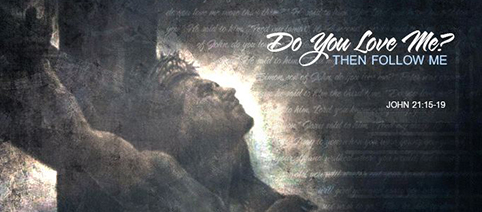
“When they had finished breakfast, Jesus said to Simon Peter, “Simon, son of John, do you love me more than these?” He said to him, “Yes, Lord; you know that I love you.” He said to him, “Feed my lambs.” He said to him a second time, “Simon, son of John, do you love me?” He said to him, “Yes, Lord; you know that I love you.” He said to him, “Tend my sheep.” He said to him the third time, “Simon, son of John, do you love me?” Peter was grieved because he said to him the third time, “Do you love me?” and he said to him, “Lord, you know everything; you know that I love you.” Jesus said to him, “Feed my sheep. Truly, truly, I say to you, when you were young, you used to dress yourself and walk wherever you wanted, but when you are old, you will stretch out your hands, and another will dress you and carry you where you do not want to go.” (This he said to show by what kind of death he was to glorify God.) And after saying this he said to him, “Follow me.” ~ John 21:15-19 (ESV)

Jesus uses the word ἀγαπάω agapaō translated “love” which means “to love dearly” in verses 15 & 16. Jesus challenges Peter’s answers. Now, in verse 17 Jesus uses a different word. Knowing Peter would grieve and be offended at the being asked a third time, He says, “Simon, son of Jonas, are you fond of me?” φιλέω phileō, which means “to love affectionately as a friend.”

Noting this, observe what word Peter uses in response to Jesus. In verse 15 Peter says literally, “you know that I am fond of you.” Φιλέω phileō.  Again in verse 16, Peter says the same thing, “O Lord, you know that I am fond of you.” Φιλέω phileō. The third time Jesus asks Peter, he responds, “O Lord, you know all things, you know that I am fond of you!” Φιλέω phileō.

The reason Jesus asks Peter three times is to determine if he really loved Jesus above all else. Jesus asked Peter, “Simon, son of John, do you love me more than these?” Jesus wanted Peter to understand the difference in what He expected from him, and where Peter was in his heart.

Being a disciple is to love God with all your heart, soul, mind and strength, and your neighbor as yourself – and also to love God above even your neighbor to the point where you would give your life for His sake (vs. 18-19).

grief

A Grief Observed by C. S. Lewis

The short book entitled “A Grief Observed” by C.S. Lewis relates how the author joined the human race when his wife and spirited poet, Joy Gresham, died of cancer. Lewis, the Oxford professor whose Christian apologetics make it seem like he’s got an answer for everything, experienced crushing doubt for the first time during her illness and after his wife’s tragic death. A Grief Observed contains meaningful reflections on that period: “Your bid–for God or no God, for a good God or the Cosmic Sadist, for eternal life or nonentity–will not be serious if nothing much is staked on it. And you will never discover how serious it was until the stakes are raised horribly high,” Lewis writes. “Nothing will shake a man–or at any rate a man like me–out of his merely verbal thinking and his merely notional beliefs. He has to be knocked silly before he comes to his senses. Only torture will bring out the truth. Only under torture does he discover it himself.”

This is the book that inspired the film Shadowlands but it is more wrenching, more revelatory, and more real than the movie. It is a beautiful and unflinchingly honest record of how even a stalwart believer can lose all sense of meaning in the universe, and how he can gradually regain his bearings.

Although this book is non-fiction it is written like the author of so many famous books of fiction can write.  Yet, from a very personal standpoint, Lewis comes to grips with the reality of terminal illness.  It is always from the viewpoint of “this can’t be happening to me!”  He goes through stages of denial, first of the illness itself, and second of the untimely death of his wife.  Sharing his feelings with her son was very hard for Lewis.  Lewis and Joy’s son Douglas became very close.  The relationship started because he enjoyed reading Lewis’ classics.  Douglas truly admired and respected Lewis. Lewis was always the professor and statesman, and always had that stiff upper lip of the Englishman.  But when it came down to facing his feelings, Lewis was the first to really get in touch with them.  His wife, Joy, helped him get through the times of unknowing before she died.  Lewis and Douglas grew very fond of each other and mourned the loss of Joy together, arm in arm.

JoyJack

Joy was very warm and caring toward him during her therapy and temporary recovery.  She insisted on spending as much time with Lewis as possible.  They basically did everything together.  What is really touching about this story is what became of their marriage, and the reason why they married in the first place.

From the first meeting of Lewis, Joy Gresham, and her son Douglas, the beginning of their lasting friendship, through the courtship that took many years, A Grief Observed blends the two worlds or cultures of American values and those of the British.  The book brings you into the heart of Lewis like no other book he had written.  When you finish this book, your heart will be warmed and your mind will rest assured of the possibility of loving someone so deeply as to suffer more than the one who is sick.

I would recommend this book to anyone who is going through the illness of a loved one, especially if he or she has been diagnosed as terminal.

Kerygma

Kerygma

What is kerygma and what does it mean?

During the last seven weeks of the Communication in Ministry course I am taking, we are concentrating on preaching or delivering sermons or messages to our congregations.  We are studying structuring sermons, how to select our passages and how to interpret the biblical passage. We are learning how to relate the interpretation of the biblical passage to our “audience.” We are learning all the ways and means to creating a great sermon.

This brings me to the word kerygma. Dictionary.com gives the definition of kerygma as “the preaching of the gospel of Christ, especially in the manner of the early church, and the content or message of such preaching.”

Kerygma is the Greek word κήρυγμα kérugma, translated proclamation or preaching. Kergyma is the preaching of the Gospel of Jesus Christ in spoken words, or even viewed in the celebration of the Lord’s Supper. It is the proclamation of Jesus redemptive work. Proclamation was usually followed by teaching and instruction in the elements of the faith, or the reading of a Creed. What Jesus did and taught in His ministry was included within the basic proclamation. Ok, so lets break this definition down. 

1. Kerygma is the preaching of the Gospel.

2. Kerygma is preaching in the manner of the early church.

3. Kerygma has to do with the content or message of what is being preached.

What is the Gospel? It is the Good News of the life, ministry, death, resurrection, and ascension of Jesus Christ. The Gospel includes the facts of Jesus’ incarnation as the Word. It includes the fact that Jesus is the Son of God. It includes the fact that Jesus was begotten of the Father and not a creature that the Father made. Jesus is in the Father as the Father is in Him. It includes the fact that salvation from sin, sickness, death, and the devil is only through Jesus the Messiah. It includes the fact that we are made right with God, declared righteous because of the righteousness of Jesus the Messiah. The Gospel is Good News!

2. What was the manner of preaching in the early church? The book of Acts clearly demonstrates that the early church preached the Gospel focusing on Jesus Christ; on repentance, faith, baptism and the forgiveness of sins, especially that salvation is through Jesus alone. The early church preached Jesus’ death, burial, resurrection, and His ascension to the right hand of the Father, and the gift of the Holy Spirit. The reason is that the Apostles were witnesses to the life, ministry, death, burial, resurrection and ascension of Jesus Christ. The early church preached what they heard from Jesus, the Apostles, and what they witnessed – it is the Gospel.

3. What is the content or message of what was being preached by the early church? When looking into the book of Acts we see:

  • All of the messages mention the doctrine of God.
  • All of the messages mention Jesus the Messiah.
  • Seven messages mention Jesus’ death.
  • Seven messages mention His resurrection.
  • Four messages declare that Jesus is now exalted in heaven at the right hand of the Father.
  • Four messages mention the giving of the Holy Spirit.
  • Seven message mention the forgiveness of sins.
  • Five messages mention repentance.
  • Three messages mention the need for faith.
  • Five messages mention Scripture.
  • None of the messages use the word Kingdom, because the Kingdom of God was brought to the earth in Jesus the Messiah.

Therefore, the content or the message preached by the early church included everything mentioned above. The church today must preach the Gospel like the early church. The early church preached the Gospel within the context of her audience, whether Jew or Gentile, or whether it was in Palestine or Athens, Rome or Crete. The kerygma was the same. They preached and taught the Gospel. The early church preached and taught the Gospel as it was given to them by the Apostles. The kerygma is the Apostolic Gospel message. The Church should be preaching the Gospel the same way the Apostles preached it: in the wisdom and power of God.

St. Paul gives an example of the kerygma:

“For I delivered to you as of first importance what I also received: that Christ died for our sins in accordance with the Scriptures, that He was buried, that He was raised on the third day in accordance with the Scriptures, and that He appeared to Cephas, then to the twelve. Then He appeared to more than five hundred brothers at one time, most of whom are still alive, though some have fallen asleep. Then He appeared to James, then to all the apostles. Last of all, as to one untimely born, He appeared also to me.” 1 Corinthians 15:3-8 (ESV)

In conclusion, based upon the Four Gospels and Acts, there are seven elements to the ancient kerygma of the Church:

1. God loves you and seeks after you.
2. Sin will destroy you.
3. Jesus Christ died to save you.
4. Repent and believe the Gospel.
5. Be Baptized – receive the Holy Spirit.
6. Abide in Christ and His Body the Church.
7. Go make disciples.

Lastly, there are four elements (Acts 2:42) to living the Christian life revolving around the kerygma:

1. The Apostles’ Teaching – The Church steadfastly went on in the study of ancient Scripture and the sacred teachings of the Faith given them by the Apostles.
2. The Fellowship – They were daily interacting within Christ’s Body the Church, frequently gathering for worship, and other gatherings as the Body of Christ.
3. The Breaking of the Bread – This is another way of saying that they faithfully received Holy Communion, the Lord’s Supper, or the Eucharist and, by extension, all the Sacraments.
4. The Prayers – Using forms of prayers, in both the personal and community contexts.

ancient-faith

A Call to an Ancient Evangelical Future

PROLOGUE

In every age the Holy Spirit calls the Church to examine its faithfulness to God’s revelation in Jesus Christ, authoritatively recorded in Scripture and handed down through the Church. Thus, while we affirm the global strength and vitality of worldwide Evangelicalism in our day, we believe the North American expression of Evangelicalism needs to be especially sensitive to the new external and internal challenges facing God’s people.

These external challenges include the current cultural milieu and the resurgence of religious and political ideologies. The internal challenges include Evangelical accommodation to civil religion, rationalism, privatism and pragmatism. In light of these challenges, we call Evangelicals to strengthen their witness through a recovery of the faith articulated by the consensus of the ancient Church and its guardians in the traditions of Eastern Orthodoxy, Roman Catholicism, the Protestant Reformation and the Evangelical awakenings. Ancient Christians faced a world of paganism, Gnosticism and political domination. In the face of heresy and persecution, they understood history through Israel’s story, culminating in the death and resurrection of Jesus and the coming of God’s Kingdom.

Today, as in the ancient era, the Church is confronted by a host of master narratives that contradict and compete with the gospel. The pressing question is: who gets to narrate the world? The Call to an Ancient Evangelical Future challenges Evangelical Christians to restore the priority of the divinely inspired biblical story of God’s acts in history. The narrative of God’s Kingdom holds eternal implications for the mission of the Church, its theological reflection, its public ministries of worship and spirituality and its life in the world. By engaging these themes, we believe the Church will be strengthened to address the issues of our day.

1. ON THE PRIMACY OF THE BIBLICAL NARRATIVE

We call for a return to the priority of the divinely authorized canonical story of the Triune God. This story-Creation, Incarnation, and Re-creation-was effected by Christ’s recapitulation of human history and summarized by the early Church in its Rules of Faith. The gospel-formed content of these Rules served as the key to the interpretation of Scripture and its critique of contemporary culture, and thus shaped the church’s pastoral ministry. Today, we call Evangelicals to turn away from modern theological methods that reduce the gospel to mere propositions, and from contemporary pastoral ministries so compatible with culture that they camouflage God’s story or empty it of its cosmic and redemptive meaning. In a world of competing stories, we call Evangelicals to recover the truth of God’s word as the story of the world, and to make it the centerpiece of Evangelical life.

2. ON THE CHURCH, THE CONTINUATION OF GOD’S NARRATIVE

We call Evangelicals to take seriously the visible character of the Church. We call for a commitment to its mission in the world in fidelity to God’s mission (Missio Dei), and for an exploration of the ecumenical implications this has for the unity, holiness, catholicity, and apostolicity of the Church. Thus, we call Evangelicals to turn away from an individualism that makes the Church a mere addendum to God’s redemptive plan. Individualistic evangelicalism has contributed to the current problems of churchless Christianity, redefinitions of the Church according to business models, separatist ecclesiologies and judgmental attitudes toward the Church. Therefore, we call Evangelicals to recover their place in the community of the Church catholic.

3. ON THE CHURCH’S THEOLOGICAL REFLECTION ON GOD’S NARRATIVE

We call for the Church’s reflection to remain anchored in the Scriptures in continuity with the theological interpretation learned from the early Fathers. Thus, we call Evangelicals to turn away from methods that separate theological reflection from the common traditions of the Church. These modern methods compartmentalize God’s story by analyzing its separate parts, while ignoring God’s entire redemptive work as recapitulated in Christ. Anti-historical attitudes also disregard the common biblical and theological legacy of the ancient Church. Such disregard ignores the hermeneutical value of the Church’s ecumenical creeds. This reduces God’s story of the world to one of many competing theologies and impairs the unified witness of the Church to God’s plan for the history of the world. Therefore, we call Evangelicals to unity in “the tradition that has been believed everywhere, always and by all,” as well as to humility and charity in their various Protestant traditions.

4. ON THE CHURCH’S WORSHIP AS TELLING AND ENACTING GOD’S NARRATIVE

We call for public worship that sings, preaches and enacts God’s story. We call for a renewed consideration of how God ministers to us in baptism, Eucharist, confession, the laying on of hands, marriage, healing and through the charisma of the Spirit, for these actions shape our lives and signify the meaning of the world. Thus, we call Evangelicals to turn away from forms of worship that focus on God as a mere object of the intellect or that assert the self as the source of worship. Such worship has resulted in lecture-oriented, music-driven, performance-centered and program-controlled models that do not adequately proclaim God’s cosmic redemption. Therefore, we call Evangelicals to recover the historic substance of worship of Word and Table and to attend to the Christian year, which marks time according to God’s saving acts.

5. ON SPIRITUAL FORMATION IN THE CHURCH AS EMBODIMENT OF GOD’S NARRATIVE

We call for a catechetical spiritual formation of the people of God that is based firmly on a Trinitarian biblical narrative. We are concerned when spirituality is separated from the story of God and baptism into the life of Christ and his Body. Spirituality, made independent from God’s story, is often characterized by legalism, mere intellectual knowledge, an overly therapeutic culture, New Age Gnosticism, a dualistic rejection of this world and a narcissistic preoccupation with one’s own experience. These false spiritualities are inadequate for the challenges we face in today’s world. Therefore, we call Evangelicals to return to a historic spirituality like that taught and practiced in the ancient catechumenate.

6. ON THE CHURCH’S EMBODIED LIFE IN THE WORLD

We call for a cruciform holiness and commitment to God’s mission in the world. This embodied holiness affirms life, biblical morality and appropriate self-denial. It calls us to be faithful stewards of the created order and bold prophets to our contemporary culture. Thus, we call Evangelicals to intensify their prophetic voice against forms of indifference to God’s gift of life, economic and political injustice, ecological insensitivity and the failure to champion the poor and marginalized. Too often we have failed to stand prophetically against the culture’s captivity to racism, consumerism, political correctness, civil religion, sexism, ethical relativism, violence and the culture of death. These failures have muted the voice of Christ to the world through his Church and detract from God’s story of the world, which the Church is collectively to embody. Therefore, we call the Church to recover its counter-cultural mission to the world.

EPILOGUE

In sum, we call Evangelicals to recover the conviction that God’s story shapes the mission of the Church to bear witness to God’s Kingdom and to inform the spiritual foundations of civilization. We set forth this Call as an ongoing, open-ended conversation. We are aware that we have our blind spots and weaknesses. Therefore, we encourage Evangelicals to engage this Call within educational centers, denominations and local churches through publications and conferences.

We pray that we can move with intention to proclaim a loving, transcendent, triune God who has become involved in our history. In line with Scripture, creed and tradition, it is our deepest desire to embody God’s purposes in the mission of the Church through our theological reflection, our worship, our spirituality and our life in the world, all the while proclaiming that Jesus is Lord over all creation.

This Call is issued in the spirit of sic et non; therefore those who affix their names to this Call need not agree with all its content. Rather, its consensus is that these are issues to be discussed in the tradition of semper reformanda as the church faces the new challenges of our time. Over a period of seven months, more than 300 persons have participated via e-mail to write the Call. These men and women represent a broad diversity of ethnicity and denominational affiliation. The four theologians who most consistently interacted with the development of the Call have been named as Theological Editors. The Board of Reference was given the special assignment of overall approval.

Just before his death in 2007, Robert E. Webber (inset picture) spent a good portion of his time working collaboratively with over 300 theologians and other leaders to craft A Call to an Ancient Evangelical Future. The Call continues some themes and expands upon the Chicago Call” of 1977, and sets forth a vision for an Ancient-Future faith in a postmodern world. That Webber helped to craft such a call is not unusual, for he spent the whole of his professional life calling the church to continual reform and, most especially, encouraging leaders and laity alike to drink from the refreshing well of ancient truth. That the Call came, as it did, at a time of great change in the world and in the church, and that it also came just before his passing, gives it a kind of weight that makes it especially compelling to examine.
Washstain

Blessed are those who wash their robes, so that they may have the right to the tree of life and that they may enter the city by the gates. ~ Revelation 22:14 (ESV)

Remember the stain…

I remember the stain
at times it doesn’t seem right
to recall what marred my walk in the light
it cannot be removed
so much of life reviewed
in my minds eye

I remember the stain
i cannot clean it
even the rushing tide
sweeping away foot prints over and again
cannot remove it

I remember the stain
of idolatry, rebellion, and caustic choices
trying to reign over me
why do I remember?

I remember the stain
even though i can still see it
has been washed in blood deep red
where my Father sees me white as snow
where no stain is left to judge me rightly
where no bondage there to bind me tightly
where freedom rings so very brightly
at the dawn of His appearing
He remembers no stain at me leering

I remember the stain
maybe at my minds random recollection
to remind once more my souls misdirection
at one time I knew not
the Deliverer from before
to grasp again His winsome words
Nor do I condemn you, go and sin no more…

Narcissism, Social Media, and the Church

A definition of narcissism: The inordinate fascination with oneself; excessive self-love; vanity.

“The true destination for most of our online endeavors really are the new media equivalent of the biblical statues that were presented as deities. These digital shrines {idols} that we create to ourselves.” ~ from Confessions of a Narcissist, by Mitch Joel

Social-Media-Make-Us-Narcissistic


“Woe to you, teachers of the law and Pharisees, you hypocrites! You clean the outside of the cup and dish, but inside they are full of greed and self-indulgence.” Matthew 23:25 (NIV)

“He will render to each one according to his works: to those who by patience in well-doing seek for glory and honor and immortality, he will give eternal life; but for those who are self-seeking and do not obey the truth, but obey unrighteousness, there will be wrath and fury.” Romans 2:6-8 (ESV)

“You have lived on the earth in luxury and in self-indulgence. You have fattened your hearts in a day of slaughter.” James 5:5 (ESV)

“Love is patient, love is kind. It does not envy, it does not boast, it is not proud. It does not dishonor others, it is not self-seeking, it is not easily angered, it keeps no record of wrongs.” 1 Corinthians 13:4-5 (NIV)

“What kind of impact could Christians have if we were more interested in helping a world in pain than in how good we look  to our digital friends? How can we {the church} redeem our online presence without becoming weird, obnoxious or confrontational?” (Shraeder & Hendricks, pp. 170-171)

References:

Schrader, T., Hendricks, K. (Eds.). (2011). Outspoken: conversations on church communication. Los Angeles, CA.   Center for Church Communication.

Does Social Media Make Us Narcissistic? Retrieved from: http://brandongaille.com/does-social-media-make-us-     narcissistic/


media-press

Evaluating Media Forms in Ministry

I subscribe to a magazine called “Salvo.” It is a publication of The Fellowship of St. James (http://www.fsj.org), Salvo is dedicated to debunking the cultural myths that have undercut human dignity, all but destroyed the notions of virtue and morality, and slowly eroded our appetite for transcendence. It also seeks to promote the Christian worldview. (http://www.salvomag.com)

That being said, I came to the “Book Blip” page, where a book review entitled “Trust Me, I’m Lying: Confessions of a Media Manipulator” was given by Ryan Holiday. This is the review he wrote:

Trust Me, I’m Lying: Confessions of a Media Manipulator is a fast-moving, straight-talking mea culpa (which means “through my fault” and is an acknowledgement of having done wrong) from a marketer, media strategist, and apparent “first defector” from the “unreality” of the blogosphere — a nebulous entity whose very business model “rests on exploiting the difference between perception and reality.” Simultaneously fascinating and disturbing, Trust Me, I’m Lying: Confessions of a Media Manipulator exposes the modus operandi of the internet news “racket” and educates readers in how to be more media-savvy.” (Salvo Magazine, Issue 32, Spring 2015, p. 6)

I share this with you all to establish a thought. The thought is, is the Church, which uses a variety of media forms in ministry actually telling the truth about their ministry? Is what is being marketed, or expressed the exact true representation of what the inquirer will actually find upon visiting the church? What is the intent and purpose of the church’s use of that media form? What is the desired goal from the use of a specific media form?

Here is another thought. I remember one year, receiving in the mail an invitation to go to a local resort hotel, have fun at its water park, and then come Sunday, enjoy the various zoo animals on display after the church service was over. What was the goal of this mailer? I think it was an attraction attention getter for those people with families, who, if so moved, would come to this local evangelical church. Did this church say anything that was untrue? No. They did exactly what they said they would. All you had to do was show the card you got in the mail, and you could play at the water park until you passed out. Then, the pièce de résistance was the various zoo animals on display after the church service. There was free hot dogs, popcorn, and soda for all. What was the intent of all of this engaging marketing? To get people to come to their church. I am sure hundreds went to the resort for a free water park fling, and yet out of the hundreds maybe 1-2% actually visited the church. More than likely those 1-2% were just there for the zoo animals. Instead of sending a card with the Gospel message on it, or a teaser with the answer for all the world’s problems, they spent thousands of dollars on a marketing campaign. Was it the right or wrong way to get people to church?

In our text book OutSpoken, we are told that we should be good stewards regarding how we use the various media forms at the church’s disposal. The goal or intent of using varying media forms, from my understanding, is obedience to the command to GO, make disciples of all nations, baptizing them, and teaching them everything Jesus had commanded the apostles.

When it is our turn to take advantage of the various media forms, which method or means are we going to use, and for what purpose, really?

John_3_16_by_Valster73

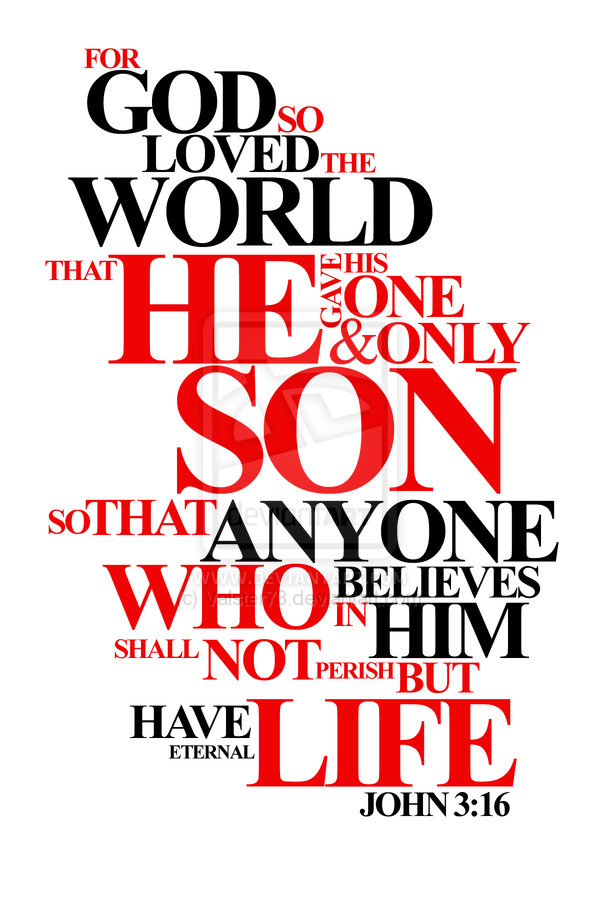
“For God loved the world in this way: He gave His One and Only Son, so that everyone who believes in Him will not perish but have eternal life. For God did not send His Son into the world that He might condemn the world, but that the world might be saved through Him. Anyone who believes in Him is not condemned, but anyone who does not believe is already condemned, because he has not believed in the name of the One and Only Son of God. “This, then, is the judgment: The light has come into the world, and people loved darkness rather than the light because their deeds were evil. For everyone who practices wicked things hates the light and avoids it, so that his deeds may not be exposed. But anyone who lives by the truth comes to the light, so that his works may be shown to be accomplished by God.” ~ The Gospel of John 3:16-21

Do you believe that Jesus Christ is the Son of God, your Savior? Click here to learn more!

Expository

Some of you may have little or no experience with what I mean by preaching. What I mean by preaching is expository exultation. (This is how I preach – took it right out of my mouth!)

Preaching Is Expository

Expository means that preaching aims to exposit, or explain and apply, the meaning of the Bible. The reason for this is that the Bible is God’s word, inspired, infallible, profitable—all 66 books of it.

The preacher’s job is to minimize his own opinions and deliver the truth of God. Every sermon should explain the Bible and then apply it to people’s lives.

The preacher should do that in a way that enables you to see that the points he is making actually come from the Bible. If you can’t see that they come from the Bible, your faith will end up resting on a man and not on God’s word.

The aim of this exposition is to help you eat and digest biblical truth that will make your spiritual bones more like steel, double the capacity of your spiritual lungs, make the eyes of your heart dazzled with the brightness of the glory of God, and awaken the capacity of your soul for kinds of spiritual enjoyment you didn’t even know existed.

Preaching Is Exultation

Preaching is also exultation. This means that the preacher does not just explain what’s in the Bible, and the people do not simply try understand what he explains. Rather, the preacher and the people exult over what is in the Bible as it is being explained and applied.

Preaching does not come after worship in the order of the service. Preaching is worship. The preacher worships—exults—over the word, trying his best to draw you into a worshipful response by the power of the Holy Spirit.

My job is not simply to see truth and show it to you. (The devil could do that for his own devious reasons.) My job is to see the glory of the truth and to savor it and exult over it as I explain it to you and apply it for you. That’s one of the differences between a sermon and a lecture.

Preaching Isn’t Church, but It Serves the Church

Preaching is not the totality of the church. And if all you have is preaching, you don’t have the church. A church is a body of people who minister to each other.

One of the purposes of preaching is to equip us for that and inspire us to love each other better.

But God has created the church so that she flourishes through preaching. That’s why Paul gave young pastor Timothy one of the most serious, exalted charges in all the Bible in 2 Timothy 4: 1-2: “I charge you in the presence of God and of Christ Jesus, who is to judge the living and the dead, and by his appearing and his kingdom: preach the word.”

What to Expect from My Preaching and Why

If you’re used to a twenty-minute, immediately practical, relaxed talk, you won’t find that from what I’ve just described.

I preach twice that long;

I do not aim to be immediately practical but eternally helpful;

and I am not relaxed.

I standing vigilantly on the precipice of eternity speaking to people who this week could go over the edge whether they are ready to or not. I will be called to account for what I said there.

That’s what I mean by preaching. Amen!

~ John Piper