Posts Tagged ‘Church’

the-gospel1

The Good News

We bring you the good news that what God promised to the fathers, this he has fulfilled to us their children by raising Jesus…. – Acts 13:32-33

“Are You Saved?” Have you heard this message but not know what it means? What are you being saved from? From whom are you being saved?

1. Confess that you are a sinner and that you cannot save yourself.

“For all have sinned and fall short of the glory of God…” (Romans 3:23). This means that even though you try to do your best, you still fall short because you are a sinner. Romans 6:23 says that “the wages of sin is death, but the gift of God is eternal life in Christ Jesus our Lord.” Salvation is the gift of God to you. That’s the way He planned it.

2. Repent of and confess your sin to God.

And Peter said to them, “Repent and be baptized every one of you in the name of Jesus Christ for the forgiveness of your sins, and you will receive the gift of the Holy Spirit. For the promise is for you and for your children and for all who are far off, everyone whom the Lord our God calls to himself.” (Acts 2:38-39)

2. Confess that Jesus Christ is Lord, He is the Son of God, and that He alone can save you.

“Salvation is found in no one else, for there is no other name under heaven given to men by which we must be saved” (Acts 4:12). “For there is one God and one mediator between God and men, the man Christ Jesus, who gave himself as a ransom for all men–the testimony given at its proper time” (1 Timothy 2:5-6). Isaiah 53:6 says that “We all, like sheep, have gone astray, each of us has turned to his own way; and the Lord has laid on Him the iniquity of us all.” Jesus took our sins upon Himself when He died on the cross. He paid the penalty for our sins so that we would not have to. He was raised from the dead, showing that He has victory of sin and death. Romans 10:9 says that “if you confess with your mouth, ‘Jesus is Lord,’ and believe in your heart that God raised Him from the dead, you will be saved.”

3. Acknowledge that salvation will be yours if you put your faith in Jesus Christ.

“The time is fulfilled, and the kingdom of God is at hand; repent and believe in the Gospel.” (Mark 1:15)

Ephesians 2:8 says that “For it is by grace you have been saved, through faith–and this not from yourselves, it is the gift of God–not by works, so that no one can boast.” This clearly indicates that God gives the gift of faith first. Then you take the faith He has given you and place it in Christ you will be saved by faith alone–there is nothing more for you to do.

4. Pray and receive Jesus Christ as your Savior and Lord from this day forward, and forever.

2 Corinthians 5:17 says that “Therefore, if anyone is in Christ, he is a new creation; the old has gone, the new has come!” This is what is known as “new life in Christ,” or as John 3:3 puts it, being “born again.”

Receiving Christ is the beginning. As we learn in Colossians 2:6-7, “Just as you received Christ Jesus as Lord, continue to live in him, rooted and built up in him, strengthened in the faith as you were taught, and overflowing with thankfulness.”

After receiving Him, be obedient by following Him in baptism and by uniting with the church. When you do, you will find that life truly does have new purpose and meaning.

Learn more about your new relationship with God here and click on Q1 (Question 1) to begin!

God bless you!

cropped-Bridge-Banner062

My Journey of Faith
Gary DeSha

The dictionary defines “journey” as “a traveling from one place to another, usually taking a rather long time.” Faith is defined as “confidence or trust in a person or thing; belief that is not based on proof; belief in God or in the doctrines or teachings of Christianity.” I believe my journey of faith began when I was born. The journey continued until, in the summer of 1972, when it took a turn and became defined by faith, that gift of God, which enabled me to trust in Him as my Savior and Lord. Thereafter, my journey has enable me to associate myself with many expressions of the Christian faith. Each one has left a lasting mark upon my soul, all of which I am thankful to God for the time and experiences.

My journey of faith has become like a Bridge. The Bridge allows me to access both the treasures of Orthodoxy and the treasures of the Reformation. So, let me tell you my story; the story of my journey of faith.

I became a born again Christian through the prayers and ministry of my father and the pastor of an independent Baptist Church in June of 1972. Shortly thereafter, I received baptism. From that day, I was discipled in the Christian faith through regular church attendance, teaching, prayer, and Bible study.

In January of 1973, while attending a worship service, I read the Holy Scripture from Joshua 1:8-9 which says, “This book of the law shall not depart from your mouth, but you shall meditate on it day and night, so that you may be careful to do according to all that is written in it; for then you will make your way prosperous, and then you will have success. Have I not commanded you? Be strong and courageous! Do not tremble or be dismayed, for the LORD your God is with you wherever you go.” From this verse of Holy Scripture, and what the pastor was speaking on that day, I felt His Spirit upon me, and God calling me to preach the Gospel of Jesus Christ; the Gospel of the Kingdom of God.
From that day forth, I began deep study of God’s Word, and began a program of mentorship under very mature men of God, pastors, and leaders within the Church. In 1973, I began an active duty career in the United States Army Chaplains Corps as a Chaplains Assistant. In my career, these Chaplains were a great help to me in my spiritual growth.

In 1975, while listening to a radio broadcast by the Rev. R. W. Schambach, I received the Baptism in the Holy Spirit and spoke in tongues for the first time. After this wonderful experience of the infilling of the Holy Spirit, I sought out a Pentecostal church that would teach me the deeper spiritual things of God. I continued to grow in grace and in the knowledge of God. I received my license to preach from South Gardens Baptist Church, in Savannah, GA. The pastor (Bro. Chambliss) was a man on fire for God, a true soul winner and preacher of the Gospel.

Since that time, I have served the Lord in a variety of capacities. From ministering to the soldiers of the United States Army, to the saints in local churches, I preached and taught the Word of God to many. I have served as the Pentecostal Fellowship Pastor sponsored by the Church of God, Cleveland, TN ministry to the military. I have served as worship leader and evangelist for an Assemblies of God church in Arkansas. I have planted and pastored several churches across the country.

There came a time in my Christian life, where I was concerned about how the some churches viewed the Lord’s Supper. After much prayer, study, and thought, I discovered for the first time in my spirit, the reality of the real presence of Christ in the bread and wine served at Holy Communion. In 1995, I was ordained a priest in the Evangelical Episcopal Church. I served an Episcopal parish in the State of Georgia. In 1996, while still searching and seeking God, I discovered the Eastern Orthodox Church. At that time, I believed I had discovered the full true expression of the Christian faith in Holy Orthodoxy. I sought out a local priest and after dialogue with his bishop; in 1998 I was received into the Eastern Orthodox Church and ordained as an Eastern Orthodox Christian priest. I have since served as a local parish priest and assisted local Eastern Orthodox bishops in their divine services, and on November 15, 2012 was consecrated Bishop for the Eastern Orthodox diocese of Minneapolis and all of North Dakota.

An Eastern Orthodox bishop, depending on his jurisdiction and rank, may be called Bishop (usually auxiliary to an Archbishop); Metropolitan (head of a large city or a Diocese); Archbishop (head of an Orthodox country or capital city); Patriarch (head of an ancient or ethnic Church). The bishops of the ancient Sees of Rome and Alexandria are also called Popes. Eastern Orthodox clergy of all orders wear the cassock or riassa in public, but when participating in a church service wear the vestment of their own order and rank. The Greek Orthodox also wears a black cylinder-like hat on top of which the celibates (except deacons) wear a black veil dropping down the back.

An Eastern Orthodox presbyter (priest or pastor) is either married serving as a parish priest or celibate, generally belonging to a monastic order called “Archimandrite”.

Vladyka or Theophilestate Vladyka is the Russian or Greek Orthodox form of address for an Orthodox Bishop (the English word commonly used in the Protestant, Roman Catholic or Eastern Orthodox churches).

Since the summer of 2008, when my wife of 21 years passed away having lost her battle with breast cancer, I decided to re-look at my call to ministry, to determine exactly where God wanted me, and to take inventory of my Christian life. I discovered that I needed to be free of the Eastern Orthodox mindset I understood as being exclusive, a thought process that excluded other true branches of the Christian Church from one another. I could not accept that the traditions of men overruled the Word of God, the Bible as the final authority for faith and practice. I could not accept the fact the pagan worship practices had crept into the Church. The tradition of the Church is were useful to a point, this is true just so long as it maintains its integrity with what Jesus taught the Apostles. True church tradition is what the Apostles of Jesus Christ taught. I also discovered that I must take what I have learned from the Eastern Orthodox Church and weave that into what I learned many, many years before. God has brought me back to my first love, the true preaching, and teaching of the Gospel of Jesus Christ, and the Kingdom of God. I am a student of the Word of God, and I am learning more and more each day. I must move in line with where God is taking me, and from where God has brought me thus far.

However, God did revealed to me something very wonderful. The most interesting event during my Christian life and ministry was the discovery of the truths of the teaching that came out of the Reformation of the 16th century. Almost three years ago, my journey and the process of learning as a Christian were aided by serving as associate pastor at a Lutheran Church in my local area. I served as preaching pastor for a new plant, and youth pastor for the parent congregation. During this time, I studied the Book of Concord, Lutheran doctrine, and really dove into what Martin Luther discovered. God opened this door for me to come to the knowledge of the truths of the Reformation. There were some aspects of Lutheran doctrine that I could not biblically confirm. To me, they were inconsistent with Luther’s discovery in the Word. I was confused as to why he held on to some of them. Anyway, I dove into the writings of John Calvin, and other infamous theologians and scholars. The doctrines of grace were being opened up to me, piece by piece. Some I had understood earlier in my Christian life, and then there were those things that were new to me. I had to change my thinking on some things too! The final step the Holy Spirit took was for me to read and understand the Canon’s of the Synod of Dort. God’s light shown that day, when reading the canons, and from there I have been assimilating Reformation teaching. I have determined what I must hold dear from my past and what I must depart from. What a glorious time of revelation it has been for my wife, Sue, and me. God has truly blessed us!

Therefore, I would like to reaffirm that: I believe God called me to preach the Gospel. I believe God called me to preach freedom those who are captive. I believe God called me to bring the healing power of God to those who are sick and infirm. I believe that God called me to care for the poor, the naked, and the homeless. I believe God called me to preach the full Gospel, the whole counsel of God, the true Apostolic teaching once delivered unto the saints. That Gospel is sans ritualism and formalism, yet it is complete with the understanding of what the Apostles themselves received from Jesus Christ and handed down to the churches. It is the succession of this apostolic teaching that is what I have been entrusted to uphold and guard. We measure not this full Gospel by what man has done or will do, but measure it by preaching the Gospel in the power and might of the Holy Spirit of God. We experience the full Gospel by how God uses his gifted people, Apostles, Prophets, Evangelists, Pastors, and Teachers to equip and build up the Body of Christ. We experience the full Gospel by how God gives gifts to the Body of Christ for edification and revelation.

In conclusion, I would like to say that I am a Reformed Christian who believes in the continuation of the experience of Pentecost with all of the biblical gifts and anointed treasures He has bestowed upon the Church. How can I be an Eastern Orthodox Christian, when in actuality I am not?

I would like to share my statement of faith. I believe that the most important statement of faith in the Christian Church is the Nicene Creed, the product of two Ecumenical Councils in the fourth century. Delineated in the midst of a life-and-death controversy, I believe it contains the essence of the full apostolic Gospel teaching about God the Father, Son, and Holy Spirit, the Virgin birth, the Church, and the sacraments, guarding that life-giving truth against those who would change the very nature of God and reduce Jesus Christ to a created being, rather than God in the flesh. The Nicene Creed gives me a sure interpretation of the Scriptures against those who would distort them to support their own religious schemes. Called the “symbol of faith” and confessed in many of the services of the Christian Church, the Nicene Creed constantly reminds me of what I personally believe, keeping my faith on track.

The Nicene Creed

I believe in one God, the Father Almighty, Maker of heaven and earth, and of all things visible and invisible.
And in one Lord Jesus Christ, the only-begotten Son of God, begotten of the Father before all worlds (æons), Light of Light, very God of very God, begotten, not made, being of one substance with the Father;
by Whom all things were made;
Who for us men, and for our salvation, came down from heaven, and was incarnate by the Holy Spirit and the Virgin Mary, and was made man;
He was crucified for us under Pontius Pilate, and suffered, and was buried, and the third day he rose again, according to the Scriptures, and ascended into heaven, and sits on the right hand of the Father;
from He shall come again, with glory, to judge the living and the dead;
Whose kingdom shall have no end.
And in the Holy Spirit, the Lord and Giver of life, who proceeds from the Father, who with the Father and the Son together is worshiped and glorified, Who spoke by the prophets.
In one holy, catholic, and apostolic Church; I acknowledge one baptism for the remission of sins; I look for the resurrection of the dead, and the life of the world to come. Amen.

May God bless and keep you in His love and grace. In the Name of the Father, and of the Son, and of the Holy Spirit. Amen.

wesatminsterconfessionoffaithbig

Chapter II – Of God, and of the Holy Trinity.

i. There is but one only(1) living and true God,(2) who is infinite in being and perfection,(3) a most pure spirit,(4) invisible,(5) without body, parts,(6) or passions;(7) immutable,(8) immense,(9) eternal,(10) incomprehensible,(11) almighty,(12) most wise,(13) most holy,(14) most free,(15) most absolute,(16) working all things according to the counsel of His own immutable and most righteous will,(17) for His own glory;(18) most loving,(19) gracious, merciful, long-suffering, abundant in goodness and truth, forgiving iniquity, transgression, and sin,(20) the rewarder of them that diligently seek Him;(21) and withal, most just, and terrible in His judgments;(22) hating all sin,(23) and who will by no means clear the guilty.(24) The Westminster Confession of Faith, 3

(1) Dt 6:4; 1Co 8:4,6
(2) 1Th 1:9; Jer 10:10
(3) Job 11:7,8,9; Job 26:14
(4) Jn 4:24
(5) 1Ti 1:17
(6) Dt 4:15,16; Jn 4:24; Lk 24:39
(7) Ac 14:11,15
(8) Jas 1:17; Mal 3:6
(9) 1Ki 8:27; Jer 23:23,24
(10) Ps 90:2;1Ti 1:17
(11) Ps 145:3
(12) Ge 17:1; Rev 4:8
(13) Ro 16:27
(14) Isa 6:3; Rev 4:8
(15) Ps 15:3
(16) Ex 3:14
(17) Eph 1:11
(18) Pr 16:4; Ro 11:36
(19) 1Jn 4:8,16
(20) Ex 34:6,7
(21) Heb 11:6
(22) Ne 9:32,33
(23) Ps 5:5,6
(24) Nah. 1:2,3; Ex 34:7

ii. God hath all life,(1) glory,(2) goodness,(3) blessedness,(4) in and of Himself; and is alone in and unto Himself all-sufficient, not standing in need of any creatures which He hath made,(5) not deriving any glory from them,(6) but only manifesting His own glory in, by, unto, and upon them: He is the alone fountain of all being, of whom, through whom, and to whom are all things,(7) and hath most sovereign dominion over them, to do by them, for them, or upon them whatsoever Himself pleaseth.(8) In His sight all things are open and manifest;(9) His knowledge is infinite, infallible, and independent upon the creature,(10) so as nothing is to Him contingent, or uncertain.(11) He is most holy in all His counsels, in all His works, and in all His commands.(12) To Him is due from angels and men, and every other creature, whatsoever worship, service, or obedience He is pleased to require of them.
(13)
(1) Jn 5:26
(2) Ac 7:2
(3) Ps 119:68
(4) 1Ti 6:15; Ro 9:5
(5) Ac 17:24,25
(6) Job 22:2,3
(7) Ro 11:36
(8) Rev 4:11; 1Ti 6:15; Da 4:25,35
(9) Heb 4:13
(10) Ro 11:33,34; Ps 147:5
(11) Ac 15:18; Eze 11:5
(12) Ps 145:17 ; Ro 7:12
(13) Rev 5:12,13,14

iii. In the unity of the Godhead there be three persons, of one substance, power, and eternity; God the Father, God the Son, and God the Holy Ghost.(1) The Father is of none, neither begotten, nor proceeding; the Son is eternally begotten of the Father;(2) the Holy Ghost eternally proceeding from the Father and the Son.
(3)
(1) 1Jn 5:7; Mt 3:16,17; M Mt 28:19; 2Co 13:14
(2) Jn 1:14,18
(3) Jn 15:26; Gal 4:6

wesatminsterconfessionoffaithbig

Blessed is the man who walks not in the counsel of the wicked, nor stands in the way of sinners, nor sits in the seat of scoffers; but his delight is in the law of the LORD, and on his law he meditates day and night.
(Psalms 1:1-2)

Chapter 1 Of the Holy Scriptures:

i. Although the light of nature, and the works of creation and providence do so far manifest the goodness, wisdom, and power of God, as to leave men inexcusable;(1) yet are they not sufficient to give that knowledge of God, and of His will, which is necessary unto salvation:(2) therefore it pleased the Lord, at sundry times, and in divers manners, to reveal Himself, and to declare that His will unto His Church;(3) and afterwards, for the better preserving and propagating of the truth, and for the more sure establishment and comfort of the Church against the corruption of the flesh, and the malice of Satan and of the world, to commit the same wholly unto writing;(4) which maketh the Holy Scripture to be most necessary;(5) those former ways of God’s revealing His will unto His people being now ceased.

(6)
(1) Ro 2:14,15; Ro 1:19,20; Ps 19:1,2,3; Ro 1:32; Ro 2:1
(2) 1Co 1:21; 1Co 2:13,14
(3) Heb 1:1
(4) Pr 22:19,20,21;Lk 1:3,4; Ro 15:4; Mt 4:4,7,10; Isa 8:19,20
(5) 2Ti 3:15; 2Pe 1:19
(6) Heb 1:1,2

ii. Under the name of Holy Scripture, or the Word of God written, are now contained all the books of the Old and New Testament, which are these:

Of the Old Testament:
Genesis, Exodus, Leviticus, Numbers, Deuteronomy, Joshua, Judges, Ruth, I Samuel, II Samuel, I Kings, II Kings, I Chronicles, II Chronicles, Ezra, Nehemiah, Esther, Job, Psalms, Proverbs, Ecclesiastes, The Song of Songs, Isaiah, Jeremiah, Lamentations, Ezekiel, Daniel, Hosea, Joel, Amos, Obadiah, Jonah, Micah, Nahum, Habakkuk, Zephaniah, Haggai, Zechariah, Malachi

Of the New Testament:
The Gospels according to Matthew, Mark, Luke, John, The Acts of the Apostles, Paul’s Epistles to the Romans, Corinthians I, Corinthians II, Galatians, Ephesians, Philippians, Colossians, Thessalonians I, Thessalonians II, To Timothy I, To Timothy II, To Titus, To Philemon, The Epistle to the Hebrews, The Epistle of James, The first and second Epistles of Peter, The first, second, and third Epistles of John, The Epistle of Jude, The Revelation
All which are given by inspiration of God to be the rule of faith and life.(1)
(1) Lk 16:29,31; Eph 2:20; Rev 22:18,19; 2Ti 3:16

iii. The books commonly called Apocrypha, not being of divine inspiration, are no part of the canon of the Scripture; and therefore are of no authority in the Church of God, nor to be any otherwise approved, or made use of, than other human writings.
(1)
(1) Lk 24:27,44; Ro 3:2; 2Pe 1:21

iv. The authority of the Holy Scripture, for which it ought to be believed, and obeyed, dependeth not upon the testimony of any man, or Church; but wholly upon God (who is truth itself) the author thereof: and therefore it is to be received, because it is the Word of God.

(1)
(1) 2Pe 1:19,21; 2Ti 3:16; 1Jn 5:9; 1Th 2:13

v. We may be moved and induced by the testimony of the Church to an high and reverent esteem of the Holy Scripture,(1) and the heavenliness of the matter, the efficacy of the doctrine, the majesty of the style, the consent of all the parts, the scope of the whole, (which is to give all glory to God), the full discovery it makes of the only way of man’s salvation, the many other incomparable excellencies, and the entire perfection thereof, are arguments whereby it doth abundantly evidence itself to be the Word of God; yet, notwithstanding, our full persuasion and assurance of the infallible truth, and divine authority thereof, is from the inward work of the Holy Spirit, bearing witness by and with the word in our hearts.

(2)
(1) 1Ti 3:15
(2) 1Jn 2:20,27; Jn 16:13,14; 1Co 2:10,11,12; Isa 59:21

vi. The whole counsel of God, concerning all things necessary for His own glory, man’s salvation, faith and life, is either expressly set down in Scripture, or by good and necessary consequence may be deduced from Scripture: unto which nothing at any time is to be added, whether by new revelations of the Spirit, or traditions of men.(1) Nevertheless, we acknowledge the inward illumination of the Spirit of God to be necessary for the saving understanding of such things as are revealed in the word;(2) and that there are some circumstances concerning the worship of God, and government of the Church, common to human actions and societies, which are to be ordered by the light of nature, and Christian prudence, according to the general rules of the word, which are always to be observed.

(3)
(1) 2Ti 3:15,16,17; Gal 1:8,9; 2Th 2:2
(2) Jn 6:45; 1Co 2:9,10,11,12
(3) 1Co 11:13,14; 1Co 14:26,40

vii. All things in Scripture are not alike plain in themselves, nor alike clear unto all;(1) yet those things which are necessary to be known, believed, and observed for salvation, are so clearly propounded, and opened in some place of Scripture or other, that not only the learned, but the unlearned, in a due use of the ordinary means, may attain unto a sufficient understanding of them.

(2)
(1) 2Pe 3:16
(2) Ps 119:105,130

viii. The Old Testament in Hebrew (which was the native language of the people of God of old), and the New Testament in Greek (which, at the time of the writing of it was most generally known to the nations), being immediately inspired by God, and, by His singular care and providence, kept pure in all ages, are therefore authentical;(1) so as, in all controversies of religion, the Church is finally to appeal unto them.(2) But, because these original tongues are not known to all the people of God, who have right unto and interest in the Scriptures, and are commanded, in the fear of God, to read and search them,(3) therefore they are to be translated into the vulgar language of every nation unto which they come,(4) that the Word of God dwelling plentifully in all, they may worship Him in an acceptable manner;(5) and, through patience and comfort of the Scriptures, may have hope.

(6)
(1) Mt 5:18
(2) Isa 8:20; Ac 15:15; Jn 5:39,46
(3) Jn 5:39
(4) 1Co 14:6,9,11,12,24,27, 28
(5) Col 3:16
(6) Ro 15:4

ix. The infallible rule of interpretation of Scripture is the Scripture itself: and therefore, when there is a question about the true and full sense of any Scripture (which is not manifold, but one), it must be searched and known by other places that speak more clearly.

(1)
(1) 2Pe 1:20,21; Ac 15:15,16

x. The supreme Judge, by which all controversies of religion are to be determined, and all decrees of councils, opinions of ancient writers, doctrines of men, and private spirits, are to be examined, and in whose sentence we are to rest, can be no other but the Holy Spirit speaking in the Scripture.

(1)
(1) Mt 22:29,31; Eph 2:20; Ac 28:25

council-of-nicaea

While on earth, our Lord confirmed that He and the Father are one (John 10:30). On the other hand, He asked, “Why do you call me good, no one but my Father is good?” (Mark 10:18). Putting those two statements together is not very easy. However, the Bible does not leave only that question to resolve. Jesus could tell the “unknown” inquisitive sinner hiding in a tree that He would have lunch with him while also claiming that no one knows the time or the hour but the Father (Mark 13:32).

There is an inherent tension in these and other biblical passages. To express the tension sharply, the big issue relative to Jesus’ earthly ministry is this: The divine One who turned water into wine, who raised His friend Lazarus from the grave, who walked on water and commanded His friend Peter to do the same, could also die a bloody and shameful death upon the cross.

Truly Jesus is the God-man, but the relationship between the two is not that easy to figure out. The resurrection did not make the situation any simpler. After conquering death, Mary could worship Him and hold onto His feet. His new body still had nail marks that Thomas could see and touch. Jesus could cook a fish breakfast for His depressed fishing disciples. But He could also walk through locked doors, and after talking to some disciples, He could suddenly vanish. At the end of His time on earth, after being seen (He was no apparition) by many, He ascended bodily to heaven and is now seated at the Father’s right hand.

These and other Scripture passages taught the ancient church, and they teach us today, to cry out: “Jesus is God!” Our voices unify with Christians of two thousand years ago and rejoice that we have a great High Priest who “knows” our weaknesses because He is truly man. We confess with them that Jesus of Nazareth, a man born of Mary, is also “Lord.”

While we sing the same song of praise, our world is different from that of Christ’s followers during the first four centuries. We don’t have to worship in catacombs, and, at least here in America, government officials don’t want us dead for our profession of faith. Fortunately, the fourth-century world of Christian persecution came to a screaming stop when the Emperor Constantine rescinded past anti-Christian decrees and elevated Christianity to the official faith of the empire. Suddenly, the church had time and leisure to reflect upon these difficult, and seemingly contradictory, biblical truths.

Facing our task from another direction, we ask: How has the church understood Paul’s teaching, who tells us that Jesus took “the form of a servant” (Phil. 2:7), and the teaching of the beloved disciple who reminds us that we “beheld His glory”? (John 1:14). Granting that Jesus Christ is the God-man, the church had to determine how it was possible for the divine and the human to come together. Those questions were resolved in the fourth century, from the time of the council of Nicaea (325) to the council of Constantinople (381).

The Call For a Meeting at Nicaea

As is so often the case in the church, a controversy arose over these difficult issues. Particular figures became associated with different theological positions. On the one hand there was the theologian named Arius. For him, certain themes of Scripture were very important. For example, in the Jewish synagogues a particular Hebrew phrase, called the “Shema,” was memorized and repeated: “Hear O Israel, the Lord our God, the Lord is One” (Deut. 6:4). This is good and true teaching! Nevertheless, if the Lord is “One,” how does Jesus fit into the equation? The answer for Arius was simple. At the incarnation, Jesus of Nazareth “became” the God-man. Once again, on first reading, this phrase too is correct. Jesus did become the God-man two-thousand years ago when He was born of the virgin.

But lurking behind this correct phrase was an overflowing garbage can of bad ideas. Any orthodox Christian today affirms that Jesus “became” the God-man in the little town of Bethlehem, but we also affirm that the second person of the Trinity existed in full deity before that time. This pre-existence of Christ was the rub for Arius. He did not believe it, and he said, “there was a time when He was not [the eternal Son of God].”

At this point in the debate, orthodoxy’s hero, Athanasius, rightfully raised a shout of alarm. To state the issue clearly and concisely, Arius’ followers had denied the full eternal deity of the Son and the Holy Spirit to the Father. This is heresy.

However, Arius’ position was easy to understand. It supposedly helped to “clarify” the biblical problems. It was an attractive position, but it was wrong! The debate between Athanasius and Arius’ followers rolled like thunder around the empire. To resolve the controversy, the Emperor Constantine called for a giant church meeting.

Amid much debate, the theologians who met in 325 at the council of Nicaea had established the eternal preexistent Godhead of Christ. Their formulations excluded Arianism from the church. Jesus was declared to be “of one substance” with the Father. The Greek word for “of one, or same, substance” is homoousios. It consists of two words smashed together. Most know that the word “homo” means “same” — “ousia” means “substance.”

After 325

With this first great council, grounds for peace in the church had been established. A good theological stance had been taken, and the controversy about Christ’s nature should have come to an end. But we are talking about theologians here! While Arianism was officially condemned, and while Athanasius had won theologically and politically, not everyone was convinced of the orthodox position.

The struggle after 325 surrounds not men, but words. The controversy was between those who held to homoousios and those who proclaimed a new word: homoiousios. If you are reading this for the first time, the different spelling may not even have been noticed. An “i” is inserted in the second word.

Is a little “i” so important? If I evaluate a student’s outstanding paper and intend to give an “A” grade, but forget one little line, there is a big difference in meaning. That “A” would become an “F” on the class records. Theology students can become very concerned over one little line! They can also become concerned about a little “i.” While homoousios means of the “same substance,” homoiousios means that Jesus is of a “like substance.”

However, when we are talking about the very “substance” or “essence” of something, it is either completely of that substance, or it is not. For example, one “apple” can be “like” another “apple.” There could be differences of color or taste, but both would be “apples.” There is room for some differences in details: more sweet or less sweet, red or green in color. But an “apple” cannot taste like a ham sandwich and look like an elephant and still be an “apple”! It has to have all of the qualities of “apple-ness.” It has to be either “apple” in its substance — or it is something else.

After considerable debate, the theologians agreed. When it comes to the substance of divinity or humanity, there is no “almost” divine or “partly” human. God has to be fully God, and a man has to be a man. Homoiousios (with the “i” — “like,” or “similar” substance) was rejected by all, and most gave up their position that Jesus could be “like” God in substance, thus confirming orthodoxy.

But there were still some unconvinced troublemakers. They would not bow their knees to the notion of a full incarnation of the eternally divine Son of God. They pushed the envelope further and said that Jesus was “unlike” the Father in His substance.

This was an extreme position — and everyone now saw that it had to be rejected. Even the homoiousios pushers stood side by side with their former opponents (homoousios) to fight against the new enemy, “unlike.” To finish the controversy, yet another council was called, this time to convene at the city of Constantinople in 381. There a full creed was affirmed, the one that we term the “Nicene Creed.” It is properly called the “Niceno-Constantinopolitan Creed.”

The Chalcedonian Creed (451) wisely does not attempt to explain comprehensively the mystery of how Christ can be fully God and man. It does establish that we can reflect theologically between two boundaries, that His divine nature must be full, and that His human nature must be complete. It also warns against a false relationship between the two natures.

There are two natures in Christ’s one unified person. Yet, He had one undivided self-consciousness. The Chalcedonian Creed affirmed that even after the incarnation, and through all eternity, the distinction between the two natures continues. While they are distinct, without confusion or conversion, yet they are also without separation or division. In terms of Christ’s will, the divine will remains divine, and the human will remains human. In Christ, the God-man, the two have one common life and interpenetrate each other. This is also similar to the relationship between the three persons of the Trinity.

One final note as it relates to the glorious doctrine of the person of Jesus Christ, we would be impoverished were it not for the arduous labors of the theologians of the fourth century.

~ Dr. Rick Gamble (Professor of systematic theology at Reformed Presbyterian Theological Seminary and is senior pastor of College Hill Reformed Presbyterian Church in Beaver Falls, PA)

Faith Alone = By Jesus suffering and death on the Cross-as the substitute for us all for all time, Jesus purchased & won forgiveness & eternal life for us. Those who hear this Good News and believe it have the eternal life. Through faith in Jesus Christ, we receive forgiveness and become a new creation.

Grace Alone = God loves the people of the world, even though they are sinful, and rebel against Him. They do not deserve His love. However, God sent Jesus, His Son, to love the unlovable and save the ungodly.

Scripture Alone = The Holy Scriptures, the Bible, is God’s inerrant & infallible Word, in which He reveals His Law and the Gospel of salvation, healing & deliverance. It is the testimony of divine revelation in Jesus Christ, the Incarnate Word; the standard & trustworthy source of the doctrines of the Christian Church.

One God. We worship one, personal, knowable, holy God. There are not two gods or ten gods or ten million gods, only one. He has always been and will always be. He is not a product of our mind or imagination. He really exists and we can know him because he has spoken to us in his word.

Two kinds of being. We are not gods. God is not found in the trees or the wind or in us. He created the universe and cares for all that he has made, but he is distinct from his creation. The story of the world is not about being released from the illusion of our existence or discovering the god within. The story is about God, the people he made, and how the creatures can learn to delight in, trust in, and obey their Creator.

Three persons. The one God exists eternally in three persons. The Father is God. The Son, our Lord Jesus Christ, is God. The Holy Spirit, the Spirit of the Father and the Son, is also God. And yet these three—equal in glory, rank, and power—are three persons. The doctrine of the Trinity helps explain how there can be true unity and diversity in our world. It also shows that our God is a relational God.

For us. Something happened in history that changed the world. The Son of God came into the world as a man, perfectly obeyed his Father, fulfilled Israel’s purpose, succeeded where Adam failed, and began the process of reversing the curse. Jesus Christ died for the sins of the world. He rose again from the dead on the third day. By faith in him our sins can be forgiven and we can be assured of living forever with God and one day being raised from the dead like Christ.

~ Kevin Deyoung

Esther 9:22 – “As the days on which the Jews had rest from their enemies, as the month which was turned from sorrow to joy for them, & from mourning to a holiday; that they should make them days of feasting and joy, of sending presents to one another and gifts to the poor.”

There can be a lull in the battle. The enemy, Satan, waits for a time or a season to bombard us with something painful. When you are feeling somewhat good about your life, the attack begins. The enemy comes at you with curve balls, hand grenades, mortars, and a frontal attack. All this to test how fragile you are. This is to test your faith in God.

There is no rest from our enemies. They stand ready to attack at a moment’s notice, regardless of the situation or timing. They are ready to pounce heavily. These attacks happen daily to those in the Body of Christ. The Body of Christ must maintain its guard, and watchfulness to protect itself.

That is why the Church, the Body of Christ exists, to help one another and to stand together and fight the enemy.

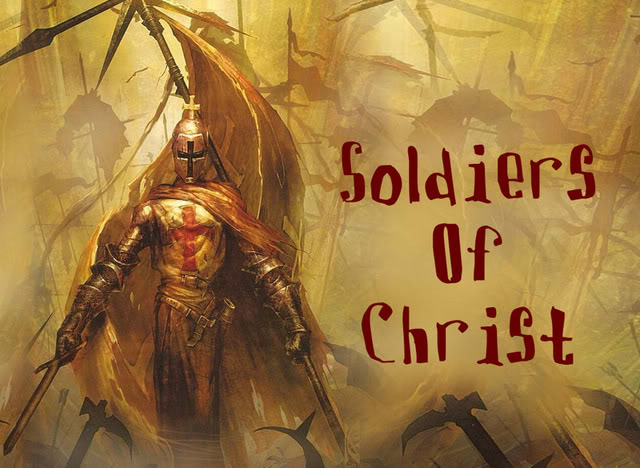
We are soldiers of Christ (Miles Christi). The Church is One and reveals a great and generous heart. The Church, deeply moved by the heart of Christ, struggles with how indifferent people respond to God’s love through her. She looks to the Cross upon Calvary with affection, knowing all too well all that has been left at its foot. A change must come upon the Church. The Church fears in horror that she may become mediocre, useless, and express an empty life. Now, the Church must look upon the Lord and ask, “What have I done for You, what am I doing for You, and what must I do for You?”