Archive for the ‘Repentance’ Category

One God. We worship one, personal, knowable, holy God. There are not two gods or ten gods or ten million gods, only one. He has always been and will always be. He is not a product of our mind or imagination. He really exists and we can know him because he has spoken to us in his word.

Two kinds of being. We are not gods. God is not found in the trees or the wind or in us. He created the universe and cares for all that he has made, but he is distinct from his creation. The story of the world is not about being released from the illusion of our existence or discovering the god within. The story is about God, the people he made, and how the creatures can learn to delight in, trust in, and obey their Creator.

Three persons. The one God exists eternally in three persons. The Father is God. The Son, our Lord Jesus Christ, is God. The Holy Spirit, the Spirit of the Father and the Son, is also God. And yet these three—equal in glory, rank, and power—are three persons. The doctrine of the Trinity helps explain how there can be true unity and diversity in our world. It also shows that our God is a relational God.

For us. Something happened in history that changed the world. The Son of God came into the world as a man, perfectly obeyed his Father, fulfilled Israel’s purpose, succeeded where Adam failed, and began the process of reversing the curse. Jesus Christ died for the sins of the world. He rose again from the dead on the third day. By faith in him our sins can be forgiven and we can be assured of living forever with God and one day being raised from the dead like Christ.

~ Kevin Deyoung


DOMINION OVER SIN: Sin shall not have dominion over you…(Romans 6:14)

DOMINION OVER THE FLESH: So then brethren, we are under obligation, not to the flesh, to live according to the flesh… (Romans 8:12)

DOMINION OVER SATAN: Resist the devil and he will flee from you. (James 4:7)

DOMINION OVER DEMONS: Behold I have given you authority to tread upon serpents and scorpions, and over all the power of the enemy, and nothing shall injure you. (Luke 10:19)

DOMINION OVER SICKNESS: Is anyone among you sick? Let him call for the elders of the church, and let them pray over him, anointing him with oil in the name of the Lord; and the prayer offered in faith will restore the one who is sick… ( James 5:14)

DOMINION OVER EVIL: Do not be overcome by evil, but overcome evil with good. (Romans 12:21)

DOMINION OVER THE WORLD: For whatever is born of God overcomes the world, and this is the victory that has overcome the world – our faith. (1 John 5:4)

DOMINION OVER FEAR: Perfect love casts out fear…(1 John 4:18)

DOMINION OVER…? But with God all things are possible…(Matthew 19:26)

~ David Ravenhill

Esther 9:22 – “As the days on which the Jews had rest from their enemies, as the month which was turned from sorrow to joy for them, & from mourning to a holiday; that they should make them days of feasting and joy, of sending presents to one another and gifts to the poor.”

There can be a lull in the battle. The enemy, Satan, waits for a time or a season to bombard us with something painful. When you are feeling somewhat good about your life, the attack begins. The enemy comes at you with curve balls, hand grenades, mortars, and a frontal attack. All this to test how fragile you are. This is to test your faith in God.

There is no rest from our enemies. They stand ready to attack at a moment’s notice, regardless of the situation or timing. They are ready to pounce heavily. These attacks happen daily to those in the Body of Christ. The Body of Christ must maintain its guard, and watchfulness to protect itself.

That is why the Church, the Body of Christ exists, to help one another and to stand together and fight the enemy.

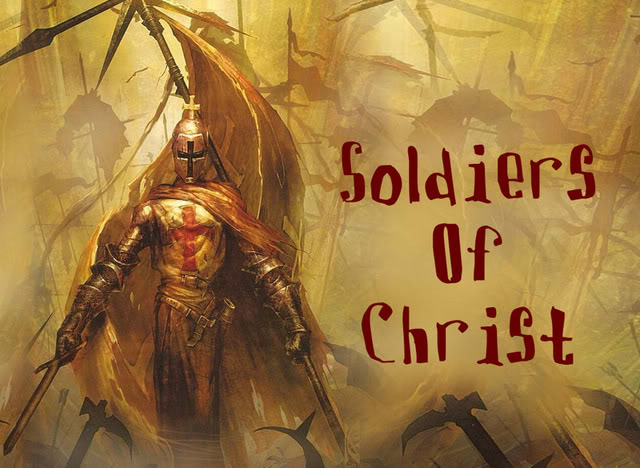
We are soldiers of Christ (Miles Christi). The Church is One and reveals a great and generous heart. The Church, deeply moved by the heart of Christ, struggles with how indifferent people respond to God’s love through her. She looks to the Cross upon Calvary with affection, knowing all too well all that has been left at its foot. A change must come upon the Church. The Church fears in horror that she may become mediocre, useless, and express an empty life. Now, the Church must look upon the Lord and ask, “What have I done for You, what am I doing for You, and what must I do for You?”

The entrance into the Kingdom of God is by grace through faith in Jesus Christ alone. My call to ministry is one based upon God’s faithfulness to fulfill His revealed purpose in my life. I had no ability to acquire salvation on my own. Because of God’s sovereignty, He chose me in Christ before the foundation of the world. His mercy and grace brought me faith. God enabled me to make the choice of trusting in Jesus Christ as Savior and Lord. He regenerated and transformed me into a new creation in Christ Jesus, and now His sanctifying grace is making me holy in my daily life.

The Holy Spirit baptized me into the Body of Christ, the Church (the ekklēsia), of which I am a member. Now, I am a member of the Community (ekklēsia) of Jesus Christ. God created a community of worship, dedication, and faith in the time of the Old Covenant. Now, the community has changed with the coming of the new and better covenant. Within this community of the Kingdom, I am able to view my calling more clearly. It means that being a “covenant person” of a covenant people; I am called to a mission along with many others, and am equipped by God through the Holy Spirit.

Therefore, I can speak with conviction along with the Apostle Paul when he said in 2 Corinthians 3:6, “ He has made us competent as ministers of a new covenant – not of the letter but of the Spirit, for the letter kills, but the Spirit gives life.” Therefore, I see that those members of the Community of Jesus Christ are ministers unto each other, the world, and unto God.

My call and the call of His Church (Matthew 25:35-45) is to minister unto a world that is lost. We are to be beacons of light to those who are blind in darkness. We are to be workers of justice and freedom for the oppressed and captive. We are to demonstrate to the poor the power of His greatness and His faithfulness from which we hope, and to proclaim the Gospel and His Kingdom!


I stand high above the sea of souls
Gazing at the wondrous beauty of the Body
The building upon which I stand is enormous
The purest white, spacious, with many rooms, and many floors, and many wings
I stand watching…
I stand waiting…
I stand listening…
I hear countless tales and lore
I hear the many words come forth
Sometimes I hear something strange
Sometimes I see a wall coming
That alienates
That separates
Then the Word comes
Then the Spirit comes
They come together as One
With the Father
In the high tower
Of protection its sure
Inside that which my invocation seeks
The prayer of the heart
For upon which I stand
As a watchman…

In the Bible, we read about a “wounded spirit” and about a “broken spirit.” In some ways, the meaning of these two terms is similar. Both terms indicate distress. It is possible even that one person will have a wounded spirit in response to the same situation that results in a broken spirit for another person.

However, the two terms stand in contrast. First, let us consider how they are used in Scripture. “The spirit of a man will sustain his infirmity; but a wounded spirit who can bear?” (Proverbs 18:14). The same Hebrew word is translated broken in Proverbs 17:22, where we read, “…a broken spirit drieth the bones.” The Hebrew word literally means “stricken.” In both verses, the NIV says “a crushed spirit.”

A wounded spirit is one that is hurting, but one in which the hurt has festered into unbearable attitudes and responses. A person with a wounded spirit lives in inner misery that focuses regularly on his injuries. Out of this focus come the following “unbearable” characteristics:

1. A negative mind-set. The person with a wounded spirit is preoccupied with past injuries. He views incidents in life in the worst light. He sees the bad and ignores the good. His mind is filled with woes, suspicion, and assumption of evil.

2. Victim reasoning. With a wounded spirit, a person views himself as a sufferer. He can turn even kind actions of others into additional grievances, into added pain in his life. He is pleased when others notice his misery, and hurt when they do not.

3. Grievance mannerisms. Out of a wounded spirit come sighs, groans, and exclamations that draw attention to the hurt. There is body language such as shaking the head, throwing dark looks, facial misery, and slumped shoulders.

4. Blame tactics. A person with a wounded spirit holds other people responsible for the misery in his life. In truth, others may have done him wrong, but those wrongs become the means of blaming others. The wounded spirit is able to cough up old injuries no matter what the present subject. The stories that are told put others in the worst light. In addition to direct blame, there are ways of insinuating–giving details in such a way that worse is implied.

Is it any wonder the proverb exclaims, “A wounded spirit, who can bear!” Out of the wound oozes the stench of self-pity, bitterness, and accusation.

In contrast to this is the broken spirit. “The sacrifices of God are a broken spirit: a broken and a contrite heart, O God, thou wilt not despise” (Psalm 51:17).

The Hebrew word translated broken is a strong word. It means “wrecked, shattered, even crippled, or maimed.” The Lord delights in the person with a broken spirit. In Psalm 51, characteristics associated with such brokenness include:

1. Acknowledgment of wrong. A person with a broken spirit does not make excuses or blame others. He takes full responsibility for his wrongdoing.

2. Contrition. A broken spirit produces genuine sorrow.

3. Humility. Self-will has been shattered. There is no attempt to lift oneself up.

4. Seeking after God. The person with a broken spirit has faced his own poverty and sin. He has no righteousness of his own to promote, but rather, he seeks to know God.

5. Teachability. He is done with his own answers to life and is ready to turn to the Lord for help. He does not want his problem explained or justified; instead, he wants help to change.

6. Unworthiness. The person who is broken is spirit does not demand, he asks. His focus is not on getting all that he deserves because he knows he has been spared from what he really deserves. He is grateful instead of complaining. He has tasted mercy, and he is done with demanding rights.

Much as a wounded spirit makes a person difficult to live with, a broken spirit makes a person a joy to be around. He has tenderness in manner, a gratitude for what others do humility about himself, and gentleness in relating to others who have faults.

God heals the broken-hearted. He declares that He will dwell “with him also that is of a contrite and humble spirit” (Isaiah 57:15). When we experience brokenness and the blessings that follow, we wonder why we resisted such joy and freedom for so long.

I am told that one village that received the Gospel for the first time and experienced genuine brokenness began the custom of greeting one another, “Do I meet you broken, brother?” Perhaps this would be a good practice to begin.

~ Author unknown