Archive for the ‘orthodoxy’ Category

EarthDay

The first part of the Nicene Creed states, “We believe in one God, Father Almighty, Creator of heaven and earth and of all things visible and invisible.”

Today is Earth Day, all over the world, and here in Minnesota. God has given humanity the responsibility to care for this earth. Have we done so? I don’t think we have. With the rise of technology and the knowledge of how to turn rock into steel, we have come to pollute our air and waterways.

From the orthodox Christian point of view, life is eucharistic. The word “eucharist” means thanksgiving. It is used as the definition of the Sacrament where we receive the body and blood of our Lord Jesus Christ. But in viewing life and the creation, we must see it all as a Eucharistic celebration. The celebration is the outcome of being responsible for our earth and all of its contents.

This life we live, and this earth we live on, was a life of communion with God. When Adam and Eve sinned, we lost the earth as a means of communion with God. The earth before the fall of humanity was filled with the Divine Presence of God. Since then, and now, the earth appears void of the Divine Presence.

The Holy Scriptures tell us that in God “we live, move, and have our being.” That includes the earth! When we purposely destroy rain forests that disrupt the ecology; when we purposely shoot pollutants into the air creating holes in the O-Zone layer, we go against the sacramental meaning of our relationship to this planet. God gave humanity everything it needed to survive. God gave us fruit, vegetables, and plants to eat from. But then, after the fall, and after the great flood of Noah’s time, God allowed us to eat meat. This isn’t a plug for being vegetarian, but humanity was vegetarian in the beginning. The killing of an animal is opposed to the understanding of our relationship with the earth and all of creation that God inherently gave us.

Fr. Alexander Schmemann wrote in his book entitled Holy Week: A Liturgical Explanation for the Days of Holy Week, “…world and food, once they are deprived of their initial sacramental meaning as means of communion with God; once they are not received for God’s sake, and filled with hunger and thirst for God; once, in other words, God is no longer their real “content,” can give no life, satisfy no hunger, for they have no life in themselves.” This is what has become of humanity. Nothing satisfies, so we go for more. Nothing gives life, so we think we can create it. Our hunger and thirst is not for food or that which satisfies, but it is a hunger and thirst for union and communion with God.

As we celebrate “Earth Day” today, let us look to God as our source, as our satisfaction, and the One who fills our hunger and quenches our thirst. For nothing is more important to the earth today, than our coming back to what was once sanctified; what was once transformed into a world of thanksgiving and adoration of God our Creator. Let us yearn and repent toward a more perfect eucharistic life, that is filled with God, and watch it become again a Divine and immortal life that He has given to all humanity especially to those who believe in Him.

God bless you!

Kerygma

Kerygma

What is kerygma and what does it mean?

During the last seven weeks of the Communication in Ministry course I am taking, we are concentrating on preaching or delivering sermons or messages to our congregations.  We are studying structuring sermons, how to select our passages and how to interpret the biblical passage. We are learning how to relate the interpretation of the biblical passage to our “audience.” We are learning all the ways and means to creating a great sermon.

This brings me to the word kerygma. Dictionary.com gives the definition of kerygma as “the preaching of the gospel of Christ, especially in the manner of the early church, and the content or message of such preaching.”

Kerygma is the Greek word κήρυγμα kérugma, translated proclamation or preaching. Kergyma is the preaching of the Gospel of Jesus Christ in spoken words, or even viewed in the celebration of the Lord’s Supper. It is the proclamation of Jesus redemptive work. Proclamation was usually followed by teaching and instruction in the elements of the faith, or the reading of a Creed. What Jesus did and taught in His ministry was included within the basic proclamation. Ok, so lets break this definition down. 

1. Kerygma is the preaching of the Gospel.

2. Kerygma is preaching in the manner of the early church.

3. Kerygma has to do with the content or message of what is being preached.

What is the Gospel? It is the Good News of the life, ministry, death, resurrection, and ascension of Jesus Christ. The Gospel includes the facts of Jesus’ incarnation as the Word. It includes the fact that Jesus is the Son of God. It includes the fact that Jesus was begotten of the Father and not a creature that the Father made. Jesus is in the Father as the Father is in Him. It includes the fact that salvation from sin, sickness, death, and the devil is only through Jesus the Messiah. It includes the fact that we are made right with God, declared righteous because of the righteousness of Jesus the Messiah. The Gospel is Good News!

2. What was the manner of preaching in the early church? The book of Acts clearly demonstrates that the early church preached the Gospel focusing on Jesus Christ; on repentance, faith, baptism and the forgiveness of sins, especially that salvation is through Jesus alone. The early church preached Jesus’ death, burial, resurrection, and His ascension to the right hand of the Father, and the gift of the Holy Spirit. The reason is that the Apostles were witnesses to the life, ministry, death, burial, resurrection and ascension of Jesus Christ. The early church preached what they heard from Jesus, the Apostles, and what they witnessed – it is the Gospel.

3. What is the content or message of what was being preached by the early church? When looking into the book of Acts we see:

  • All of the messages mention the doctrine of God.
  • All of the messages mention Jesus the Messiah.
  • Seven messages mention Jesus’ death.
  • Seven messages mention His resurrection.
  • Four messages declare that Jesus is now exalted in heaven at the right hand of the Father.
  • Four messages mention the giving of the Holy Spirit.
  • Seven message mention the forgiveness of sins.
  • Five messages mention repentance.
  • Three messages mention the need for faith.
  • Five messages mention Scripture.
  • None of the messages use the word Kingdom, because the Kingdom of God was brought to the earth in Jesus the Messiah.

Therefore, the content or the message preached by the early church included everything mentioned above. The church today must preach the Gospel like the early church. The early church preached the Gospel within the context of her audience, whether Jew or Gentile, or whether it was in Palestine or Athens, Rome or Crete. The kerygma was the same. They preached and taught the Gospel. The early church preached and taught the Gospel as it was given to them by the Apostles. The kerygma is the Apostolic Gospel message. The Church should be preaching the Gospel the same way the Apostles preached it: in the wisdom and power of God.

St. Paul gives an example of the kerygma:

“For I delivered to you as of first importance what I also received: that Christ died for our sins in accordance with the Scriptures, that He was buried, that He was raised on the third day in accordance with the Scriptures, and that He appeared to Cephas, then to the twelve. Then He appeared to more than five hundred brothers at one time, most of whom are still alive, though some have fallen asleep. Then He appeared to James, then to all the apostles. Last of all, as to one untimely born, He appeared also to me.” 1 Corinthians 15:3-8 (ESV)

In conclusion, based upon the Four Gospels and Acts, there are seven elements to the ancient kerygma of the Church:

1. God loves you and seeks after you.
2. Sin will destroy you.
3. Jesus Christ died to save you.
4. Repent and believe the Gospel.
5. Be Baptized – receive the Holy Spirit.
6. Abide in Christ and His Body the Church.
7. Go make disciples.

Lastly, there are four elements (Acts 2:42) to living the Christian life revolving around the kerygma:

1. The Apostles’ Teaching – The Church steadfastly went on in the study of ancient Scripture and the sacred teachings of the Faith given them by the Apostles.
2. The Fellowship – They were daily interacting within Christ’s Body the Church, frequently gathering for worship, and other gatherings as the Body of Christ.
3. The Breaking of the Bread – This is another way of saying that they faithfully received Holy Communion, the Lord’s Supper, or the Eucharist and, by extension, all the Sacraments.
4. The Prayers – Using forms of prayers, in both the personal and community contexts.

Westminster

The Westminster Creed

I believe man’s chief end is to glorify God, and to enjoy Him forever;
I believe God is a Spirit, infinite, eternal, and unchangeable in His being,
wisdom, power, holiness, justice, goodness, and truth;

I believe there is but one true and living God;
that there are three persons in the Godhead:
the Father, the Son, and the Holy Ghost;
and that these three are one God,
the same in substance, equal in power and glory;

I believe God has foreordained whatever comes to pass;
that God made all things of nothing,
by the word of His power, in the space of six days, and all very good;
and that God preserves and governs all His creatures and all their actions.

I believe our first parents, though created in knowledge, righteousness, and holiness,
sinned against God, by eating the forbidden fruit;
and that their fall brought mankind into an estate of sin and misery;

I believe God determined, out of His mere good pleasure,
to deliver His elect out of the estate of sin and misery,
and to bring them into an estate of salvation by a Redeemer;
I believe the only Redeemer of God’s elect is the Lord Jesus Christ,
Who, being the eternal Son of God, became man,
and so was, and continues to be,
God and man in two distinct natures, and one person, forever;

I believe Christ, as our Redeemer,
executes the office of a prophet, of a priest, and of a king.

I believe Christ as our Redeemer underwent the miseries of this life,
the wrath of God, the cursed death of the cross, and burial;
He rose again from the dead on the third day, ascended up into heaven,
sits at the right hand of God, the Father,
and is coming to judge the world at the last day.

I believe we are made partakers of the redemption purchased by Christ,
by the effectual application of it to us by his Holy Spirit;

I believe God requires of us faith in Jesus Christ,
and repentance unto life to escape the wrath and curse of God due to us for sin;

I believe by His free grace we are effectually called, justified, and sanctified,
and gathered into the visible church, out of which there is no ordinary possibility of salvation;

I believe that we also are given in this life such accompanying benefits
as assurance of God’s love, peace of conscience, joy in the Holy Ghost,
increase of grace, and perseverance therein to the end;
that at death, we are made perfect in holiness, and immediately pass into glory;
and our bodies, being still united in Christ, rest in their graves, till the resurrection;
and at the resurrection, we shall be raised up in glory,
we shall openly be acknowledged and acquitted in the day of judgment,
and made perfectly blessed in the full enjoying of God to all eternity.

~ adapted from the 17th century Westminster Shorter Catechism

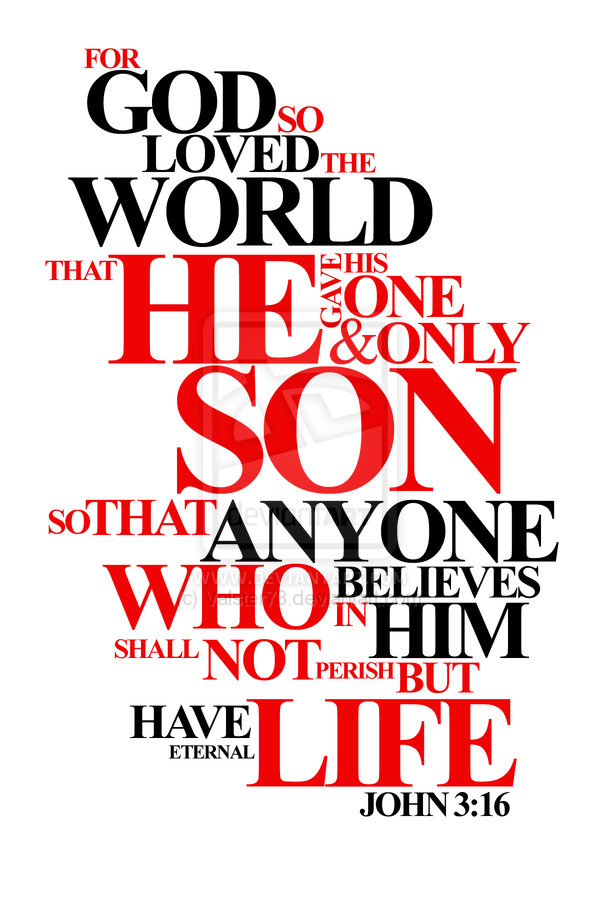
John_3_16_by_Valster73

“For God loved the world in this way: He gave His One and Only Son, so that everyone who believes in Him will not perish but have eternal life. For God did not send His Son into the world that He might condemn the world, but that the world might be saved through Him. Anyone who believes in Him is not condemned, but anyone who does not believe is already condemned, because he has not believed in the name of the One and Only Son of God. “This, then, is the judgment: The light has come into the world, and people loved darkness rather than the light because their deeds were evil. For everyone who practices wicked things hates the light and avoids it, so that his deeds may not be exposed. But anyone who lives by the truth comes to the light, so that his works may be shown to be accomplished by God.” ~ The Gospel of John 3:16-21

Do you believe that Jesus Christ is the Son of God, your Savior? Click here to learn more!

Esther 9:22 – “As the days on which the Jews had rest from their enemies, as the month which was turned from sorrow to joy for them, & from mourning to a holiday; that they should make them days of feasting and joy, of sending presents to one another and gifts to the poor.”

There can be a lull in the battle. The enemy, Satan, waits for a time or a season to bombard us with something painful. When you are feeling somewhat good about your life, the attack begins. The enemy comes at you with curve balls, hand grenades, mortars, and a frontal attack. All this to test how fragile you are. This is to test your faith in God.

There is no rest from our enemies. They stand ready to attack at a moment’s notice, regardless of the situation or timing. They are ready to pounce heavily. These attacks happen daily to those in the Body of Christ. The Body of Christ must maintain its guard, and watchfulness to protect itself.

That is why the Church, the Body of Christ exists, to help one another and to stand together and fight the enemy.

We are soldiers of Christ (Miles Christi). The Church is One and reveals a great and generous heart. The Church, deeply moved by the heart of Christ, struggles with how indifferent people respond to God’s love through her. She looks to the Cross upon Calvary with affection, knowing all too well all that has been left at its foot. A change must come upon the Church. The Church fears in horror that she may become mediocre, useless, and express an empty life. Now, the Church must look upon the Lord and ask, “What have I done for You, what am I doing for You, and what must I do for You?”