Posts Tagged ‘redemption’

Gospel

The Gospel is: εὐαγγέλιον – euaggelion; a reward for good tidings; the glad tidings of the kingdom of God soon to be set up, and subsequently also of Jesus the Messiah, the founder of this kingdom. After the death of Christ, the term Gospel comprises also the preaching of (concerning) Jesus Christ as having suffered death on the cross to procure eternal salvation for the men in the kingdom of God, but as restored to life and exalted to the right hand of God in heaven, thence to return in majesty to consummate the kingdom of God; the glad tidings of salvation through Jesus Christ; the proclamation of the grace of God manifest and pledged in Jesus Christ; as the Messianic rank of Jesus was proved by His words, His deeds, and His death, the narrative of the sayings, deeds, and death of Jesus Christ came to be called the Gospel or glad tidings.

The Gospel shall be proclaimed in all the inhabited world!

The Gospel must be preached, to the Jews; even to all, without any distinction of people, Jews and Gentiles, Barbarians, Scythians, bond and free, male and female, rich and poor, greater or lesser sinners, even to all mankind; than which, nothing was more provoking to the Jews; who would, if they could, have revoked and made null this commission of Jesus Christ. The Gospel is the word of peace and reconciliation, by His atoning sacrifice; the doctrine of free and full pardon by His blood; and of justification by His righteousness; and of complete salvation by Him: even every doctrine relating to His person, as God and man; to every office of His, as prophet, priest, and king; to His incarnation, sufferings, and death, His resurrection, ascension, session at the right hand of God, and intercession for His people, and second coming to judgment; with every doctrine relating to the grace of God, of the Father in election, and the covenant of peace, of the Son in redemption, and of the Spirit in regeneration and sanctification: all which he must be published and declared in the most free, plain, and open manner, with all boldness, faithfulness, and constancy! 

“Now brothers, I want to clarify for you the Gospel I proclaimed to you; you received it and have taken your stand on it. You are also saved by it, if you hold to the message I proclaimed to you—unless you believed for no purpose. For I passed on to you as most important what I also received:

that Christ died for our sins
according to the Scriptures,
that He was buried,
that He was raised on the third day
according to the Scriptures…” ~ 1 Corinthians 15:1-4

When God was displeased with the Jews, he delivered Jerusalem to the enemy, and they were conquered by those who hated them; there were no more sacrifices or feasts. Likewise angered at a soul who had broken his commands, God handed it over to its enemies, who corrupted and totally dishonoured it. When a house has no master living in it, it becomes dark, vile and contemptible, choked with filth and disgusting refuse. So too is a soul which has lost its master, who once rejoiced there with his angels. This soul is darkened with sin, its desires are degraded, and it knows nothing but shame.

Woe to the path that is not walked on, or along which the voices of men are not heard, for then it becomes the haunt of wild animals. Woe to the soul if the Lord does not walk within it to banish with his voice the spiritual beasts of sin. Woe to the house where no master dwells, to the field where no farmer works, to the pilotless ship, storm-tossed and sinking. Woe to the soul without Christ as its true pilot; drifting in the darkness, buffeted by the waves of passion, storm-tossed at the mercy of evil spirits, its end is destruction. Woe to the soul that does not have Christ to cultivate it with care to produce the good fruit of the Holy Spirit. Left to itself, it is choked with thorns and thistles; instead of fruit it produces only what is fit for burning. Woe to the soul that does not have Christ dwelling in it; deserted and foul with the filth of the passions, it becomes a haven for all the vices.

When a farmer prepares to till the soil he must put on clothing and use tools that are suitable. So Christ, our heavenly king, came to till the soil of mankind devastated by sin. He assumed a body and, using the cross as his ploughshare, cultivated the barren soul of man. He removed the thorns and thistles which are the evil spirits and pulled up the weeds of sin. Into the fire he cast the straw of wickedness. And when he had ploughed the soul with the wood of the cross, he planted in it a most lovely garden of the Spirit, that could produce for its Lord and God the sweetest and most pleasant fruit of every kind.

~ Saint Macarius, bishop (circa 330 AD)


In 1993, my wife and I were involved in an historic train wreck. The crash of the Sunset Limited into an inlet from Mobile Bay killed more passengers than any Amtrak accident in history. We survived that eerie accident but not without ongoing trauma. The wreck left my wife with an ongoing anxiety about being able to sleep on a train at night. The wreck left me with a back injury that took fifteen years of treatment and therapy to overcome. Nevertheless, with these scars from the trauma we both learned a profound lesson about the providence of God. Clearly, God’s providence in this case for us was one of benign benevolence. It also illustrated to us an unforgettable sense of the tender mercies of God. In as much as we are convinced that God’s providence is an expression of His absolute sovereignty over all things, I would think that a logical conclusion from such a conviction would be the end of all anxiety.

However, that is not always the case. Of course, our Lord Himself gave the instruction to be anxious for nothing to His disciples and, by extension, to the church. His awareness of human frailties expressed in our fears was manifested by His most common greeting to His friends: “Fear not.” Still, we are creatures who, in spite of our faith, are given to anxiety and at times even to melancholy.

As a young student and young Christian, I struggled with melancholy and sought the counsel of one of my mentors. As I related my struggles, he said, “You are experiencing the heavy hand of the Lord on your shoulder right now.” I had never considered God’s hand being one that gave downward pressure on my shoulder or that would cause me to struggle in this way. I was driven to prayer that the Lord would remove His heavy hand from my shoulder. In time, He did that and delivered me from melancholy and a large degree of anxiety.

On another occasion I was in a discussion with a friend, and I related to him some of the fears that were plaguing me. He said, “I thought you believed in the sovereignty of God.” “I do,” I said, “and that’s my problem.” He was puzzled by the answer, and I explained that I know enough about what the Bible teaches of God’s providence and of His sovereignty to know that sometimes God’s sovereign providence involves suffering and affliction for His people. That we are in the care of a sovereign God whose providence is benevolent does not exclude the possibility that He may send us into periods of trials and tribulations that can be excruciatingly painful. Though I trust God’s Word that in the midst of such experiences He will give to me the comfort of His presence and the certainty of my final deliverance into glory, in the meantime I know that the way of affliction and pain may be difficult to bear.

The comfort that I enjoy from knowing God’s providence is mixed at times with the knowledge that His providence may bring me pain. I don’t look forward to the experience of pain with a giddy anticipation; rather, there are times when it’s necessary for me and for others to grit our teeth and to bear the burdens of the day. Again, I have no question about the outcome of such affliction, and yet at the same time, I know that there are afflictions that will test me to the limits of my faith and endurance. That kind of experience and knowledge makes it easy to understand the tension between confidence in God’s sovereign providence and our own struggles with anxiety.

Romans 8:28, which is a favorite for many of us, states that “all things work together for good to those who love God, to those who are the called according to His purpose” (NKJV). There’s no other text that demonstrates so clearly and magnificently the beauty of God’s sovereign providence than that one. The text does not say that everything that happens to us, considered in and of itself, is good; rather, it says that all things that happen are working together for our good. That is the master plan of God’s redemptive providence. He brings good out of evil. He brings glory out of suffering. He brings joy out of affliction. This is one of the most difficult truths of sacred Scripture for us to believe. I’ve said countless times that it is easy to believe in God but far more difficult to believe God. Faith involves living a life of trust in the Word of God.

As I live out the travail that follows life on this side of glory, hardly a day goes by that I am not forced to look at Romans 8:28 and remind myself that what I’m experiencing right now feels bad, tastes bad, is bad; nevertheless, the Lord is using this for my good. If God were not sovereign, I could never come to that comforting conclusion — I would be constantly subjected to fear and anxiety without any significant relief. The promise of God that all things work together for good to those who love God is something that has to get not only into our minds, but it has to get into our bloodstreams, so that it is a rock-solid principle by which life can be lived.

I believe this is the foundation upon which the fruit of the Spirit of joy is established. This is the foundation that makes it possible for the Christian to rejoice even while in the midst of pain and anxiety. We are not stoics who are called to keep a stiff upper lip out of some nebulous concept of fate; rather, we are those who are to rejoice because Christ has overcome the world. It is that truth and that certainty that gives relief to all of our anxieties.

~ R. C. Sproul (from Tabletalk, January 2010)

“For the preaching of the cross is to them that perish foolishness; but unto us which are saved it is the power of God.” ~ 1 Corinthians 1:18

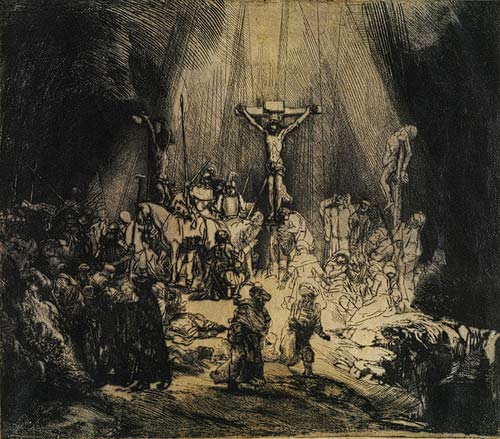
Let us set fully before our eyes the doctrine of Christ dying in our place – His substituted death, and rest our souls on it. Let us hold on firmly to the mighty truth, that Christ on the cross:

Christ on the cross: Stood in the place of His people

Christ on the cross: Died for His people

Christ on the cross: Suffered for His people

Christ on the cross: Was counted a curse and sin for His people

Christ on the cross: Paid the debts of His People

Christ on the cross: Made restitution for His people

Christ on the cross: Became the guarantee of His people

Christ on the cross: Became the representative of His people

In this way Christ obtained His people’s freedom. Let us understand this clearly, and then we will see what a mighty privilege it is to be made free by Christ. This is freedom which, above all others is worth having.

~ J. C. Ryle