Posts Tagged ‘Jesus Christ’

the-gospel1

The Good News

We bring you the good news that what God promised to the fathers, this he has fulfilled to us their children by raising Jesus…. – Acts 13:32-33

“Are You Saved?” Have you heard this message but not know what it means? What are you being saved from? From whom are you being saved?

1. Confess that you are a sinner and that you cannot save yourself.

“For all have sinned and fall short of the glory of God…” (Romans 3:23). This means that even though you try to do your best, you still fall short because you are a sinner. Romans 6:23 says that “the wages of sin is death, but the gift of God is eternal life in Christ Jesus our Lord.” Salvation is the gift of God to you. That’s the way He planned it.

2. Repent of and confess your sin to God.

And Peter said to them, “Repent and be baptized every one of you in the name of Jesus Christ for the forgiveness of your sins, and you will receive the gift of the Holy Spirit. For the promise is for you and for your children and for all who are far off, everyone whom the Lord our God calls to himself.” (Acts 2:38-39)

2. Confess that Jesus Christ is Lord, He is the Son of God, and that He alone can save you.

“Salvation is found in no one else, for there is no other name under heaven given to men by which we must be saved” (Acts 4:12). “For there is one God and one mediator between God and men, the man Christ Jesus, who gave himself as a ransom for all men–the testimony given at its proper time” (1 Timothy 2:5-6). Isaiah 53:6 says that “We all, like sheep, have gone astray, each of us has turned to his own way; and the Lord has laid on Him the iniquity of us all.” Jesus took our sins upon Himself when He died on the cross. He paid the penalty for our sins so that we would not have to. He was raised from the dead, showing that He has victory of sin and death. Romans 10:9 says that “if you confess with your mouth, ‘Jesus is Lord,’ and believe in your heart that God raised Him from the dead, you will be saved.”

3. Acknowledge that salvation will be yours if you put your faith in Jesus Christ.

“The time is fulfilled, and the kingdom of God is at hand; repent and believe in the Gospel.” (Mark 1:15)

Ephesians 2:8 says that “For it is by grace you have been saved, through faith–and this not from yourselves, it is the gift of God–not by works, so that no one can boast.” This clearly indicates that God gives the gift of faith first. Then you take the faith He has given you and place it in Christ you will be saved by faith alone–there is nothing more for you to do.

4. Pray and receive Jesus Christ as your Savior and Lord from this day forward, and forever.

2 Corinthians 5:17 says that “Therefore, if anyone is in Christ, he is a new creation; the old has gone, the new has come!” This is what is known as “new life in Christ,” or as John 3:3 puts it, being “born again.”

Receiving Christ is the beginning. As we learn in Colossians 2:6-7, “Just as you received Christ Jesus as Lord, continue to live in him, rooted and built up in him, strengthened in the faith as you were taught, and overflowing with thankfulness.”

After receiving Him, be obedient by following Him in baptism and by uniting with the church. When you do, you will find that life truly does have new purpose and meaning.

Learn more about your new relationship with God here and click on Q1 (Question 1) to begin!

God bless you!

GoodSam

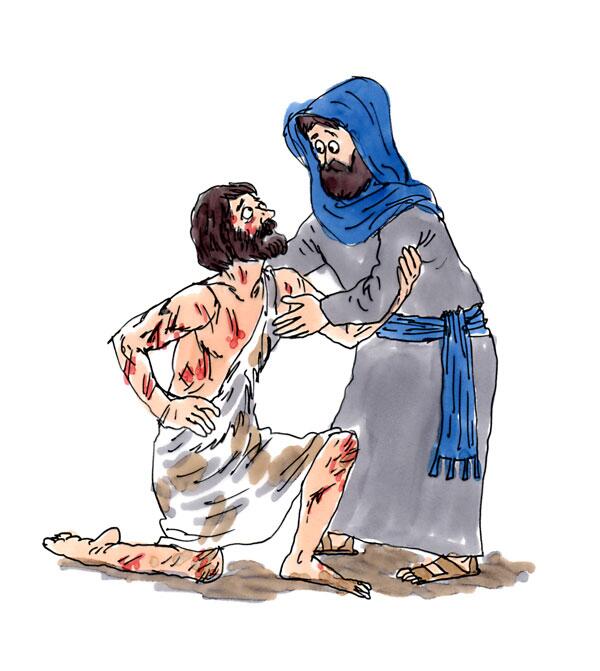
The man wanted to justify his actions, so he asked Jesus, “And who is my neighbor?” Jesus replied with a story: “A Jewish man was traveling from Jerusalem down to Jericho, and he was attacked by bandits. They stripped him of his clothes, beat him up, and left him half dead beside the road. “By chance a priest came along. But when he saw the man lying there, he crossed to the other side of the road and passed him by. A Temple assistant walked over and looked at him lying there, but he also passed by on the other side. “Then a despised Samaritan came along, and when he saw the man, he felt compassion for him. Going over to him, the Samaritan soothed his wounds with olive oil and wine and bandaged them. Then he put the man on his own donkey and took him to an inn, where he took care of him. The next day he handed the innkeeper two silver coins, telling him, ‘Take care of this man. If his bill runs higher than this, I’ll pay you the next time I’m here.’ “Now which of these three would you say was a neighbor to the man who was attacked by bandits?” Jesus asked. The man replied, “The one who showed him mercy.” Then Jesus said, “Yes, now go and do the same.” ~ (Luke 10:29-37)

Come to Me

Weak and wounded sinner
Lost and left to die
O, raise your head, for Love is passing by
Come to Jesus
Come to Jesus
Come to Jesus and live!

Now your burdens lifted
And carried far away
And precious blood has washed away the stain…so
Sing to Jesus
Sing to Jesus
Sing to Jesus and live!

And like a newborn baby
Dont be afraid to crawl
And remember when you walk, sometimes we fall…so
Fall on Jesus
Fall on Jesus
Fall on Jesus and live!

Sometimes the way is lonely
And steep and filled with pain
So if your sky is dark and pours the rain…then
Cry to Jesus
Cry to Jesus
Cry to Jesus and live!

O, and when the love spills over
And music fills the night
And when you cant contain your joy inside…then
Dance for Jesus
Dance for Jesus
Dance for Jesus and live!

And with your final heartbeat
Kiss the world goodbye
Then go in peace, and laugh on glory’s side…and
Fly to Jesus
Fly to Jesus
Fly to Jesus and live!

Music & Lyrics by Chris Rice

Canons-of-Dort-Word-Cloud

TULIP

The historic five points of Calvinism, simplified in the acrostic TULIP, distinguish Reformed theology at the key points of issue, but in no way exhaust the content of Reformed theology. These five points include:

T – total depravity
U – unconditional election
L – limited atonement
I – irresistible grace
P – perseverance of the saints

Briefly, total depravity declares that all men are corrupted by the Fall to the extent that sin penetrates the whole person, leaving them in a state by which they are now by nature spiritually dead and at enmity with God. This results in the bondage of the will to sin by which the sinner is morally unable to incline himself to God, or to convert himself, or to exercise faith without first being spiritually reborn by the sovereign work of the Holy Spirit (Ps. 51:5, Rom. 5:12, Col. 2:13, John 3:5-7).

Unconditional election refers to God’s sovereign and gracious work of election by which, from all eternity, God determines to exercise saving grace to a particular group of people chosen from out of the mass of fallen humanity. God gives this saving grace according to the good pleasure of His will, and not according to some foreseen actions, responses, or conditions met by men. God’s election is based purely on His sovereign grace and not upon anything done by humans. The elect are brought to saving faith by the work of the Holy Spirit. The elect receive special grace from God. The non-elect receive common grace, but in the end receive the justice of God (Deut. 7:6,7; Rom. 8:28-30; Eph. 1:4; 1 Peter 2:8,9; John 6:44).

Limited atonement means that though the value and merit of Christ’s atonement are unlimited and sufficient to save the whole world and are offered to all who repent and believe, the efficacy of the atonement is applied only to the elect, and that, by God’s design. This means that in God’s eternal plan of salvation the atonement was designed to accomplish redemption for the elect and that God’s plan of redemption is not frustrated by the refusal of the impenitent to avail themselves of its benefits. In this sense all for whom the atonement was designed to save, will be saved (2 Cor. 5:21; 1 Peter 3:18; Gal 3:13; John 11).

Irresistible grace refers to the grace of regeneration by which God effectually calls His elect inwardly, converting them to Himself, and quickening them from spiritual death to spiritual life. Regeneration is the sovereign and immediate work of the Holy Spirit, working monergistically. This grace is operative, not cooperative, meaning that those who are regenerate always come to saving faith, as they are made willing to come to Christ to Whom they most certainly flee and cling for their redemption (Ez. 36:26-27; Rom. 8:30; John 3:3-8; Titus 3:5; Eph. 2:1-10).

Perseverance of the saints means that those who are truly regenerate and truly come to saving faith will never lose their salvation. They may fall via manifold temptations and spiritual weakness, even into radical sin but never fully and finally because God, by His grace, preserves them. The intercession of Christ for the elect is efficacious unto eternity (John 3:16; John 10:27-30; Rom. 8:35-39; 1 Jn. 5:13).

council-of-nicaea

While on earth, our Lord confirmed that He and the Father are one (John 10:30). On the other hand, He asked, “Why do you call me good, no one but my Father is good?” (Mark 10:18). Putting those two statements together is not very easy. However, the Bible does not leave only that question to resolve. Jesus could tell the “unknown” inquisitive sinner hiding in a tree that He would have lunch with him while also claiming that no one knows the time or the hour but the Father (Mark 13:32).

There is an inherent tension in these and other biblical passages. To express the tension sharply, the big issue relative to Jesus’ earthly ministry is this: The divine One who turned water into wine, who raised His friend Lazarus from the grave, who walked on water and commanded His friend Peter to do the same, could also die a bloody and shameful death upon the cross.

Truly Jesus is the God-man, but the relationship between the two is not that easy to figure out. The resurrection did not make the situation any simpler. After conquering death, Mary could worship Him and hold onto His feet. His new body still had nail marks that Thomas could see and touch. Jesus could cook a fish breakfast for His depressed fishing disciples. But He could also walk through locked doors, and after talking to some disciples, He could suddenly vanish. At the end of His time on earth, after being seen (He was no apparition) by many, He ascended bodily to heaven and is now seated at the Father’s right hand.

These and other Scripture passages taught the ancient church, and they teach us today, to cry out: “Jesus is God!” Our voices unify with Christians of two thousand years ago and rejoice that we have a great High Priest who “knows” our weaknesses because He is truly man. We confess with them that Jesus of Nazareth, a man born of Mary, is also “Lord.”

While we sing the same song of praise, our world is different from that of Christ’s followers during the first four centuries. We don’t have to worship in catacombs, and, at least here in America, government officials don’t want us dead for our profession of faith. Fortunately, the fourth-century world of Christian persecution came to a screaming stop when the Emperor Constantine rescinded past anti-Christian decrees and elevated Christianity to the official faith of the empire. Suddenly, the church had time and leisure to reflect upon these difficult, and seemingly contradictory, biblical truths.

Facing our task from another direction, we ask: How has the church understood Paul’s teaching, who tells us that Jesus took “the form of a servant” (Phil. 2:7), and the teaching of the beloved disciple who reminds us that we “beheld His glory”? (John 1:14). Granting that Jesus Christ is the God-man, the church had to determine how it was possible for the divine and the human to come together. Those questions were resolved in the fourth century, from the time of the council of Nicaea (325) to the council of Constantinople (381).

The Call For a Meeting at Nicaea

As is so often the case in the church, a controversy arose over these difficult issues. Particular figures became associated with different theological positions. On the one hand there was the theologian named Arius. For him, certain themes of Scripture were very important. For example, in the Jewish synagogues a particular Hebrew phrase, called the “Shema,” was memorized and repeated: “Hear O Israel, the Lord our God, the Lord is One” (Deut. 6:4). This is good and true teaching! Nevertheless, if the Lord is “One,” how does Jesus fit into the equation? The answer for Arius was simple. At the incarnation, Jesus of Nazareth “became” the God-man. Once again, on first reading, this phrase too is correct. Jesus did become the God-man two-thousand years ago when He was born of the virgin.

But lurking behind this correct phrase was an overflowing garbage can of bad ideas. Any orthodox Christian today affirms that Jesus “became” the God-man in the little town of Bethlehem, but we also affirm that the second person of the Trinity existed in full deity before that time. This pre-existence of Christ was the rub for Arius. He did not believe it, and he said, “there was a time when He was not [the eternal Son of God].”

At this point in the debate, orthodoxy’s hero, Athanasius, rightfully raised a shout of alarm. To state the issue clearly and concisely, Arius’ followers had denied the full eternal deity of the Son and the Holy Spirit to the Father. This is heresy.

However, Arius’ position was easy to understand. It supposedly helped to “clarify” the biblical problems. It was an attractive position, but it was wrong! The debate between Athanasius and Arius’ followers rolled like thunder around the empire. To resolve the controversy, the Emperor Constantine called for a giant church meeting.

Amid much debate, the theologians who met in 325 at the council of Nicaea had established the eternal preexistent Godhead of Christ. Their formulations excluded Arianism from the church. Jesus was declared to be “of one substance” with the Father. The Greek word for “of one, or same, substance” is homoousios. It consists of two words smashed together. Most know that the word “homo” means “same” — “ousia” means “substance.”

After 325

With this first great council, grounds for peace in the church had been established. A good theological stance had been taken, and the controversy about Christ’s nature should have come to an end. But we are talking about theologians here! While Arianism was officially condemned, and while Athanasius had won theologically and politically, not everyone was convinced of the orthodox position.

The struggle after 325 surrounds not men, but words. The controversy was between those who held to homoousios and those who proclaimed a new word: homoiousios. If you are reading this for the first time, the different spelling may not even have been noticed. An “i” is inserted in the second word.

Is a little “i” so important? If I evaluate a student’s outstanding paper and intend to give an “A” grade, but forget one little line, there is a big difference in meaning. That “A” would become an “F” on the class records. Theology students can become very concerned over one little line! They can also become concerned about a little “i.” While homoousios means of the “same substance,” homoiousios means that Jesus is of a “like substance.”

However, when we are talking about the very “substance” or “essence” of something, it is either completely of that substance, or it is not. For example, one “apple” can be “like” another “apple.” There could be differences of color or taste, but both would be “apples.” There is room for some differences in details: more sweet or less sweet, red or green in color. But an “apple” cannot taste like a ham sandwich and look like an elephant and still be an “apple”! It has to have all of the qualities of “apple-ness.” It has to be either “apple” in its substance — or it is something else.

After considerable debate, the theologians agreed. When it comes to the substance of divinity or humanity, there is no “almost” divine or “partly” human. God has to be fully God, and a man has to be a man. Homoiousios (with the “i” — “like,” or “similar” substance) was rejected by all, and most gave up their position that Jesus could be “like” God in substance, thus confirming orthodoxy.

But there were still some unconvinced troublemakers. They would not bow their knees to the notion of a full incarnation of the eternally divine Son of God. They pushed the envelope further and said that Jesus was “unlike” the Father in His substance.

This was an extreme position — and everyone now saw that it had to be rejected. Even the homoiousios pushers stood side by side with their former opponents (homoousios) to fight against the new enemy, “unlike.” To finish the controversy, yet another council was called, this time to convene at the city of Constantinople in 381. There a full creed was affirmed, the one that we term the “Nicene Creed.” It is properly called the “Niceno-Constantinopolitan Creed.”

The Chalcedonian Creed (451) wisely does not attempt to explain comprehensively the mystery of how Christ can be fully God and man. It does establish that we can reflect theologically between two boundaries, that His divine nature must be full, and that His human nature must be complete. It also warns against a false relationship between the two natures.

There are two natures in Christ’s one unified person. Yet, He had one undivided self-consciousness. The Chalcedonian Creed affirmed that even after the incarnation, and through all eternity, the distinction between the two natures continues. While they are distinct, without confusion or conversion, yet they are also without separation or division. In terms of Christ’s will, the divine will remains divine, and the human will remains human. In Christ, the God-man, the two have one common life and interpenetrate each other. This is also similar to the relationship between the three persons of the Trinity.

One final note as it relates to the glorious doctrine of the person of Jesus Christ, we would be impoverished were it not for the arduous labors of the theologians of the fourth century.

~ Dr. Rick Gamble (Professor of systematic theology at Reformed Presbyterian Theological Seminary and is senior pastor of College Hill Reformed Presbyterian Church in Beaver Falls, PA)

seek-the-truth

The Truth About Jesus

There is a 2,000 year old truth about Jesus that may still need to be discovered in your life. The Bible informs us that we tragically exchange the truth of God for all kinds of substitutes (Romans 1:25). And yet, marvelously, the truth can win us over. It’s the truth about why Jesus came and why he died.

Jesus’ Bold Claim and How He Proved It

Jesus made a bold claim during his days on earth. He said, “I am the way, and the truth, and the life. No one comes to the Father except through me” (John 14:6, ESV).

Did you get that? Jesus says that you can only know God the father through belief in him. That’s a pretty radical statement! But he backed it up by going to the cross, dying in our place, and rising again on the third day. The Bible says that we should have been punished for breaking God’s law, but he took the punishment in our place. Jesus Christ, God’s Son, came to earth to reveal a marvelous message that our offenses can be forgiven and we may become reconciled to God, and have eternal life.

How You Can Know the Truth

Are you wandering, not sure about truth, lost in your search for identity? Do you know yourself to be guilty of unfaithfulness to God? Do you know you need to be saved from moral compromise? Well then, there’s very good news for you. Jesus appeals to you to come to him, to ask him to forgive you and make you a child of God.

For you see, anyone who receives him has the right to become a child of God (John 1:12). This is the message Jesus taught that Peter and Mary believed. Jesus calls you to know the truth so you can be set free (John 8:32).

How You Can Receive the Truth

If you’d like to know the God of truth, lift up the empty hands of faith and trust Him for your salvation. Come to Him on your knees and pray this prayer:

O Lord, I am lost without You. My life is empty without Your truth and your love. I commit my life to You. I turn away from my sinful behaviors and I turn toward You. Forgive me for all my offenses and give me the power to do good. Reconcile me with Yourself. Look at me only through the work of Jesus, and enable me to live for Him. Thank You that You care for someone like me. Thank You that You welcome me into heaven, because Your love knows no bounds. Help me to grow in grace and guide me in all my ways. In Christ’s name, Amen.

How You Can Continue in the Truth

Now that you have committed your life to the Lord, it is important that you identify yourself to a leader from a Bible-believing church in your area. You have begun an amazing journey. The church is there to ensure that you grow and enjoy the Lord in fellowship, and not alone. The church will help you understand more about all of these things, and will guide you into the life of worship and the celebration of the sacraments.

I can help you. Call 888.492.0285 or Send an email and I will pray with you and/or for you!

God bless you all!

drawing-of-christ-and-cross2

Salvation is the grace gift of God to man, received by faith alone in the Lord Jesus Christ (John 3:16). No one ever earns or deserves anything from God. But in His infinite love and grace, God freely provides everything for us to have an eternal relationship with Him.

For by grace you have been saved through faith; and that [salvation] not of yourselves, it is the gift of God; not as a result of works, that no one should boast. (Ephesians 2:8–9)

God’s plan of “grace and truth is realized through Jesus Christ” (John 1:17), the uniquely born Son of God. Jesus Christ became true humanity to be our substitute and pay the penalty for our sins. When our Lord Jesus Christ was on the cross, He was judged for the sins of the world. Every sin that has ever been committed in the history of the human race was imputed to Him on the cross and judged.

He Himself bore our sins in His body on the cross. (1 Peter 2:24a)

He made Him who knew no sin to be sin on our behalf [as our substitute], that we might become the righteousness of God in Him. (2 Corinthians 5:21)

Because of the work of Jesus Christ, salvation is available to everyone.

For God so loved the world, that He gave His only begotten [uniquely born] Son, that whoever believes in Him should not perish, but have eternal life. (John 3:16)

Jesus says, “No, I tell you; but unless you repent, you will all likewise perish.” Luke 13:3

And Peter said to them, “Repent and be baptized every one of you in the name of Jesus Christ for the forgiveness of your sins, and you will receive the gift of the Holy Spirit. Acts 2:38

And Peter said again, “Repent therefore, and turn again, that your sins may be blotted out…” Acts 3:19

And they said, “Believe in the Lord Jesus, and you shall be saved.” (Acts 16:31a)

Believing in Christ means you receive as true the fact that He died as your personal substitute. In the moment you believe, God gives you eternal life and guarantees your salvation. Instantly, you are brought into an eternal relationship with God forever.

Your heart attitude toward Jesus Christ determines your eternal future. You can either believe in Christ for eternal life or reject Him for eternal condemnation.

Repent, believe, and be baptized. Turn from sin to God. Turn 180 degrees around to God. Trust in, rely upon, believe in your heart that Jesus Christ is the Son of God, our Savior, Who died on the Cross for your sins, Who is risen from the dead, and now sits at the right hand of the Father in glory. Follow the example of Jesus Christ, as an answer of a clear conscience toward God by the declaration of your faith, be baptized.

He who believes in the Son has eternal life; but he who does not obey [believe] the Son shall not see life, but the wrath of God abides on him. (John 3:36)

God bless you all!

the-four-gospels

When it comes to basic facts about the NT canon that Christians should memorize, one of the most critical is the statement by Irenaeus, bishop of Lyons, around A.D. 180: “It is not possible that the gospels can be either more or fewer than the number they are. For, since there are four zones of the world in which we live and four principle winds… [and] the cherubim, too, were four-faced.”[1]

Here Irenaeus not only affirms the canonicity the four gospels, but is keen to point out that only these four gospels are recognized by the church. Indeed, Irenaeus is so certain that the canon of the gospels is closed that he can argue that it is entrenched in the very structure of creation—four zones of the world, four principle winds, etc.

In an effort to minimize the implications of Irenaeus’ statement, some scholars have suggested that only Irenaeus held this view. He is thus portrayed as lonely, isolated, innovator who is trying to break into new and uncharted territory. This whole idea of a fourfold gospel, we are told, was invented by Irenaeus.

But, does this Irenaeus-as-innovator approach fit the facts? Not really. There are several considerations that raise doubts about it:

1. Irenaeus’ own writings. When Irenaeus talks about the fourfold gospel in his writings, he gives no indication that he is presenting a new idea, or that he is asking the reader to consider a new concept. On the contrary, he speaks in a manner that assumes the reader knows and follows these same gospels. He speaks of them naturally and unapologetically. In short, Irenaeus does not write like a person advocating the scriptural status of these books for the first time.

2. Irenaeus’ contemporaries. The idea that Irenaeus was alone runs into a serious challenge, namely that there were other writers at the end of the second century that affirmed these same four gospels as exclusive. The Muratorian fragment, Clement of Alexandria, and Theophilus of Antioch are examples. Apparently, Irenaeus was not the only one under the impression that the church had four gospels.

In addition, one should consider Tatian’s Diatesseron—a harmony of the four gospels written c.170. The Diatesseron not only tells us that these four gospels were known and used, but it tells us that they were seen as authoritative enough to warrant harmonization. After all, why would one bother harmonizing books that were not authoritative? If they weren’t authoritative, then it wouldn’t matter if they contradicted each other.

3. Irenaeus’ Predecessors. Although the evidence prior to Irenaeus is less clear, we can still see a commitment to the fourfold gospel. For instance, Justin Martyr, writing c.150, refers to plural “gospels”[2] and at one point provides an indication of how many he has in mind when he describes these gospels as “drawn up by His apostles and those who followed them.”[3] Since such language indicates (at least) two gospels written by apostles, and (at least) two written by apostolic companions, it is most naturally understood as reference to our four canonical gospels.[4]

This is confirmed by the fact that Justin cites from all three Synoptic Gospels,[5] and even seems to cite the gospel of John directly, “For Christ also said, ‘Except ye be born again, ye shall not enter into the kingdom of heaven’” (cf. John 3:3).[6] The fact that Justin was the mentor for Tatian (who produced a harmony of the four gospels) provides yet another reason to think that he had a fourfold gospel.

In the end, there are ample reasons to reject the idea that Irenaeus was the inventor of the fourfold gospel canon. Not only did his contemporaries have this same view, but this view was even shared by those before him. Thus, we must consider the possibility that Irenaeus was actually telling the truth when he says that the fourfold gospel was something that was “handed down”[7] to him.

——————————————————————————–

[1] Haer. 3.11.8.

[2] 1 Apol. 66.3.

[3] Dial. 103.

[4] G. Stanton, “The Fourfold Gospel,” NTS 43 (1997): 317–346.

[5] E.g., Dial 100.1; 103.8; 106.3-4. Koester, Ancient Christian Gospels, 38, declares that the citations in Justin “derive from written gospels, usually from Matthew and Luke, in one instance from Mark.”

[6] 1 Apol. 61.4.

[7] Haer 3.1.1.

by Michael Kruger

b-b-warfield-portrait1

“The habit of calling ‘Evangelical’ everything which was from time to time characteristic of that church or which any strong party in that church wished to make characteristic of it—has ended in robbing the term of all meaning.

Along a somewhat different pathway we have arrived at the same state of affairs in America. Does anybody in the world know what ‘Evangelical’ means, in our current religious speech?

The other day, a professedly evangelical pastor, serving a church which is certainly committed by its formularies to an evangelical confession, having occasion to report in one of our newspapers on a religious meeting composed practically entirely of Unitarians and Jews, remarked with enthusiasm upon the deeply evangelical character of its spirit and utterances.

But we need not stop with ‘Evangelical.’ Take an even greater word. Does the word ‘Christianity’ any longer bear a definite meaning? Men are debating on all sides of us what Christianity really is…

We hear of Christianity without dogma, Christianity without miracle, Christianity without Christ. Since, however, Christianity is a historical religion, an undogmatic Christianity would be an absurdity; since it is through and through a supernatural religion, a non-miraculous Christianity would be a contradiction; since it is Christianity, a Christ-less Christianity would be—well, let us say’ lamely (but with a lameness which has perhaps its own emphasis), a misnomer.

People set upon calling unchristian things Christian are simply washing all meaning out of the name. If everything that is called Christianity in these days is Christianity, then there is no such thing as Christianity. A name applied indiscriminately to everything, designates nothing.”

~ Benjamin Breckinridge (B. B.) Warfield (1851-1921)
taken from: The Princeton Theological Review, Volume 14, pg. 199.

Patrick_Ireland4

I bind unto myself today
The strong Name of the Trinity,
By invocation of the same,
The Three in One and One in Three.

I bind this day to me forever.
By power of faith, Christ’s incarnation;
His baptism in the Jordan river;
His death on Cross for my salvation;
His bursting from the spiced tomb;
His riding up the heavenly way;
His coming at the day of doom;
I bind unto myself today.

I bind unto myself the power
Of the great love of the cherubim;
The sweet ‘well done’ in judgment hour,
The service of the seraphim,
Confessors’ faith, Apostles’ word,
The Patriarchs’ prayers, the Prophets’ scrolls,
All good deeds done unto the Lord,
And purity of virgin souls.

I bind unto myself today
The virtues of the starlit heaven,
The glorious sun’s life-giving ray,
The whiteness of the moon at even,
The flashing of the lightning free,
The whirling wind’s tempestuous shocks,
The stable earth, the deep salt sea,
Around the old eternal rocks.

I bind unto myself today
The power of God to hold and lead,
His eye to watch, His might to stay,
His ear to hearken to my need.
The wisdom of my God to teach,
His hand to guide, His shield to ward,
The word of God to give me speech,
His heavenly host to be my guard.

Against the demon snares of sin,
The vice that gives temptation force,
The natural lusts that war within,
The hostile men that mar my course;
Or few or many, far or nigh,
In every place and in all hours,
Against their fierce hostility,
I bind to me these holy powers.

Against all Satan’s spells and wiles,
Against false words of heresy,
Against the knowledge that defiles,
Against the heart’s idolatry,
Against the wizard’s evil craft,
Against the death wound and the burning,
The choking wave and the poisoned shaft,
Protect me, Christ, till Thy returning.

Christ be with me, Christ within me,
Christ behind me, Christ before me,
Christ beside me, Christ to win me,
Christ to comfort and restore me.
Christ beneath me, Christ above me,
Christ in quiet, Christ in danger,
Christ in hearts of all that love me,
Christ in mouth of friend and stranger.

I bind unto myself the Name,
The strong Name of the Trinity;
By invocation of the same.
The Three in One, and One in Three,
Of Whom all nature hath creation,
Eternal Father, Spirit, Word:
Praise to the Lord of my salvation,
Salvation is of Christ the Lord.