Posts Tagged ‘God’
His Story
Posted: May 24, 2013 in Biblical, catholic, Charismatic, Christian, Church, Evangelical, Liturgical, Orthodox, Pentecostal, Reformed, Repentance, Sacramental, Scriptural, universalTags: Father, God, healing, Holiness, Holy Spirit, hope, love, rebellion, redemption, sacrifice, Salvation, Sanctification, Savior, sin, Son
For God so loved the world…
Posted: May 20, 2013 in Ancient Faith, Biblical, Calling, Covenant, Covenant theology, Evangelical, Evangelism, Faith, life, Ministry, Orthodox, orthodoxy, Preaching, Protestant, Reformed, Repentance, sanctification, Scriptural, Teaching, Testimony, The StoryTags: Anyone, believe, Christ, eternal life, Everlasting, For, Gave, God, Jesus, life, Loved, Messiah, Only Begotten, Savior, So, Son, Son of God, world
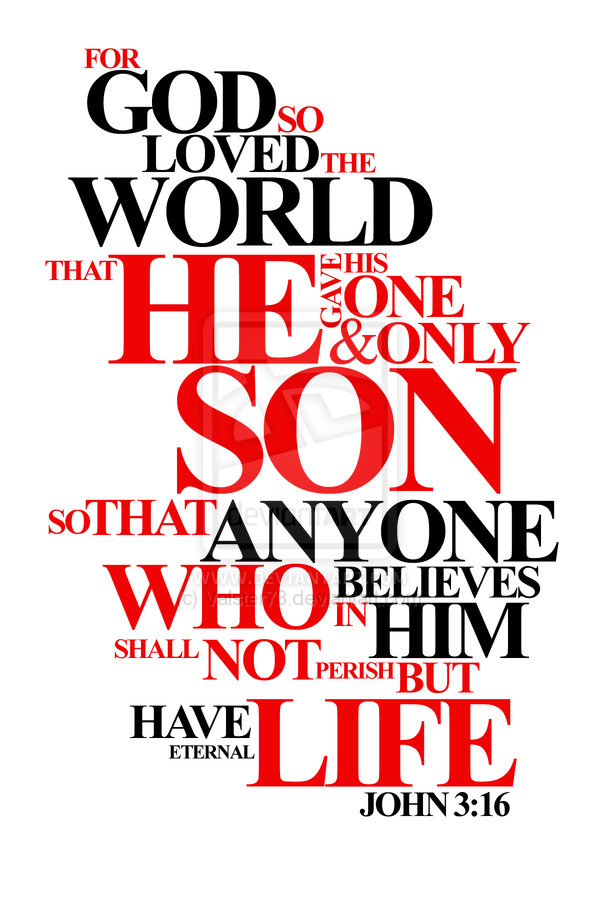
“For God loved the world in this way: He gave His One and Only Son, so that everyone who believes in Him will not perish but have eternal life. For God did not send His Son into the world that He might condemn the world, but that the world might be saved through Him. Anyone who believes in Him is not condemned, but anyone who does not believe is already condemned, because he has not believed in the name of the One and Only Son of God. “This, then, is the judgment: The light has come into the world, and people loved darkness rather than the light because their deeds were evil. For everyone who practices wicked things hates the light and avoids it, so that his deeds may not be exposed. But anyone who lives by the truth comes to the light, so that his works may be shown to be accomplished by God.” ~ The Gospel of John 3:16-21
Do you believe that Jesus Christ is the Son of God, your Savior? Click here to learn more!
Who Is Truth?
Posted: April 20, 2013 in Biblical, catholic, Charismatic, Christian, Church, Evangelical, Liturgical, Orthodox, Pentecostal, Reformed, Renaissance, Repentance, Sacramental, Scriptural, universalTags: accept, belief, child of God, death, disease, faith, Father, forgiveness, God, Holy Spirit, hope, Jesus Christ, love, punishment, reality, receive, redemption, regeneration, repent, repentance, Salvation, save, saved, search, seeking, sickness, sin, Son, Truth, unbelief, wrath

The Truth About Jesus
There is a 2,000 year old truth about Jesus that may still need to be discovered in your life. The Bible informs us that we tragically exchange the truth of God for all kinds of substitutes (Romans 1:25). And yet, marvelously, the truth can win us over. It’s the truth about why Jesus came and why he died.
Jesus’ Bold Claim and How He Proved It
Jesus made a bold claim during his days on earth. He said, “I am the way, and the truth, and the life. No one comes to the Father except through me” (John 14:6, ESV).
Did you get that? Jesus says that you can only know God the father through belief in him. That’s a pretty radical statement! But he backed it up by going to the cross, dying in our place, and rising again on the third day. The Bible says that we should have been punished for breaking God’s law, but he took the punishment in our place. Jesus Christ, God’s Son, came to earth to reveal a marvelous message that our offenses can be forgiven and we may become reconciled to God, and have eternal life.
How You Can Know the Truth
Are you wandering, not sure about truth, lost in your search for identity? Do you know yourself to be guilty of unfaithfulness to God? Do you know you need to be saved from moral compromise? Well then, there’s very good news for you. Jesus appeals to you to come to him, to ask him to forgive you and make you a child of God.
For you see, anyone who receives him has the right to become a child of God (John 1:12). This is the message Jesus taught that Peter and Mary believed. Jesus calls you to know the truth so you can be set free (John 8:32).
How You Can Receive the Truth
If you’d like to know the God of truth, lift up the empty hands of faith and trust Him for your salvation. Come to Him on your knees and pray this prayer:
O Lord, I am lost without You. My life is empty without Your truth and your love. I commit my life to You. I turn away from my sinful behaviors and I turn toward You. Forgive me for all my offenses and give me the power to do good. Reconcile me with Yourself. Look at me only through the work of Jesus, and enable me to live for Him. Thank You that You care for someone like me. Thank You that You welcome me into heaven, because Your love knows no bounds. Help me to grow in grace and guide me in all my ways. In Christ’s name, Amen.
How You Can Continue in the Truth
Now that you have committed your life to the Lord, it is important that you identify yourself to a leader from a Bible-believing church in your area. You have begun an amazing journey. The church is there to ensure that you grow and enjoy the Lord in fellowship, and not alone. The church will help you understand more about all of these things, and will guide you into the life of worship and the celebration of the sacraments.
I can help you. Call 888.492.0285 or Send an email and I will pray with you and/or for you!
God bless you all!
The Four Gospels: Well established by the end of Second Century
Posted: April 9, 2013 in Biblical, catholic, Charismatic, Christian, Church, Evangelical, Liturgical, Orthodox, Pentecostal, Reformed, Renaissance, Repentance, Sacramental, Scriptural, universalTags: Bible, Father, God, Holy Scripture. Gospels, Holy Spirit, Irenaeus, Jesus Christ, John, Luke, Mark, Matthew, Son

When it comes to basic facts about the NT canon that Christians should memorize, one of the most critical is the statement by Irenaeus, bishop of Lyons, around A.D. 180: “It is not possible that the gospels can be either more or fewer than the number they are. For, since there are four zones of the world in which we live and four principle winds… [and] the cherubim, too, were four-faced.”[1]
Here Irenaeus not only affirms the canonicity the four gospels, but is keen to point out that only these four gospels are recognized by the church. Indeed, Irenaeus is so certain that the canon of the gospels is closed that he can argue that it is entrenched in the very structure of creation—four zones of the world, four principle winds, etc.
In an effort to minimize the implications of Irenaeus’ statement, some scholars have suggested that only Irenaeus held this view. He is thus portrayed as lonely, isolated, innovator who is trying to break into new and uncharted territory. This whole idea of a fourfold gospel, we are told, was invented by Irenaeus.
But, does this Irenaeus-as-innovator approach fit the facts? Not really. There are several considerations that raise doubts about it:
1. Irenaeus’ own writings. When Irenaeus talks about the fourfold gospel in his writings, he gives no indication that he is presenting a new idea, or that he is asking the reader to consider a new concept. On the contrary, he speaks in a manner that assumes the reader knows and follows these same gospels. He speaks of them naturally and unapologetically. In short, Irenaeus does not write like a person advocating the scriptural status of these books for the first time.
2. Irenaeus’ contemporaries. The idea that Irenaeus was alone runs into a serious challenge, namely that there were other writers at the end of the second century that affirmed these same four gospels as exclusive. The Muratorian fragment, Clement of Alexandria, and Theophilus of Antioch are examples. Apparently, Irenaeus was not the only one under the impression that the church had four gospels.
In addition, one should consider Tatian’s Diatesseron—a harmony of the four gospels written c.170. The Diatesseron not only tells us that these four gospels were known and used, but it tells us that they were seen as authoritative enough to warrant harmonization. After all, why would one bother harmonizing books that were not authoritative? If they weren’t authoritative, then it wouldn’t matter if they contradicted each other.
3. Irenaeus’ Predecessors. Although the evidence prior to Irenaeus is less clear, we can still see a commitment to the fourfold gospel. For instance, Justin Martyr, writing c.150, refers to plural “gospels”[2] and at one point provides an indication of how many he has in mind when he describes these gospels as “drawn up by His apostles and those who followed them.”[3] Since such language indicates (at least) two gospels written by apostles, and (at least) two written by apostolic companions, it is most naturally understood as reference to our four canonical gospels.[4]
This is confirmed by the fact that Justin cites from all three Synoptic Gospels,[5] and even seems to cite the gospel of John directly, “For Christ also said, ‘Except ye be born again, ye shall not enter into the kingdom of heaven’” (cf. John 3:3).[6] The fact that Justin was the mentor for Tatian (who produced a harmony of the four gospels) provides yet another reason to think that he had a fourfold gospel.
In the end, there are ample reasons to reject the idea that Irenaeus was the inventor of the fourfold gospel canon. Not only did his contemporaries have this same view, but this view was even shared by those before him. Thus, we must consider the possibility that Irenaeus was actually telling the truth when he says that the fourfold gospel was something that was “handed down”[7] to him.
——————————————————————————–
[1] Haer. 3.11.8.
[2] 1 Apol. 66.3.
[3] Dial. 103.
[4] G. Stanton, “The Fourfold Gospel,” NTS 43 (1997): 317–346.
[5] E.g., Dial 100.1; 103.8; 106.3-4. Koester, Ancient Christian Gospels, 38, declares that the citations in Justin “derive from written gospels, usually from Matthew and Luke, in one instance from Mark.”
[6] 1 Apol. 61.4.
[7] Haer 3.1.1.
by Michael Kruger
Not Everything Called Christianity, Is Christianity
Posted: March 14, 2013 in Biblical, catholic, Charismatic, Christian, Church, Evangelical, Liturgical, Orthodox, Pentecostal, Reformed, Renaissance, Repentance, Sacramental, Scriptural, universalTags: Christian, Christianity, dogma, error, evangelical, false teaching, falsehood, Father, God, heresy, Holy Spirit, Jesus Christ, spiritual, Truth

“The habit of calling ‘Evangelical’ everything which was from time to time characteristic of that church or which any strong party in that church wished to make characteristic of it—has ended in robbing the term of all meaning.
Along a somewhat different pathway we have arrived at the same state of affairs in America. Does anybody in the world know what ‘Evangelical’ means, in our current religious speech?
The other day, a professedly evangelical pastor, serving a church which is certainly committed by its formularies to an evangelical confession, having occasion to report in one of our newspapers on a religious meeting composed practically entirely of Unitarians and Jews, remarked with enthusiasm upon the deeply evangelical character of its spirit and utterances.
But we need not stop with ‘Evangelical.’ Take an even greater word. Does the word ‘Christianity’ any longer bear a definite meaning? Men are debating on all sides of us what Christianity really is…
We hear of Christianity without dogma, Christianity without miracle, Christianity without Christ. Since, however, Christianity is a historical religion, an undogmatic Christianity would be an absurdity; since it is through and through a supernatural religion, a non-miraculous Christianity would be a contradiction; since it is Christianity, a Christ-less Christianity would be—well, let us say’ lamely (but with a lameness which has perhaps its own emphasis), a misnomer.
People set upon calling unchristian things Christian are simply washing all meaning out of the name. If everything that is called Christianity in these days is Christianity, then there is no such thing as Christianity. A name applied indiscriminately to everything, designates nothing.”
~ Benjamin Breckinridge (B. B.) Warfield (1851-1921)
taken from: The Princeton Theological Review, Volume 14, pg. 199.
St. Patrick’s Breastplate
Posted: March 13, 2013 in Biblical, catholic, Charismatic, Christian, Church, Evangelical, Liturgical, Orthodox, Pentecostal, Reformed, Renaissance, Repentance, Sacramental, Scriptural, universalTags: bind, direct, God, guard, guide, Holy Spirit, Jesus Christ, lead, Lord, one, Savior, shield, St. Patrick, Trinity, Truth, Word

I bind unto myself today
The strong Name of the Trinity,
By invocation of the same,
The Three in One and One in Three.
I bind this day to me forever.
By power of faith, Christ’s incarnation;
His baptism in the Jordan river;
His death on Cross for my salvation;
His bursting from the spiced tomb;
His riding up the heavenly way;
His coming at the day of doom;
I bind unto myself today.
I bind unto myself the power
Of the great love of the cherubim;
The sweet ‘well done’ in judgment hour,
The service of the seraphim,
Confessors’ faith, Apostles’ word,
The Patriarchs’ prayers, the Prophets’ scrolls,
All good deeds done unto the Lord,
And purity of virgin souls.
I bind unto myself today
The virtues of the starlit heaven,
The glorious sun’s life-giving ray,
The whiteness of the moon at even,
The flashing of the lightning free,
The whirling wind’s tempestuous shocks,
The stable earth, the deep salt sea,
Around the old eternal rocks.
I bind unto myself today
The power of God to hold and lead,
His eye to watch, His might to stay,
His ear to hearken to my need.
The wisdom of my God to teach,
His hand to guide, His shield to ward,
The word of God to give me speech,
His heavenly host to be my guard.
Against the demon snares of sin,
The vice that gives temptation force,
The natural lusts that war within,
The hostile men that mar my course;
Or few or many, far or nigh,
In every place and in all hours,
Against their fierce hostility,
I bind to me these holy powers.
Against all Satan’s spells and wiles,
Against false words of heresy,
Against the knowledge that defiles,
Against the heart’s idolatry,
Against the wizard’s evil craft,
Against the death wound and the burning,
The choking wave and the poisoned shaft,
Protect me, Christ, till Thy returning.
Christ be with me, Christ within me,
Christ behind me, Christ before me,
Christ beside me, Christ to win me,
Christ to comfort and restore me.
Christ beneath me, Christ above me,
Christ in quiet, Christ in danger,
Christ in hearts of all that love me,
Christ in mouth of friend and stranger.
I bind unto myself the Name,
The strong Name of the Trinity;
By invocation of the same.
The Three in One, and One in Three,
Of Whom all nature hath creation,
Eternal Father, Spirit, Word:
Praise to the Lord of my salvation,
Salvation is of Christ the Lord.
Observations on Law and Grace…
Posted: March 11, 2013 in Biblical, catholic, Charismatic, Christian, Church, Evangelical, Liturgical, Orthodox, Pentecostal, Reformed, Renaissance, Repentance, Sacramental, Scriptural, universalTags: death, faith, fear, forgiveness, God, Grace, Jesus Christ, Law, life, regeneration, Savior, sickness, sin, sinner, trust, wrath

Some recent observations about Law & Grace…
If we attend Christian instruction/Catechism before we are born again, what happens then is we are trained on the treadmill of merit (Law). Our orientation is backwards. Law comes before Grace. The same thing can happen when you become a Christian and are not instructed in the Christian faith — you end up on the treadmill running away from the fear of not “performing” up to what you think are God’s standards. The Law was given as a teacher – “this is how your relationship with God must be; this is how your relationship to others should be.” It teaches us that we are sinners, and there is no way that we can “keep” this Law on our own. Grace says, Here is God’s mercy. Here is God’s love for you, in that while you were yet sinners, My beloved Son died in your place, Jesus paid the price for your redemption from sin, sickness and death. He took upon Himself God’s wrath – our punishment was upon Him.
It is by means of God’s mercy do we perceive that the Law says I’m a sinner, and then in God’s mercy His Grace touches our hearts, He delivers us through “the bath of regeneration and renewal of the Holy Spirit. (Titus 3:5)
“The one trusting in the Son has eternal life; but the one resisting the Son shall not see the life, but the anger of God remains upon him.” ~ John 3:36
Therefore, it is “…by grace you are saved, through faith, and this not of yourselves; it is the gift of God; not of works, that not anyone should boast; for we are His workmanship, created in Christ Jesus unto good works, which God before prepared that we should walk in them.” (Ephesians 2:8-10)
Now, we live the Law, because God has written it upon our hearts, and being empowered by the Holy Spirit, we are enabled to observe our relationship to God and others as the Law requires. We are made free from vain effort, but none the less do we put forth effort, because God is behind us encouraging us in our abundant life. And, if we fail, if we sin, God is faithful to forgive us, because He promised that to us in Christ. At the same time, God is righteous and holy. Therefore, He promised, because of the shed blood of Christ on Calvary to cleanse us from all our unrighteousness. This is conditional though, because we are told to confess our sin, and turn from it back toward God.
“If we should say that we do not have sin, we mislead ourselves, and the truth is not in us. If we should acknowledge our sins, He is trustworthy and just that He should have forgiven us the sins and should have cleansed us from all iniquity.” ~ 1 John 1:8-9
Jesus Christ is our salvation, our redemption, our righteousness, our sanctification, and our glorification. He is our ALL in ALL. The life I live, is Christ Jesus my Lord.
The Story
Posted: March 2, 2013 in Biblical, catholic, Charismatic, Christian, Church, Evangelical, Liturgical, Orthodox, Pentecostal, Reformed, Renaissance, Repentance, Sacramental, Scriptural, The Story, universalTags: birth, death, Father, forgiveness, God, Holy Spirit, Jesus Christ, redemption, remission, repent, repentance, Resurrection, Salvation, Savior, sin, trespasses

What If I’m Wrong?
Posted: February 26, 2013 in Biblical, catholic, Charismatic, Christian, Church, Evangelical, Liturgical, Orthodox, Pentecostal, Reformed, Renaissance, Repentance, Sacramental, Scriptural, universalTags: agnosticism, atheism, death, destiny, disease, doubt, existence, faith, God, hope, Jesus, love, reality, Salvation, sickness, sin, Truth
For those who question the existence of God, or scoff at Christianity, or faith in God.
Run For Your Life!
Posted: February 25, 2013 in Biblical, catholic, Charismatic, Christian, Church, Evangelical, Liturgical, Orthodox, Pentecostal, Reformed, Renaissance, Repentance, Sacramental, Scriptural, universalTags: death, demons, evil ones, false prophets, false teachers, Father, God, God's Word, Holy Spirit, Run for your life, sickness, sin, Son, table, Truth
“Behold, you trust for yourself on lying words without being of use. Will you steal, murder, and commit adultery, and swear falsely, and burn incense to Baal, and walk after other gods whom you do not know? And will you then come and stand before Me in this house on which My name is called, and say, We are delivered in order to do all those detestable things. Has this house on which My name is called become a den of violent ones in your eyes? Behold, even I have seen, declares Jehovah.” ~ Jeremiah 7:8-11
 In The Hands of the Refiner