Posts Tagged ‘God’

pastoralcare

“And I will give you pastors according to mine heart, which shall feed you with knowledge and understanding.”
Jeremiah 3:15 (KJV)

From this it is evident that there are five main tasks required in the pastoral office and true care of souls:

First: to lead to Christ our Lord and into His communion those who are still estranged from Him, whether through carnal excess or false worship.

Secondly: to restore those who had once been brought to Christ and into His church but have been drawn away again through the affairs of the flesh or false doctrine.

Thirdly: to assist in the true reformation of those who while remaining in the church of Christ have grievously fallen and sinned.

Fourthly: to re-establish in true Christian strength and health those who, while persevering in the fellowship of Christ and not doing anything particularly or grossly wrong, have become somewhat feeble and sick in the Christian life.

Fifthly: to protect from all offense and falling away and continually encourage in all good things those who stay within the flock and in Christ’s sheep-pen without grievously sinning or becoming weak and sick in their Christian walk.

~ from Concerning the True Care of Souls by Martin Bucer (1538) (p. 70)

{May this ever be my prayer, oh Lord my God}

*Note: Caring elders/pastors must seek the lost, bring back the wandering, restore the fallen, strengthen the weak, and encourage the strong. The Gospel brings salvation, healing, and deliverance.

mtdThere is talk in some church circles about “moralistic therapeutic deism.” We may abbreviate this ungainly phrase as “MTD,” in allusion to the popular cable channel showing music videos. Many teenagers and young adults are familiar with MTV; however, few would recognize “moralistic therapeutic deism” as playing any role in their lives.

Yet the contention we hear is that MTD, rather than classic Christianity, is the predominant religion among today’s teenagers and young adults. They may not recognize the phrase, but it describes the belief system that they actually profess and practice. And what’s more: We, the parents and other adults around them, are the ones who taught them MTD. This is a serious charge and deserves serious consideration.

An Inarticulate Faith

The phrase “moralistic therapeutic deism,” you will not be surprised to learn, was coined by an academic: Notre Dame sociologist Christian Smith. It has been disseminated more widely by Smith’s associates, including Princeton Seminary professor Kenda Creasy Dean. Based on her research with Smith, Dean published a book, Almost Christian: What the Faith of Our Teenagers is Telling the American Church. Dean has become a popular speaker at church events. She delivered a challenging presentation at my local church on a snowy Saturday in February, and I was among the large crowd that came out to hear her.

Smith, Dean, and their colleagues did surveys and in-depth interviews in which they queried thousands of young people about their religious beliefs and practices. Very few, they found, were atheists or hostile toward religion. On the other hand, relatively few were able to articulate and consistently practice a faith that resembled classic Christianity.

The vast majority of the respondents found it difficult to articulate any kind of belief system. They mentioned God, but it was a vague and distant God. They didn’t have much to say about Jesus.

What the respondents did seem to believe, as Smith summarized it, was: God functions as an authority who gives us rules to guide our behavior (this is the “moralistic” part). The main point of these rules is to be a nice person who gets along with other people. If we obey the rules, God makes us feel good about ourselves (this is the “therapeutic” part). But God isn’t involved in a personal or direct way in our daily lives (this is the “deism” part). He may show up in a crisis, to make us feel better about ourselves.

Almost Christian

This set of half-conscious assumptions is what Smith, Dean, and associates call “moralistic therapeutic deism.” It’s not necessarily false. We should seek good relations with the people around us. If we obey God’s commands, we will usually end up happier. God is a refuge in times of trouble.

Yet the Good News of Jesus Christ is so much greater than any of this. Dean, in her talk, showed a side-by-side comparison of MTD and the Apostles’ Creed. The differences were stark. MTD is all about myself and my happiness. The Apostles’ Creed is about the Truine God–Father, Son, and Holy Spirit–and God’s amazing works from the Creation to the Incarnation to the hope of life eternal.

So how did these teenagers and young adults come to settle for so much less than the Gospel? It wasn’t by rebelling against their parents’ religion. On the contrary, survey respondents by and large felt positively toward their parents and shared common values. Many of them reported that their parents had taken them regularly to church and youth group, and they had few complaints about the experience. It’s just that they didn’t emerge with a distinct Christian faith that they could articulate and practice.

Is This What We Teach Our Children?

Dean suggests a disturbing explanation: Perhaps these teenagers and young adults adopted MTD because that’s what they were taught. That’s basically the philosophy of life they have received from and observed in their parents. It’s what they learned in Sunday school and youth group: Be nice to other people and you’ll have a happy life, and God will be there when you need him. All that stuff about Jesus dying for our sins never really made an impression.

Dean’s presentation provoked some self-examination in me and others at my church: Is MTD what we are teaching our kids? When my wife and I lead Children’s Church, is the message the children are hearing the Gospel of God’s great mercy in Jesus Christ? Or is it something less? Are we preparing them to be nice people or disciples of Jesus Christ?

I must admit that some of the Sunday school curriculum we have used has been very moralistic and therapeutic. We read Bible stories, but the takeaway at the end of the lesson often seems to be that everyone is special to God and kids should be kind to their classmates. There isn’t much said about our being sinners to whom God sent a Savior. I have seen this failing not only in old line Protestant curricula, but also in curricula from publishers that have an evangelical reputation.

How would your congregation fare under this kind of self-examination? Maybe you intend to communicate the Gospel–as my wife and I do–but are you sure that’s what the children are hearing? It’s a question worth asking. The consequences go far into the future–indeed, into eternity.

Taken from “Theology Matters” http://www.theologymatters.com/

Written by: Alan F.H. Wisdom

ted-logo

Talking about TED

As the Communication in Ministry course glides midway in its third week, I remember the theme is, “what role do you believe story plays in ministry communication and how might you build stories into your ministry’s communication strategy?” The emphasis is storytelling.

The chapter we are reading in our text, Outspoken, by Shraeder & Hendricks, pp. 90-115 is entitled “Words and Stories.”

Everyone has a story. There is a story about just about everything. There are stories about food, drinks, cars, trucks, and M&M’s. I’m on the path toward a degree in Christian Ministry, and there is a story behind that, but I’m not going to tell it right now. Teased yet?

I get emails from a source called churchjobs.tv and at the bottom of the email there are some links to different resources. One of the links was to an article about TED. A gentleman named Todd Rhoades wrote an article asking the question, “What if our sermons were like TED talks?” Here’s the link: http://toddrhoades.com/what-if-your-sermon-was-like-a-ted-talk

Todd got the idea to blog out this question from another gentleman by the name of Eric Dye. Here’s his link:  http://bit.ly/1D7GKX0  “If Sermons were like TED talks”

Have you ever watched a TED talk on YouTube? I have. I have watched several, and honestly they were all very interesting.

What is TED? TED is a nonprofit devoted to spreading ideas, usually in the form of short, powerful talks (18 minutes or less). TED began in 1984 as a conference where Technology, Entertainment and Design converged, and today covers almost all topics — from science to business to global issues — in more than 100 languages. Meanwhile, independently run TEDx events help share ideas in communities around the world. http://www.ted.com/

TED is a platform for ideas worth spreading. TED today shares ideas from a broad spectrum. Meanwhile, independent TEDx events help share ideas in communities around the world. http://www.ted.com/about/our-organization

Think about the rules of a TED talk:

  1. No talk can exceed 18 minutes in length.
  2. Speakers must tell a story or argue for an idea. They may not use the TED stage to sell products, promote themselves or businesses. Every talk’s content must be original and give credit where appropriate. Speakers cannot plagiarize or impersonate other persons, living or dead.
  3. Speakers must be able to confirm the claims presented in every talk.

What about this? Can we truly expound the Word of God in 18 minutes? I know there are many ways to preach or proclaim the Word of God, by topic, by subject, by Bible book, etc. Can you say everything about a passage of Scripture in 18 minutes? You may well be able to tell a story in 18 minutes, however, would we truly be feeding our flock on a diet of short bread? Should we feed growing disciples of Christ only the milk of the Word? What about the solid food of the Word? Check out what St. Paul has to say about it, “For though by this time you ought to be teachers, you need someone to teach you again the basic elements of the oracles of God. You need milk, not solid food; for everyone who lives on milk, being still an infant, is unskilled in the word of righteousness. But solid food is for the mature, for those whose faculties have been trained by practice to distinguish good from evil.” Hebrews 5:12-14 (NRSV)

Ok, don’t get me wrong, I believe in short stories. There are a lot of great short stories in literature. Maybe it would be good every now and then to give a short story, or short sermon, or a short message to get our point across. Maybe our message could best be told condensed or in a more concise manner?

Matthew 28:11-15 tells a short story of how the Roman soldiers were given money to keep their mouths shut about the resurrection of Jesus Christ. However, the short story had an ending that said, “So they took the money and did as they were directed. And this story is still told among the Jews to this day.” Matthew 28:15 (NRSV) The short story ended up being a story that is now told through the Scriptures, and we live in 2015 AD. Matthew was written at least in 60 AD. So, a short story can have lasting effects. Does this still give credence to an 18 minute sermon, homily, message, or word from the Lord? Well, I must admit it, yes. How could it be accomplished? I think the 18 minute sermon would have to be a story.

What about the Gospel story? Here is an example of short story. The Gospel in a little more than four (4) minutes:

Elijah

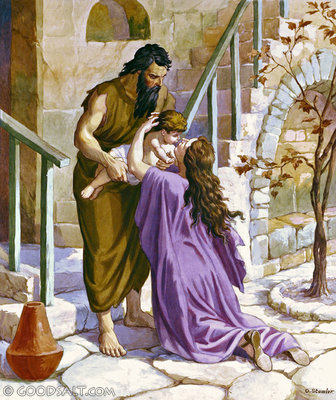
The Miracles of Zarephath

God sent Elijah to Zarephath, a small town outside Sidon, on the Phoenician coast, which is now the Mediterranean Sea. Prior to this journey, Elijah was miraculously fed by a raven, and drank from the Brook Cherith, which streamed down the east side of the mountains and flowed into the Jordan River. When the brook dried up, God told Elijah to move. He moved to hide from King Ahab, because Elijah prophesied, “As the LORD, the God of Israel, lives, before whom I stand, there shall be neither dew nor rain these years, except by my word.”

Therefore, God tells Elijah, “Arise, go to Zarephath, which belongs to Sidon, and dwell there. Behold, I have commanded a widow there to feed you.”

King Ahab had been eagerly seeking to apprehend Elijah in order to find some way to convince him to end the drought. However, it is not God’s will for that to occur, and what happens next in Zarephath turns out to be very miraculous itself.

It was apparently very hot and dry, even on the coastline; I am sure these people knew of some humidity during their lifetime living in a coastal town. It sure was dry enough to gather sticks for a fire, her last fire she thought, as she mused as to how she would use the last little bit of flour left in the jar. She had all but given up, and as the good mother, she was, and also a father to her son since her husband died; she would prepare their last meal, and wait to starve to death.

Oh, how many times have we come to the point in our lives where it just seemed so dry and lifeless? As Christians, we are bearing no fruit in our lives worth mentioning. We seem to be just gathering kindling for our last fire, thinking up ways to make it happen one last time, one last fire, one last reason to be a witness for Christ! We become sullen, looking down at the ground, crunching underneath our feet; they burn to remind us of the fire that once was aflame in our hearts for God!

She stands at the gate of the city. Why did she wander out? Were there no trees left in the city? Had everyone cut down the trees for firewood? Now, this widow has to go outside her city to find sticks, not a log or two, but just sticks, the remnant of what used to be flourishing. Why is it important to look at this widow gathering sticks at the gate? The Kingdom of God has a gate, and the Bible tells us that the only entrance into the Kingdom of God, or as St. Augustine said in his book, The City of God, is through Jesus Christ. If you are a Christian, you are part of the Kingdom of God, the Rule, and Reign of God through Jesus Christ, Who is King of Kings and Lord of Lords. However, if you are not a Christian, or maybe even doubt that you are, you stand outside the gate. The city is behind you. Maybe, in your Christian life past, you flourished in your faith; you bore the fruit of righteousness. You may have walked through the gate into the city, but since you were a widow, without a husband, you have been outcast, alone, with no one to identify with, no one to care for you. Sometimes, I am sure we can feel widowed because we feel our faith died. The Bible says we can taste of the heavenly gift, we can see the Holy Spirit working in the lives of others. We can even be witnesses to the miraculous and still never experience faith for ourselves. I can confidently tell you, that even if you were baptized as an infant, you may not be saved. Do you stand outside the gate of the city? Do you stand outside the Kingdom of God?

The Bible tells us that God has already spoken to this widow woman to help Elijah. That adds a new twist to our story this morning. This place, this city, on the Phoenician coast, away from Israel, is a place where God is not worshiped. It is a pagan land, a land of idolatry. Yet, God spoke to her, commanding her to help the prophet. Therefore, Elijah sees this widow woman; I believe he knew her to be the one God told him about. Elijah asks her for some water. Remember, there is a massive drought going on in the land. Perhaps there was a well where fresh water was retrieved. As the widow woman goes for the water, he yells at her something like, “Oh, and by the way, bring me morsel of bread, I’m hungry!”

Brothers and sisters, have you ever had God tell you to bring him a morsel? Morsel is an interesting word the author of First Kings uses to describe what Elijah is requesting. Morsel – a crumb, as if it is rubbed off an actual piece of bread. Maybe a mouthful and that is a relative statement because I know some people that can put a bunch of bread in their mouths! So let us just stay with what it really means, a crumb, a little piece of bread. What was it that God asked you to do? Was it something very minute? Was it something so small, yet so demanding of you that you would say, “I have nothing baked, only a handful of flour in a jar and a little oil in a jug. And now I am gathering a couple of sticks that I may go in and prepare it for myself and my son that we may eat it and die.” The point here is that God does not command us to do something that He cannot provide us with the means or the ability to do it. She had already had her mind made up, that God could not use her anymore because she just does not have what it takes. There is only a handful of faith, or she can barely sense the anointing of the Holy Spirit in her life. She is just trying to find enough kindling to keep those fires burning in her heart – but she is ready to die because of the despair she has fallen into. She feels there is no hope. God, how can you call upon me to help others when I just do not have the ingredients anymore?

Then Elijah tests her obedience saying, “Do not fear; go and do as you have said. First, make me a little cake of it and bring it to me, and afterward make something for yourself and your son. For thus says the LORD, the God of Israel, ‘The jar of flour shall not be spent, and the jug of oil shall not be empty, until the day that the LORD sends rain upon the earth.”

First, when God calls you to Himself, He says fear not! When God calls you to do something for Him, He says fear not! Why? Do not be afraid! Do not despair! God is in control! Brothers and sisters, God is there when the crops do not grow! God is there when a pestilence destroys your crops! God is there when the rain does not come. God is there when the ground dries up. God is there when the flood waters rage. God is there when your husband or wife dies! God is there when you lose a loved one! God is there when your tractor breaks down! What did Elijah tell the widow woman? Fear not. Go, make me a little piece of bread, and bring it to me with what you have already in your jar of flour and oil. Do you remember the parable of the mustard seed that Jesus taught? How such a very small seed was able to grow in a huge tree that looks like a gigantic bush? God tells us even the smallest amount of faith can get us through. We must learn to trust in Jesus, we must learn to trust in God with the little bit of flour and oil in our jar.

But wait, there is more! God just did not leave the poor widow woman with nothing after she makes Elijah something to eat. Elijah tells her that God says her flour will not be spent! God says that her jug of oil shall not be empty!

Brothers and sisters, God is not done with you yet! God is telling you that your flour jar is not empty. The bread of life is Jesus Christ and you should feast on Him. Get your nourishment from Jesus Christ. He is the Bread that gives life. His life is the light of men. He is your portion and your provision. You still have something to give! God is telling you this morning with what is still within you, you have what can feed multitudes.

Brothers and sisters, God says your jug of oil shall not be empty. In the Bible, oil is used to describe the substance used to anoint someone, or pour over someone who is being consecrated for a specific office or task. Oil in both the Old and New Testament represents the Holy Spirit. If you are a Christian, the blessed Holy Trinity of God dwells within you in the Person of the Holy Spirit! What joy! What solace! What a relief! God is within us, not just with us! His anointing teaches us all things, gives us wisdom, gives us power, love, and a sound mind. The oil of God gives us strength to resist temptation. The anointing of God sanctifies us by His Truth; His Word is Truth, hallelujah! Your jug of oil shall not be empty! It will remain full until you each go home to be with the Lord or He comes back in glory! Either way, His Holy Spirit has taken up residence within you; He has regenerated you, declared you righteous in God’s eyes, sets you apart as holy unto the Lord, and gives you His gifts, and enables you to bear fruit unto Christ-likeness. You do not have to be a barren tree! You can bear the fruit of a holy and righteous life. Jesus said, “I will not leave you as orphans! I will not leave you fatherless, comfortless, parentless, and bereaved, I am coming to you!” Jesus also assures us by saying, “But the Advocate, the Holy Spirit, whom the Father will send in My name, will teach you everything, and remind you of all that I have said to you. Peace I leave with you; My peace I give to you. I do not give to you as the world gives. Do not let your hearts be troubled, and do not let them be afraid.” Fear not, for the Holy Spirit is your oil of gladness!

Dear friends, as the Holy Scriptures attest, God accomplished what He said He would do. Elijah, the widow woman and her children ate for many days. In verse 16 it says, “The jar of meal was not emptied, neither did the jug of oil fail, according to the word of the LORD that he spoke by Elijah.” God is not like a human being, who will lie, cheat, steal, and not keep the promises they make. No, God is God, Who cannot lie, and He cannot contradict Himself, nor go back on His Word, because His Word is Truth, for He is Holy, Just, and Righteous.

Consequently, there comes a time as we go through our Christian lives, our flour jar full to overflowing, and our jug of oil never fails, then something catastrophic or tragic happens. We get the diagnosis, or the telephone call, or the report of an accident. What happens then? What happens when we, full of faith and hope for the days ahead hear the news of the sudden death of a loved one?

For this widow woman, one of her children, a son, comes down so sick that he dies. The first thing that we do is tell God, “What have I done to deserve this?” Why is it that we come to the immediate conclusion that God has something against us when tragedy strikes? On the other hand, like when our home is hit by a tornado.  Do we realize that we hold on to our loved ones? Do we realize that we hold on to our homes, our tractors, our pickup trucks, our snowmobiles, our sports cars? Do we realize that we idolize things in our lives, or maybe we even idolize experiences in our lives? Elijah says to the widow woman, “Give me your son.” We must give all that we are, all that we possess, all who we love, to God. God has given us many great gifts, some of which you are sitting next to right now. Nevertheless, we must surrender them to God. We must put God above all of them. We must put God on the throne of our lives. He is Lord. Jesus is Lord. God is King. We serve in His Kingdom. God is on the throne of His Kingdom. We must love God so much, that it would seem that we would hate these things or father, mother, sister, brother, wife, husband, and child. God says, “Give Me all of you – so I can give you all of Me that you can contain.” The Bible does not say much of the widow woman’s faith or trust in God through the words of Elijah. However, she did trust in God, but blamed Elijah for some reason.

What does God say when this happens? Sometimes He will test us and try us as the Refiner of gold and silver. Seeking to view Himself in us, He heats up the gold or silver to a temperature that separates the dross, the dirt, the sin, that has mingled with the new creation in Christ Jesus that we are. Once the dross has reached the surface, God skims it off, gently, to not push down, or mingle again the dross with the pure gold or silver. When the process is finished, the Refiner can see His own image in the gold or silver. The Bible tells us that we will be transformed into the image and likeness of God’s Son, Jesus Christ, by the renewing of our minds in the power of the Holy Spirit.

God hears the cry of the widow woman, her heart saddened that her son, probably because of malnutrition has succumbed to a disease that took his life. We say to ourselves in cases like this, “if only I did thus, and so.” If only. If only. Nevertheless, God says, wait, there is more!

Elijah took the child into his arms and took him up to his room. The number three has significance in the Bible. The Trinity is one example for God, the Three in One, and the One in Three. Then Elijah, it says in verse 21, “stretched himself upon the child three times.” The Hebrew word for stretched is “madad” which means to stretch or to measure. The Greek text for 1 Kings 17, to me, gives us a bit more insight into what Elijah did. The Greek word is emphusaō, and this is a word that means to puff, blow on, or breathe on. I believe that Elijah breathed on or breathed into the child three times and he was resuscitated. Sounds like Elijah gave the child artificial respiration. I do not think that was the case though, for man did not know of this life saving technique at this time in history. What this scene does represent is Elijah, the prophet, representing God breathing life back into the child. That is just what happened. The Bible says in verse 22 that “the soul of the child came into him again.”

God can infuse life back into us again, when we think there is no life left in us. God can breathe newness into our lives when we believe that we have grown stale. God tells us this, even when we go through very hard times, with words that mean, “see, your son lives.” The son can represent an area of your life that you consider dead or dying. It could be a sinful behavior that you cannot seem to shake. On the other hand, it could be you are ill, and you are having a hard time reconciling your condition. In any situation, God comes to us, He carries us through, or He delivers us from it, all based upon His sovereign will. God can prove to you that His Word is Truth. God sent His Son Jesus Christ to provide for the redemption of our souls. Jesus Christ paid the ultimate price to redeem us from bondage to sin and death. Jesus Christ was the atonement for our sins, once and for all.

God can infuse His life into you today. The Bible says that anyone who calls upon the Name of the Lord will be saved. Have you entrusted your life to God? Do you truly believe that Jesus Christ is the Son of God, the Word of God, our Savior, and Lord, that God has raised Him from the dead, and that He now is at the right hand of the Father in heaven? Believe on the Lord Jesus Christ, and you shall be saved. Can it be any more plain? Can you say like the widow woman, “Now I know that you are the Son of God Who has taken away the sins of the world.”

Brothers and sisters in Christ, receive what the Word of God is giving you today. Charles H. Spurgeon once wrote, “The word of God will repay searching. God does not bid us to sift a mountain of chaff and only find one grain of wheat in it, but the Bible is winnowed corn – we have but to open the granary door and there it is. Scripture grows upon the student. It is full of surprises. Under the teaching of the Holy Spirit, to the searching eye it glows with splendor of revelation, as if a vast temple paved with wrought gold, and roofed with rubies, emeralds, and all manner of gems. There are no goods like the merchandise of Scripture truth.” Lastly, the Scriptures reveal Jesus: “They are they which testify of me.” No more powerful motive can be urged upon you than this: he who finds Jesus finds life, heaven, all things. Happy is he who, searching his Bible, discovers his Savior.

In the Name of the Father, and of the Son, and of the Holy Spirit. Amen.

Strategies

Communication Strategies in Ministry

I graduated from Crown College with a BS degree in Christian Ministry.  I have learned the essential skills necessary for the communication of the Gospel and biblical truths through a variety of available mediums (this one included). I am studying current mediums for communication, using the basic principles of exegesis and hermeneutics, strategies for effective communication, and preaching. I hope to be further equipped to formulate an effective communication philosophy and strategy for ministry.

Finding a mentor, to me, was like looking for the holy grail. I know what I was looking for, but the search was not uncovering my mentor. You see, I live 70 miles from the church I attend. My wife and I minister there. She plays piano for worship sometimes, teaches children’s church, and I have supplied the pulpit several times. Our pastor left to take another church, so I could not use him as my mentor resource. I visited several churches in the town where I live. I got to know two of the pastors and haven’t really been in communication with them for a while. I was afraid to ask them for their help. Who likes rejection? I did not even consider dropping this course on account of this hunt for my holy mentor. I prayed and agonized about what to do. So, I am sitting here in my office, and the Lord prompted me to send an email to both of the pastors. What have I got to lose? My grade, my GPA, all my effort! Thanks be to God! He does provide and He does supply all our needs. I found a holy mentor! We had our meeting, and he signed the agreement! So, onward, and upward. Whew.

I believe, like Luther and Calvin, that my salvation is totally monergistic. All God, and none of me! However, when I became a Christian, born again, regenerated, transformed by the Holy Spirit, my interaction with God became synergistic. God tells me what to do, and I am supposed to do it! However, even if that is the case, God’s Word tells me that “it is God who is at work in you, enabling you both to will and to work for His good pleasure.” Philippians 2:13 (NRSV) Even though my relationship with God is interactive, He still helps me. He doesn’t leave me without what I need to live in union and communion with Him. He enables me, He enables my will, and He enables my effort. Why? All for His good pleasure. Our wills and our actions are the very arenas where God’s own power is working. His grace still amazes me.

How does this relate to communication strategies? Well, did you get a picture while reading this story? Did you see me as one of Monty Python’s characters riding a stick pony along the wooded landscape? Did you picture me going along hill and dale until I finally came upon that glorious email sent from above saying, “sure I’d be glad to sit down and talk with you about this?” If you did, that’s awesome. If you didn’t, was my communication strategy working? Did you get another picture in your mind while reading this? Either way, the point is that there are many means to communicate – and this blog is one of the means that I use to present the Gospel to a lost and dying world. It works for me.

Application? Always trust in the Lord. Always trust Him for anything and everything. Jesus said that if we ask anything according to God’s will, our prayers will be answered. God will provide the means to accomplish the task He has assigned to you. That says a lot about the content of our prayer…. but hey, that’s another sermon!

For I am not ashamed of the gospel, for it is the power of God for salvation to everyone who believes, to the Jew first and also to the Greek. Romans 1:16 (ESV)

The Story (Symphony Ministries).

Psalm111

Psalm 111 Observations:

Verse 1:
1. Glory and honor are due unto God
2. Not just ordinary praise, but high praise given to God
3. This high praise comes from all of our being
4. Those who have been made righteous give this praise
5. God’s work in creation, providence, & redemption is exceptional

Verses 2-4:
6. God’s workings are so marvelous they cannot be forgotten
7. Those who love God delight in and seek out His wondrous works
8. The nature and character of God is justice and holiness
9. Memorials: eternal covenant, Law, Passover (Pascha), the Lord’s Supper, Baptism
10. God has tender mercy and is actively compassionate toward us

Verse 5:
11. The Psalmist reminds the people of God’s goodness
12. The God of peace, Who through the blood of the eternal covenant

Verse 6:
13. God’s powerful working is seen in the regeneration of our souls

Verses 7-8
14. God has always had a purpose and design for His works

Verse 9:
15. There is a transition from…
15. The Psalmist declaring the mighty works that Jehovah has done for His people
16. To Mt. Sinai and the commandments that He has given to them
17. “For the entire law is fulfilled in keeping this one command: “Love your neighbor as yourself.”(Galatians 5:14)
18. “Jesus replied: “‘Love the Lord your God with all your heart and with all your soul and with all your mind.’ This is the first and greatest commandment. And the second is like it: ‘Love your neighbor as yourself.’ All the Law and the Prophets hang on these two commandments.” (Matthew 22:37-40)
19. “but he became a priest with an oath when God said to Him: “The Lord has sworn and will not change His mind: ‘You are a priest forever.'” Because of this oath, Jesus has become the guarantor of a better covenant.” (Hebrews 7:21-22)
20. Jesus Christ is the surety, the guarantee, the insurer of the eternal covenant

Verse 10:
21. Holy and terrifying is His Name – Yahweh, Jehovah, THE LORD!
22. In vs. 9 awesome or fearful = to stand in awe, to be afraid, to fear, to inspire reverence
23. In vs. 10 The fear of the Lord, = fear, terror, a terrifying thing, to stand in awe
24. “For the wisdom of this world is foolishness in God’s sight. As it is written: “He catches the wise in their craftiness”; and again, “The Lord knows that the thoughts of the wise are futile.” (1 Corinthians 3:19-20)
25. Psalm 111 speaks of God’s divine attributes: power, wisdom, faithfulness, and goodness
26. Psalm 111 issues the need for our response to God by: deep inquiry into communion with Him, being in awe of God that He is God, obedience in trusting in and relying upon God, and that true praise and worship flow from our inner most being in the gatherings of the local church, in our special personal times of devotion, and at all times in our hearts

Download the message here.

aboutgod

5CrucialQuestions

advent_wordle1

Perhaps during some late November, you have given or received an Advent calendar. Chances are, it was decorated with a religious picture and twenty-five perforated windows for each day in the month of December. When the window was opened, you could read a Bible verse or religious thought for that day. In more expensive calendars, a small piece of chocolate might be found. Parents in particular find that Advent calendars can help children “wait” during the interminable 24 days preceding Christmas, by giving them a little treat each day in December.

The word Advent comes from the Latin word adventus, which means coming. Christians celebrate the four weeks before Christmas as a time to reflect on and anticipate the “coming” of Christ at Christmas as well as the “coming” of Christ at the end of time. Preparing for the birth of Christ is a reminder of God’s great love for us—a love so vast that Christ lived and died as one of us. Preparing for the final coming of Christ is a reminder of the glory and grandeur that we will one day share in the Kingdom of God.

Customarily in the Christian tradition, the focus has been on these two “comings” of Christ. However, St. Bernard in the 11th Century identified a “third coming” that Advent leads us to await—the coming of Christ in our own soul. While the birth of Christ and the second coming of Christ are important to Christians, we must all still move through this earthly life on a day-to-day basis with Christ in our hearts.

Keeping a watchful Advent reminds us that we do not tread these days in isolation. We can live in expectation of the movement of Christ in and through every moment of those days. Even though we are frequently distracted and diverted from attention to this movement within us, the season of Advent reminds us to turn inward yet again and seek God, the Holy Spirit within us.

Advent is a time to notice the longing that runs through the silent crevices in our souls. It helps us learn to wait in patience for that longing to be filled rather than hiding it or numbing it by shuffling through the mall, standing in front of the open refrigerator, or sitting stone-like in front of the television. Advent is also a time to embrace silence and stillness in order to see more clearly and hear more keenly the movement of the Spirit of God. Finally, Advent is a time to rejoice with hope and expectation that what we say we believe will, in fact, be revealed in the ordinary and extraordinary moments of our lives.

advent-wreath-third-sunday

The Season of Advent

Advent is the beginning of the Church Year for most churches in the Western tradition. It begins on the fourth Sunday before Christmas Day, which is the Sunday nearest November 30, and ends on Christmas Eve (Dec 24). If Christmas Eve is a Sunday, it is counted as the fourth Sunday of Advent, with Christmas Eve proper beginning at sundown.

The Colors of Advent

Historically, the primary sanctuary color of Advent is Purple. This is the color of penitence and fasting as well as the color of royalty to welcome the Advent of the King.  Purple is still used in some traditions (for example Roman Catholic).  The purple of Advent is also the color of suffering used during Lent and Holy Week.  This points to an important connection between Jesus’ birth and death. The nativity, the Incarnation, cannot be separated from the crucifixion. The purpose of Jesus’ coming into the world, of the “Word made flesh” and dwelling among us, is to reveal God and His grace to the world through Jesus’ life and teaching, but also through his suffering, death, and resurrection. To reflect this emphasis, originally Advent was a time of penitence and fasting, much as the Season of Lent and so shared the color of Lent.

In the four weeks of Advent the third Sunday came to be a time of rejoicing that the fasting was almost over (in some traditions it is called Gaudete Sunday, from the Latin word for “rejoice”). The shift from the purple of the Season to pink or rose for the third Sunday Advent candles reflected this lessening emphasis on penitence as attention turned more to celebration of the season.

In recent times, however, Advent has undergone a shift in emphasis, reflected in a change of colors used in many churches.  Except in the Eastern churches, the penitential aspect of the Season has been almost totally replaced by an emphasis on hope and anticipation.

In many churches the third Sunday remains the Sunday of Joy marked by Pink or Rose. However, most Protestant churches now use blue to distinguish the Season of Advent from Lent. Royal Blue is sometimes used as a symbol of royalty. Some churches use Bright Blue to symbolize the night sky, the anticipation of the impending announcement of the King’s coming, or to symbolize the waters of Genesis 1, the beginning of a new creation. Some churches, including some Catholic churches, use blue violet to preserve the traditional use of purple while providing a visual distinction between the purple or red violet of Lent.

This does not eliminate any sense of penitence from the Season.  With the focus on the Advent or Coming of Jesus, especially in anticipating His Second Advent, there remains a need for preparation for that coming. Most liturgical churches incorporate confessional prayers into the services of Advent that relate to a sense of unworthiness as we anticipate His Coming. It is appropriate even in more traditional services of worship to incorporate confessional prayers as part of the anticipation and preparation of the Season.

With the shift to blue for Advent in most non-Catholic churches, some churches retain pink among the Advent colors, but use it on the Fourth Sunday of Advent.  It still remains associated with Joy, but is sometimes used as the climax of the Advent Season on the last Sunday before Christmas.

Red and Green are more secular colors of Christmas. Although they derive from older European practices of using evergreens and holly to symbolize ongoing life and hope that Christ’s birth brings into a cold world, they are never used as liturgical colors during Advent since those colors have other uses in other parts of the church year.

The Meaning of “Advent”

The word Advent means “coming” or “arrival.” The focus of the entire season is the celebration of the birth of Jesus the Christ in his First Advent, and the anticipation of the return of Christ the King in his Second Advent. Thus, Advent is far more than simply marking a 2,000 year old event in history. It is celebrating a truth about God, the revelation of God in Christ whereby all of creation might be reconciled to God. That is a process in which we now participate, and the consummation of which we anticipate. Scripture reading for Advent will reflect this emphasis on the Second Advent, including themes of accountability for faithfulness at His coming, judgment on sin, and the hope of eternal life.

In this double focus on past and future, Advent also symbolizes the spiritual journey of individuals and a congregation, as they affirm that Christ has come, that He is present in the world today, and that He will come again in power. That acknowledgment provides a basis for Kingdom ethics, for holy living arising from a profound sense that we live “between the times” and are called to be faithful stewards of what is entrusted to us as God’s people. So, as the church celebrates God’s inbreaking into history in the Incarnation, and anticipates a future consummation to that history for which “all creation is groaning awaiting its redemption,” it also confesses its own responsibility as a people commissioned to “love the Lord your God with all your heart” and to “love your neighbor as yourself.”

The Spirit of Advent

Advent is marked by a spirit of expectation, of anticipation, of preparation, of longing. There is a yearning for deliverance from the evils of the world, first expressed by Israelite slaves in Egypt as they cried out from their bitter oppression. It is the cry of those who have experienced the tyranny of injustice in a world under the curse of sin, and yet who have hope of deliverance by a God who has heard the cries of oppressed slaves and brought deliverance!

It is that hope, however faint at times, and that God, however distant He sometimes seems, which brings to the world the anticipation of a King who will rule with truth and justice and righteousness over His people and in His creation. It is that hope that once anticipated, and now anticipates anew, the reign of an Anointed One, a Messiah, who will bring peace and justice and righteousness to the world.

Part of the expectation also anticipates a judgment on sin and a calling of the world to accountability before God. We long for God to come and set the world right! Yet, as the prophet Amos warned, the expectation of a coming judgment at the “Day of the Lord” may not be the day of light that we might want, because the penetrating light of God’s judgment on sin will shine just as brightly on God’s people.

Because of this important truth, especially in the Eastern Orthodox Churches, the Season of Advent has been a time of fasting and penitence for sins similar to the Season of Lent. However, a different emphasis for the season of Advent has gradually unfolded in much of the rest of the church. The season of Advent has come to be celebrated more in terms of expectation or anticipation. Yet, the anticipation of the Coming of the Messiah throughout the Old Testament and Judaism was not in connection with remembrance of sins. Rather, it was in the context of oppression and injustice, the longing for redemption, not from personal guilt and sin but from the systemic evil of the world expressed in evil empires and tyrants. It is in that sense that all creation groans for its redemption as we witness the evil that so dominates our world (Rom 8:18-25).

Of course, there is the problem of longing for vindication from an evil world when we are contributors to that evil. This is the power of the images of Amos when he warns about longing for the “Day of the Lord” that will really be a day of darkness (Amos 5:18-20). Still, even with Amos’ warning the time of Advent is one of expectation and anticipation, a longing for God’s actions to restore all things and vindicate the righteous. This is why during Advent we as Christians also anticipate the Second Coming as a twin theme of the season. So, while some church traditions focus on penitence during Advent, and there remains a place for that, the spirit of that expectation from the Old Testament is better captured with a joyous sense of expectancy. Rather than a time of mourning and fasting, Advent is celebrated as a time of joy and happiness as we await the coming of the King.

There will be time enough during the rest of the journey through the Church Year to remember our sins. It begins in Epiphany when we hear about the brotherhood of the Kingdom, and realize our failure to effect it. Then as we move toward and through Lent we realize that the coming of Jesus served more to lay bare our own sin than it did to vindicate our righteousness. There will be time to shed Peter’s bitter tears as we realize that what started with such possibility and expectation has apparently ended in such failure.

It is only as we experience that full cycle, beginning with unbridled joy in Advent that slowly fades into the realization of what we have done with and to the Christ, that the awful reality of Good Friday can have its full impact. And in that realization we can finally be ready to hear the Good News on Resurrection Sunday! That is the journey that the disciples took. And so there is value in taking the same journey beginning with the anticipation and joy of Advent!

So, we celebrate with gladness the great promise in the Advent, yet knowing that there is also a somber tone as the theme of threat is added to the theme of promise. This is reflected in some of the Scripture readings for Advent, in which there is a strong prophetic tone of accountability and judgment on sin. But this is also faithful to the role of the Coming King who comes to rule, save, and judge the world.

Because of the dual themes of threat and promise, Advent is a time of preparation that is marked by prayer. While Lent is characterized by fasting and a spirit of penitence, Advent’s prayers are prayers of humble devotion and commitment, prayers of submission, prayers for deliverance, prayers from those walking in darkness who are awaiting and anticipating a great light (Isa 9)!

The spirit of Advent is expressed well in the parable of the bridesmaids who are anxiously awaiting the coming of the Bridegroom (Matt 25:1-13). There is profound joy at the Bridegroom’s expected coming. And yet a warning of the need for preparation echoes through the parable. But even then, the prayer of Advent is still:

Come, O Come, Emmanuel,
And ransom captive Israel!

Evergreens and The Advent Wreath

The beginning of Advent is a time for the hanging of the green, decoration of the church with evergreen wreaths, boughs, or trees that help to symbolize the new and everlasting life brought through Jesus the Christ. Some churches have a special weekday service, or the first Sunday evening of Advent, or even the first Sunday morning of Advent, in which the church is decorated and the Advent wreath put in place. This service is most often primarily of music, especially choir and hand bells, and Scripture reading, along with an explanation of the various symbols as they are placed in the sanctuary.

The Advent wreath is an increasingly popular symbol of the beginning of the Church year in many churches as well as homes. It is a circular evergreen wreath (real or artificial) with five candles, four around the wreath and one in the center. Since the wreath is symbolic and a vehicle to tell the Christmas story, there are various ways to understand the symbolism. The exact meaning given to the various aspects of the wreath is not as important as the story to which it invites us to listen, and participate.

The circle of the wreath reminds us of God Himself, His eternity and endless mercy, which has no beginning or end. The green of the wreath speaks of the hope that we have in God, the hope of newness, of renewal, of eternal life. Candles symbolize the light of God coming into the world through the birth of His son. The four outer candles represent the period of waiting during the four Sundays of Advent, which themselves symbolize the four centuries of waiting between the prophet Malachi and the birth of Christ.

  • 1st CANDLE– (purple) THE PROPHECY CANDLE or CANDLE OF HOPE – We can have hope because God is faithful and will keep the promises made to us. Our hope comes from God. “And again, Isaiah says, ‘The Root of Jesse will spring up, one who will arise to rule over the nations; the Gentiles will hope in him.’ May the God of hope fill you with all joy and peace as you trust in him, so that you may overflow with hope by the power of the Holy Spirit.” (Romans 15:12-13)
  • 2nd CANDLE– (purple) THE BETHLEHEM CANDLE or THE CANDLE OF PREPARATION – God kept his promise of a Savior who would be born in Bethlehem.  Preparation means to “get ready”. Help us to be ready to welcome YOU, O GOD! “As is written in the book of the words of Isaiah the prophet: ‘A voice of one calling in the desert, ‘Prepare the way for the Lord, make straight paths for him. Every valley shall be filled in, every mountain and hill made low. The crooked roads shall become straight, the rough ways smooth. And all mankind will see God’s salvation.‘ (Luke 3:4-6)
  • 3rd CANDLE– (pink) THE SHEPHERD CANDLE or THE CANDLE OF JOY – The angels sang a message of JOY! “…and she gave birth to her firstborn, a son. She wrapped him in cloths and placed him in a manger, because there was no room for them in the inn. And there were shepherds living out in the fields nearby, keeping watch over their flocks at night. An angel of the Lord appeared to them, and the glory of the Lord shone around them, and they were terrified. But the angel said to them, ‘Do not be afraid. I bring you good news of great joy that will be for all the people. Today in the town of David a Savior has been born to you; he is Christ the Lord. This will be a sign to you: You will find a baby wrapped in cloths and lying in a manger.’ Suddenly a great company of the heavenly host appeared with the angel, praising God and saying, ‘Glory to God in the highest, and on earth peace to men on whom his favor rests.’ When the angels had left them and gone into heaven, the shepherds said to one another, ‘Let’s go to Bethlehem and see this thing that has happened, which the Lord has told us about.” (Luke 2:7-15)
  • 4th CANDLE– (purple) THE ANGEL CANDLE or THE CANDLE OF LOVE – The angels announced the good news of a Savior.  God sent his only Son to earth to save us, because he loves us! “For God so loved the world that he gave his one and only Son, that whoever believes in him shall not perish but have eternal life. For God did not send his Son into the world to condemn the world, but to save the world through him.” (John 3:16-17)
  • 5th CANDLE– (white) “CHRIST CANDLE” – The white candle reminds us that Jesus is the spotless lamb of God, sent to wash away our sins! His birth was for his death, his death was for our birth! “The next day John saw Jesus coming toward him and said, ‘Look, the Lamb of God, who takes away the sin of the world!‘” (John 1:29)

Now there was a man of the Pharisees named Nicodemus, a member of the Jewish ruling council. He came to Jesus at night and said, ‘Rabbi, we know you are a teacher who has come from God. For no one could perform the miraculous signs you are doing if God were not with him.’ In reply Jesus declared, ‘I tell you the truth, no one can see the kingdom of God unless he is born again.’ ‘How can a man be born when he is old?’ Nicodemus asked. ‘Surely he cannot enter a second time into his mother’s womb to be born!’ Jesus answered, ‘I tell you the truth, no one can enter the kingdom of God unless he is born of water and the Spirit. Flesh gives birth to flesh, but the Spirit gives birth to spirit. You should not be surprised at my saying, ‘You must be born again.’ The wind blows wherever it pleases. You hear its sound, but you cannot tell where it comes from or where it is going. So it is with everyone born of the Spirit.‘” (John 3:1-8)

– Adapted from various sources.