Posts Tagged ‘Father’

b-b-warfield-portrait1

“The habit of calling ‘Evangelical’ everything which was from time to time characteristic of that church or which any strong party in that church wished to make characteristic of it—has ended in robbing the term of all meaning.

Along a somewhat different pathway we have arrived at the same state of affairs in America. Does anybody in the world know what ‘Evangelical’ means, in our current religious speech?

The other day, a professedly evangelical pastor, serving a church which is certainly committed by its formularies to an evangelical confession, having occasion to report in one of our newspapers on a religious meeting composed practically entirely of Unitarians and Jews, remarked with enthusiasm upon the deeply evangelical character of its spirit and utterances.

But we need not stop with ‘Evangelical.’ Take an even greater word. Does the word ‘Christianity’ any longer bear a definite meaning? Men are debating on all sides of us what Christianity really is…

We hear of Christianity without dogma, Christianity without miracle, Christianity without Christ. Since, however, Christianity is a historical religion, an undogmatic Christianity would be an absurdity; since it is through and through a supernatural religion, a non-miraculous Christianity would be a contradiction; since it is Christianity, a Christ-less Christianity would be—well, let us say’ lamely (but with a lameness which has perhaps its own emphasis), a misnomer.

People set upon calling unchristian things Christian are simply washing all meaning out of the name. If everything that is called Christianity in these days is Christianity, then there is no such thing as Christianity. A name applied indiscriminately to everything, designates nothing.”

~ Benjamin Breckinridge (B. B.) Warfield (1851-1921)
taken from: The Princeton Theological Review, Volume 14, pg. 199.

?????????????????????

“If you are yet unsaved, our heart yearns over you: and we would fain say a word which may be blessed to you. Open your Bible, and read the story of the lepers, and mark their position, which was much the same as yours. If you remain where you are you must perish; if you go to Jesus you can but die. “Nothing venture, nothing win,” is the old proverb, and in your case the venture is no great one. If you sit still in sullen despair, no one can pity you when your ruin comes; but if you die with mercy sought, if such a thing were possible, you would be the object of universal sympathy. None escape who refuse to look to Jesus; but you know that, at any rate, some are saved who believe in Him, for certain of your own acquaintances have received mercy: then why not you? The Ninevites said, “Who can tell?” Act upon the same hope, and try the Lord’s mercy. To perish is so awful, that if there were but a straw to catch at, the instinct of self-preservation should lead you to stretch out your hand. We have thus been talking to you on your own unbelieving ground, we would now assure you, as from the Lord, that if you seek Him He will be found of you. Jesus casts out none who come unto Him. You shall not perish if you trust Him; on the contrary, you shall find treasure far richer than the poor lepers gathered in Syria’s deserted camp. May the Holy Spirit embolden you to go at once, and you shall not believe in vain. When you are saved yourself, publish the good news to others. Hold not your peace; tell the King’s household first, and unite with them in fellowship; let the porter of the city, the minister, be informed of your discovery, and then proclaim the good news in every place. The Lord save thee ere the sun goes down this day.”  ~ C. H. Spurgeon

TheStory_Cover

READ “THE STORY”

“Behold, you trust for yourself on lying words without being of use. Will you steal, murder, and commit adultery, and swear falsely, and burn incense to Baal, and walk after other gods whom you do not know? And will you then come and stand before Me in this house on which My name is called, and say, We are delivered in order to do all those detestable things. Has this house on which My name is called become a den of violent ones in your eyes? Behold, even I have seen, declares Jehovah.” ~ Jeremiah 7:8-11

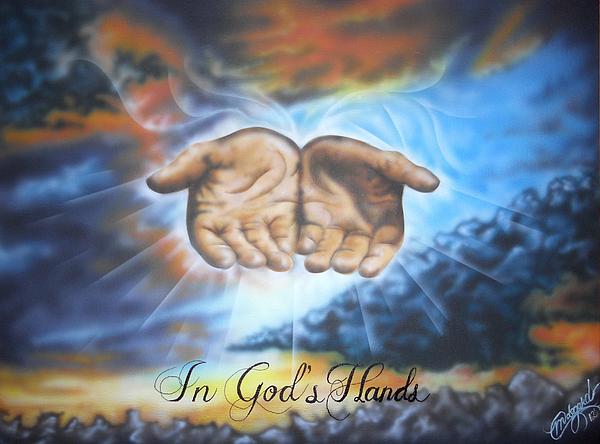
in-gods-hands-matthew-odegard

“Then Job arose and tore his robe and shaved his head and fell on the ground and worshiped. And he said, “Naked I came from my mother’s womb, and naked shall I return. The LORD gave, and the LORD has taken away; blessed be the name of the LORD.”  In all this Job did not sin or charge God with wrong.”  Job 1:20-22

1.  When Adversity comes to us:

a. How do we react?

b. What do we do?

2.  The Heidelberg Catechism asks in question 28: “What advantage is it to us to know that God has created, and by his providence does still uphold all things?”

Answer: “That we may be patient in adversity; thankful in prosperity; and that in all things, which may hereafter befall us, we place our firm trust in our faithful God and Father, that nothing shall separate us from His love; since all creatures are so in His hand, that without His will they cannot so much as move.”

3.  Acts 17:23-31 says, “For as I passed along and observed the objects of your worship, I found also an altar with this inscription, ‘To the unknown god.’ What therefore you worship as unknown, this I proclaim to you. The God who made the world and everything in it, being Lord of heaven and earth, does not live in temples made by man, nor is he served by human hands, as though he needed anything, since he himself gives to all mankind life and breath and everything. And he made from one man every nation of mankind to live on all the face of the earth, having determined allotted periods and the boundaries of their dwelling place, that they should seek God, and perhaps feel their way toward him and find him. Yet he is actually not far from each one of us, for “‘In him we live and move and have our being’; as even some of your own poets have said, “‘For we are indeed his offspring.’ Being then God’s offspring, we ought not to think that the divine being is like gold or silver or stone, an image formed by the art and imagination of man. The times of ignorance God overlooked, but now He commands all people everywhere to repent, because He has fixed a day on which He will judge the world in righteousness by a man whom He has appointed; and of this He has given assurance to all by raising Him from the dead.”

4. If we have the spiritual knowledge of God’s sovereign providence that enables us to be thankful when things are well or if adversity befalls us, we will know this, not because of the pain in and of itself, but because we know the Lord is working in it for His glory and our good.

Romans 8:28-30 declares, “And we know that for those who love God all things work together for good, for those who are called according to his purpose. For those whom he foreknew he also predestined to be conformed to the image of his Son, in order that he might be the firstborn among many brothers. And those whom he predestined he also called, and those whom he called he also justified, and those whom he justified he also glorified.”

How many times have you asked why? Is there something missing in your life? Does the guilt of your sinful behavior weigh mightily upon you? Would you like to experience God’s love, mercy, and forgiveness? Jesus said I have come so that they may have life and have it in abundance.” John 10:10b The Bible says to believe on the Lord Jesus Christ and you will be saved. Here is how:

5. We must Repent – It is a command

6. We must believe on the Lord Jesus Christ – this is how we obtain eternal life

7.  Why?

a. We are sinners – we are born that way

b. We are due punishment for our sin – “for the wages of sin is death.”

c. We face inevitable judgment – because of our disobedience

7.  There is hope! God, through His Son, Jesus Christ is calling you today; completely trust Him with the life He gave to you.  Repent, that is, turn away from your sin and unbelief, and believe on the Lord Jesus Christ with all of your heart….and you shall be saved.

Rest assured, everything IS in God’s hands!

byGraceFaith

“Salvation is like a house built beside a broad and busy highway. Like everyone else, I was born on that highway and was spending my life following it to its destination. At first the trip had been exciting and almost effortless, the constant flow of the crowd carrying me along. However, the farther down the road I got, the more difficult things became; my original joy had dissipated and I noticed that my fellow travelers rarely laughed anymore and their occasional smiles seemed forced. The backpack I had been issued at the beginning of my journey had grown heavier every day, and I was now permanently stooped from its weight. Worst of all, I had been overtaken lately by an unexplainable fear of reaching the end of the highway’.

‘One day my attention was drawn suddenly to the side of the highway to a magnificently constructed house. Over its narrow front doors a sign silently announced in bold red letters: ‘Whosoever Will May Enter and Find Rest’. I do not know how I knew it, but I realized that if I could reach the inside of this beautiful house I would be saved from the highway and its destination. Pushing my way through the mass of indifferent travelers, I broke clear of the crowd and ran up the steps to the front door. But, it was locked. Perhaps it’s only stuck, I thought, and tried again. It refused to open. I was confused. Why would someone put up a sign inviting people in and then lock the door to keep them out? Not knowing what else to do (I refused to return to the highway), I pounded on the door, and shouted for someone on the inside to open it, and tried to pick the lock – but it was useless’.

‘Suddenly a voice spoke my name, and I spun around. It was the Builder of the House. He placed in my hand a key with one word carved on it: FAITH. Turning back to the door, I inserted the key in the lock, twisted it, and heard a reassuring click. The door swung open, and I stepped across the threshold. Immediately the backpack fell from off my shoulders, my back began to straighten like a wilting flower reaching for the sunlight, and from deep within me my soul breathed a sigh of relief as an extraordinary sense of peace and well-being wrapped itself around me. The Builder of the House welcomed me to my new home, explaining that everything in the house was now mine to enjoy. This was the house that grace had built, and faith was the key’.

‘Surveying my new surroundings, I saw that the House of Salvation was a house with many rooms and I was only in the foyer. Across the way was a door marked Answered Prayer. Next to it was another Daily Victory, and next to it, Every Need Supplied. The row of doors, each promising some spiritual blessing, stretched endlessly throughout the house. The discovery of these other rooms puzzled me, for I failed to mention that the foyer in which I stood was jammed with people. It seemed that everyone who entered the house stopped in the foyer, never advancing beyond it, as though the foyer were the entire building’ – remember that as well.

‘This was little better than the highway. Couldn’t they see that there was more to the House of Salvation than the foyer? Surely, the Builder intended every room to be occupied. Hadn’t he said that everything in the house was ours to enjoy? I, for one, had no desire to spend my life standing in a foyer. This was my Father’s house; I was his child, and all he possessed was mine. I went to the door marked Answered Prayer, grabbed the knob, and twisted. It was locked. I went to the next door, the next, and the next. All were locked. Nevertheless, this time I didn’t try to pick the lock or knock the door down. I remembered my encounter with the front door and knew I had a key for that. Although I had been in the house only a short time, I had somehow managed to accumulate a large number of other keys. Rummaging through my collection, I selected one tagged Doing Your Best, and tried it. It did not fit. Nor did the one tagged Religious Activity. The key of Sincerity proved useless. Next I tried the key of Tithing (I was getting desperate); but it was as powerless as the others. I was beginning to understand why the foyer was so crowded’.

‘And then I heard a familiar voice. It was the Builder of the House. ‘Child’, he said, ‘do you remember the key I gave you to enter my house?’. ‘Yes, I remember’. ‘What was it?’. ‘Why, it was the key of Faith’, I answered’. Now listen, the Builder said: ‘The key of Faith is the master key that unlocks every door in the house’. Faith is the master key of the Christian life. From start to finish, salvation is ‘by grace through faith’. Everything we get in the Christian life we get by grace through faith. Grace makes it available and faith accepts it. Grace is God’s hand giving; faith is man’s hand receiving. Faith possesses what grace provides. Grace is God’s part; faith is man’s part. It is our positive response to God’s gracious offer. Everything God demands of man can be summed up in one word: faith.”

~ by Ronald Dunn

When God was displeased with the Jews, he delivered Jerusalem to the enemy, and they were conquered by those who hated them; there were no more sacrifices or feasts. Likewise angered at a soul who had broken his commands, God handed it over to its enemies, who corrupted and totally dishonoured it. When a house has no master living in it, it becomes dark, vile and contemptible, choked with filth and disgusting refuse. So too is a soul which has lost its master, who once rejoiced there with his angels. This soul is darkened with sin, its desires are degraded, and it knows nothing but shame.

Woe to the path that is not walked on, or along which the voices of men are not heard, for then it becomes the haunt of wild animals. Woe to the soul if the Lord does not walk within it to banish with his voice the spiritual beasts of sin. Woe to the house where no master dwells, to the field where no farmer works, to the pilotless ship, storm-tossed and sinking. Woe to the soul without Christ as its true pilot; drifting in the darkness, buffeted by the waves of passion, storm-tossed at the mercy of evil spirits, its end is destruction. Woe to the soul that does not have Christ to cultivate it with care to produce the good fruit of the Holy Spirit. Left to itself, it is choked with thorns and thistles; instead of fruit it produces only what is fit for burning. Woe to the soul that does not have Christ dwelling in it; deserted and foul with the filth of the passions, it becomes a haven for all the vices.

When a farmer prepares to till the soil he must put on clothing and use tools that are suitable. So Christ, our heavenly king, came to till the soil of mankind devastated by sin. He assumed a body and, using the cross as his ploughshare, cultivated the barren soul of man. He removed the thorns and thistles which are the evil spirits and pulled up the weeds of sin. Into the fire he cast the straw of wickedness. And when he had ploughed the soul with the wood of the cross, he planted in it a most lovely garden of the Spirit, that could produce for its Lord and God the sweetest and most pleasant fruit of every kind.

~ Saint Macarius, bishop (circa 330 AD)

The Biblical definition of marriage is the union of one man and one woman. I am committed to rebuilding a culture of marriage, and encourage pastors and teachers with these principles for marriage relationships ministry.

1. All human beings are created in the image of God

Genesis 1:27 establishes the essential and eternal value of humankind as creatures of God and therefore always due appropriate dignity and respect. Even when we do not agree with other persons’ beliefs or behaviors we affirm that they are made in God’s image and must be treated as such. As pastors we lovingly relate to those whom we serve even if we disagree with their beliefs and refuse to condone their behaviors. We continually minister to align them with God’s creative design for their lives.

2. Marriage is the union of one man and one woman

From the opening of the Bible in Genesis 2:24 to the teaching of Jesus in Matthew 19:5-6, the definition of marriage is a covenantal union of one man and one woman. We firmly hold to this biblical, historic and widely held understanding of marriage. It is our responsibility to teach this biblical doctrine and to promote strong, healthy, biblical marriages. We do not recognize living together, same gender couples or multiple partner relationships as marriage or as an equivalent to marriage.

3. As Americans we exercise our First Amendment rights

The First Amendment of the United States Constitution states that “Congress shall make no law respecting an establishment of religion, or prohibiting the free exercise thereof; or abridging the freedom of speech.” As pastors, chaplains and other clergy persons we exercise our constitutional right to practice our religion within the scope of the definition of marriage as a covenantal union between one man and one woman.

4. Pastoral ministry to those who are not married

We seek to minister to all persons, including those who have or intend to have relationships we do not recognize as marriage, but we do so as ministry to persons and not to couples. We do not condone or ratify relationships that are unbiblical alternatives or substitutes for marriage. If ministry programs may be reasonably construed to condone, ratify or promote such relationships as marriages or equivalents to marriage we may choose not to participate or not to include these persons (or, in the case of military chaplains who cannot perform service as a matter of belief and conscience to “provide for” personnel seeking service by directing them to other resources provided by the military branch). This may include but is not limited to pre-marital counsel, marriage ceremonies, marriage enrichment programs and marriage reconciliations.

5. Mutual support in ministry conviction

When government, institutional or cultural pressure is exerted on fellow clergy to compromise biblical teaching, doctrinal beliefs or ministry standards, it is appropriate and necessary for us to stand together in mutual support and solidarity.

~ These 5 principles from taken from a Pastoral Letter on Marriage Relationships Ministry offered to pastors by the National Association of Evangelicals.

“For in him dwelleth all the fulness of the Godhead bodily.” (Colossians 2:9)

The term “Godhead” occurs three times in the King James translation. Each time it translates a slightly different Greek noun, all being slight modifications of the Greek word for “God” (theos, from which we derive such English words as “theology”). It essentially means the nature, or “structure,” of God, as He has revealed Himself in His Word.

The first occurrence is in Acts 17:29: “We ought not to think that the Godhead is like unto gold, or silver, or stone, graven by art and man’s device.” Men have been guilty throughout the ages of trying to “model” the Godhead, but this leads quickly to idolatry, whether that model is a graven image of wood or stone or a philosophical construct of the human mind.

What man cannot do, however, God has done, in the very structure of His creation. “The invisible things of him from the creation of the world are clearly seen, being understood by the things that are made, even his eternal power and Godhead” (Romans 1:20). His tri-universe (space, matter, and time, with each component unique in definition and function, yet permeating and comprising the whole) perfectly “models” His triune nature (Father, Son, Holy Spirit–each distinct, yet each the whole).

This analogy can be carried much further, for this remarkable triunity pervades all reality. The tri-universe is not God (that would be pantheism), but it does clearly reflect and reveal the triune nature of His Godhead.

The last occurrence of the word is in our text. Although we cannot see the Godhead in its fullness, that fullness does dwell eternally in the Lord Jesus Christ. All that God is, is manifest in Him. “And ye are complete in him” (Colossians 2:10).

~ Henry Morris, Ph. D.

The entrance into the Kingdom of God is by grace through faith in Jesus Christ alone. My call to ministry is one based upon God’s faithfulness to fulfill His revealed purpose in my life. I had no ability to acquire salvation on my own. Because of God’s sovereignty, He chose me in Christ before the foundation of the world. His mercy and grace brought me faith. God enabled me to make the choice of trusting in Jesus Christ as Savior and Lord. He regenerated and transformed me into a new creation in Christ Jesus, and now His sanctifying grace is making me holy in my daily life.

The Holy Spirit baptized me into the Body of Christ, the Church (the ekklēsia), of which I am a member. Now, I am a member of the Community (ekklēsia) of Jesus Christ. God created a community of worship, dedication, and faith in the time of the Old Covenant. Now, the community has changed with the coming of the new and better covenant. Within this community of the Kingdom, I am able to view my calling more clearly. It means that being a “covenant person” of a covenant people; I am called to a mission along with many others, and am equipped by God through the Holy Spirit.

Therefore, I can speak with conviction along with the Apostle Paul when he said in 2 Corinthians 3:6, “ He has made us competent as ministers of a new covenant – not of the letter but of the Spirit, for the letter kills, but the Spirit gives life.” Therefore, I see that those members of the Community of Jesus Christ are ministers unto each other, the world, and unto God.

My call and the call of His Church (Matthew 25:35-45) is to minister unto a world that is lost. We are to be beacons of light to those who are blind in darkness. We are to be workers of justice and freedom for the oppressed and captive. We are to demonstrate to the poor the power of His greatness and His faithfulness from which we hope, and to proclaim the Gospel and His Kingdom!