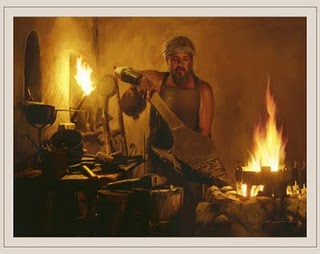
In The Hands Of The Refiner

Posted: November 29, 2009 in Christian

Malachi 3:3 says: ‘He will sit as a refiner and purifier of silver.’

This verse puzzled some women in a Bible study and they wondered what this statement meant about the character and nature of God.

One of the women offered to find out the process of refining silver and get back to the group at their next Bible Study.

That week, the woman called a silversmith and made an appointment to watch him at work. She didn’t mention anything about the reason for her interest beyond her curiosity about the process of refining Silver.

As she watched the silversmith, he held a piece of silver over the fire and let it heat up. He explained that in refining silver, one needed to hold the silver in the middle of the fire where the flames were hottest as to burn away all the impurities.

The woman thought about God holding us in such a hot spot; then she thought again about the verse that says: ‘He sits as a refiner and purifier of silver.’ She asked the silversmith if it was true that he had to sit there in front of the fire the whole time.

The man answered that yes, he not only had to sit there holding the silver, but he had to keep his eyes on the silver the entire time it was in the fire. If the silver was left a moment too long in the flames, it would be destroyed.

The woman was silent for a moment. Then she asked the silversmith, ‘How do you know when the silver is fully refined?’

He smiled at her and answered, ‘Oh, that’s easy — when I see my image in it.’
If today you are feeling the heat of the fire, remember that God has his eye on you and will keep watching you until He sees His image in you.


Committing Your Life To God

Posted: November 29, 2009 in Christian


For two thousand years, the Church has held intact the fullness of Christ. The true Church has maintained this Faith in the face of almost indescribable persecution and suffering. Within the gates of Christianity is the totality of the New Testament Faith, the Apostolic Church.

By the mercy of God, this Faith has never been reduced or diminished. Nor has it been added to or altered. The Church is that one place that "zone of safety", if you will, where the God of the Scriptures (Father, Son, and Holy Spirit) can be fully known, loved, and worshiped.

A great father of the Church, Saint John Chrysostom, a Bible teacher, and preacher of the fourth century brought and still brings thousands of people to a saving knowledge of Jesus Christ through his writings. When Saint John Chrysostom met a person who wanted to commit himself to Jesus Christ and learn to know God, Saint John Chrysostom would agree to instruct him in the orthodox Faith, after which would come Holy Baptism and the anointing with oil to receive the gift of the Holy Spirit.

Before his instruction began, the godly pastor would offer a prayer by which the person was entrusted to Jesus Christ as his Lord and King.

This prayer is still used today at the opening of the service of baptism:

"In Thy Name, O Lord, God of truth, And in the Name
of Thine Only-begotten Son, And of Thy Holy Spirit,
I lay my hands upon Thy servant, Who has been found worthy
to flee to Thy Holy Name; And to take refuge
under the shelter of Thy wings."

Let me ask you a sincere question: Are you willing to repent of your sins and believe in the Lord Jesus Christ? Do you want to learn to know Him, be cleansed of all unrighteousness, and live a life of holiness unto God? If so, a new life in Christ lies ahead for you. Your next step is to get to know a leader of a Church in your area who can guide you through a time of preparation and instruction in the Christian Faith, and then union with Christ in Baptism. If you need help with this, just send me an email.

Jesus said, "I am the way, the truth, and the life. No one comes to the Father except through Me" (John 14:6). Determine to follow Jesus Christ and learn to walk with Him on that path which leads to the knowledge of God. For Jesus Christ has promised, "The one who comes to Me, I will by no means cast out" (John 6:37). The door has been opened to you, and He will receive you as His disciple — now, TODAY is the acceptable time!

The Image and Likeness of God

Posted: November 29, 2009 in Christian


Genesis 1:26-27, “Then God said, "Let Us make man in Our image (Heb. selem), according to Our likeness (Heb. demuth); and let them rule over the fish of the sea and over the birds of the sky and over the cattle and over all the earth, and over every creeping thing that creeps on the earth. God created man in His own image, in the image of God He created him; male and female He created them.”

The image and likeness of God relate to one thing, the resemblance of God. It is most widely understood that the image and likeness do not resemble God in bodily form. The image and likeness of God can only reside in spiritual qualities, in man’s mental and moral attributes as a self-conscious, rational, personal agent, capable of self-determination and obedience to moral law. The divine likeness resembles God in the ability to think rationally, to form relationships with other human beings and with God, or with the exercise of dominion over creation. The image of God, defaced, but not entirely lost through sin, is restored in yet more perfect form in the redemption of Christ. Therefore, the image of God in which man was created, was in his spiritual, intellectual, and moral nature, in righteousness and true holiness.

In the New Testament, the teaching of Jesus indicates the value of human beings implicit in their being God’s image-bearers (Matt 6:26; 12:12). More important, Jesus himself perfectly images God in his life and ministry as he relates sinlessly to God, people, and nature. As the first Adam failed the satanic test, the second Adam passed with flying colors (Matt 4:1-11). Jesus did not forsake God as did Adam, but as the sin-bearer Jesus was forsaken by God (Matt 27:46) so that he might restore his people to harmonious relationships to God, neighbor, and nature.

It is primarily Paul who develops the New Testament teaching on the image of God. Paul sees Jesus as the one who preexisted in God’s form (morphe Php 2:6) and whose incarnation supremely imaged God (2 Cor 4:4; Col 1:15; cf. John 1:1, 14, 18; 14:9; Heb 1:3). Jesus’ work of redemption is both compared and contrasted to Adam’s work of rebellion (Rom 5:12-21; 1 Cor 15:22). Those who believe in Jesus are renewed in the image (eikon) of God and are expected to live as renewed people (2 Cor 3:18; Eph 4:22-24; Col 3:9-10). Their destiny is ultimately to be made like Jesus, to image him perfectly as he perfectly images God (1 Cor 15:49; Eph 4:13; Php 3:21). In this respect, Christians are like children who look up to their big brother and want to be like him (Rom 8:29). For the Christian, then, godliness is Christ-likeness.

For Paul salvation from start to finish, encompassing regeneration, justification, sanctification, and glorification, is nothing less than new creation (Rom 8:18-30; 2 Cor 4:6; 5:17; Gal 2:20; 6:15; Eph 2:10; cf. John 3:5; 5:24). This new creation is not merely individual but corporate and cosmic as well. The salvation of individual believers places them into community with other believers whose destiny resembles that of the physical universes’ restoration (Rom 8:19-21; 1 Cor 15:24-28; Col 1:16; cf. Matt 19:28; Heb 2:5-8).

The community of believers in Jesus has already experienced image renewal and with perseverance, they hope for the consummation of that renewal. In the meantime the ethical obedience of the Body of Christ is not merely to be like God but to be like Christ, who has imaged not only an incarnate model for godliness but also a dynamic for attaining godliness through the Spirit (John 13:14; 1 Cor 11:1; Eph 4:32-5:2; Php 2:5; Col 3:13; 1 Thess 1:6; 1 John 3:3).