Archive for the ‘universal’ Category

covenant-triangleMy New Covenant Relationship with God

I believe that entrance into the Kingdom of God is by grace through faith in Jesus Christ alone. My call to ministry is one based upon God’s faithfulness to fulfill His revealed purpose in my life. I had no ability to acquire salvation on my own. His loving grace granted me repentance and faith. God enabled me to make the choice of trusting in Jesus Christ as Savior and Lord. He transformed me into a new creation in Christ Jesus, and now His sanctifying grace is making me holy in my daily life.

The Holy Spirit baptized me into the Body of Christ, the Church, of which I am a member. Now, I am a member of the Community of Jesus Christ. God created a community of worship, dedication, and faith in the time of the Old Covenant. Now, the community has changed with the coming of the new and better covenant. Within this community of the Kingdom, I am able to view my calling more clearly. It means that being a “covenant person” of a covenant people (the Church); Called to a mission along with many others, and equipped by God through the Holy Spirit as an apostle, prophet, evangelist, pastor, and teacher, I pursue the Missio Dei.

Therefore, I can speak with conviction along with the Apostle Paul when he said in 2 Corinthians 3:6, “ He has made us competent as ministers of a new covenant – not of the letter but of the Spirit, for the letter kills, but the Spirit gives life.” Therefore, I see that those members of the Community of Faith are ministers unto each other, the world, and unto God.

My call and the call of His Church (Matthew 25:35-45) is to minister unto a world that is lost. We are to be beacons of light to those who are blind in darkness. We are to be workers of justice and freedom for the oppressed and captive. We are to demonstrate to the poor the power of His greatness and His faithfulness from which we hope, and to proclaim the Gospel and His Kingdom!

the-gospel1

The Good News

We bring you the good news that what God promised to the fathers, this he has fulfilled to us their children by raising Jesus…. – Acts 13:32-33

“Are You Saved?” Have you heard this message but not know what it means? What are you being saved from? From whom are you being saved?

1. Confess that you are a sinner and that you cannot save yourself.

“For all have sinned and fall short of the glory of God…” (Romans 3:23). This means that even though you try to do your best, you still fall short because you are a sinner. Romans 6:23 says that “the wages of sin is death, but the gift of God is eternal life in Christ Jesus our Lord.” Salvation is the gift of God to you. That’s the way He planned it.

2. Repent of and confess your sin to God.

And Peter said to them, “Repent and be baptized every one of you in the name of Jesus Christ for the forgiveness of your sins, and you will receive the gift of the Holy Spirit. For the promise is for you and for your children and for all who are far off, everyone whom the Lord our God calls to himself.” (Acts 2:38-39)

2. Confess that Jesus Christ is Lord, He is the Son of God, and that He alone can save you.

“Salvation is found in no one else, for there is no other name under heaven given to men by which we must be saved” (Acts 4:12). “For there is one God and one mediator between God and men, the man Christ Jesus, who gave himself as a ransom for all men–the testimony given at its proper time” (1 Timothy 2:5-6). Isaiah 53:6 says that “We all, like sheep, have gone astray, each of us has turned to his own way; and the Lord has laid on Him the iniquity of us all.” Jesus took our sins upon Himself when He died on the cross. He paid the penalty for our sins so that we would not have to. He was raised from the dead, showing that He has victory of sin and death. Romans 10:9 says that “if you confess with your mouth, ‘Jesus is Lord,’ and believe in your heart that God raised Him from the dead, you will be saved.”

3. Acknowledge that salvation will be yours if you put your faith in Jesus Christ.

“The time is fulfilled, and the kingdom of God is at hand; repent and believe in the Gospel.” (Mark 1:15)

Ephesians 2:8 says that “For it is by grace you have been saved, through faith–and this not from yourselves, it is the gift of God–not by works, so that no one can boast.” This clearly indicates that God gives the gift of faith first. Then you take the faith He has given you and place it in Christ you will be saved by faith alone–there is nothing more for you to do.

4. Pray and receive Jesus Christ as your Savior and Lord from this day forward, and forever.

2 Corinthians 5:17 says that “Therefore, if anyone is in Christ, he is a new creation; the old has gone, the new has come!” This is what is known as “new life in Christ,” or as John 3:3 puts it, being “born again.”

Receiving Christ is the beginning. As we learn in Colossians 2:6-7, “Just as you received Christ Jesus as Lord, continue to live in him, rooted and built up in him, strengthened in the faith as you were taught, and overflowing with thankfulness.”

After receiving Him, be obedient by following Him in baptism and by uniting with the church. When you do, you will find that life truly does have new purpose and meaning.

Learn more about your new relationship with God here and click on Q1 (Question 1) to begin!

God bless you!

Jesus

Once it was the blessing, Now it is the Lord;
Once it was the feeling, Now it is His Word.
Once His gifts I wanted, Now the Giver own;
Once I sought for healing, Now Himself alone.

Once was painful trying, Now is perfect trust;
Once a half salvation, Now the uttermost.
Once was ceaseless holding, Now He holds me fast;
Once was constant drifting, Now my anchor’s cast.

Once was busy planning, Now is trustful prayer;
Once was anxious caring, Now He has the care.
Once was what I wanted, Now what Jesus says;
Once was constant asking, Now is ceaseless praise.

Once it was my working, His it hence shall be;
Once I tried to use Him, Now He uses me.
Once the power I wanted, Now the Mighty One;
Once for self I labored, Now for Him alone.

Once I hoped in Jesus, Now I know He’s mine;
Once my lamps were dying, Now they brightly shine.
Once for death I waited, Now His coming hail;
And my hopes are anchored, Safe within the veil.

All in all forever, Jesus will I sing!
Everything in Jesus, and Jesus everything!

~ A. B. Simpson

Jesus


ViewTheStory.com/6999

To tell the old, old story of Jesus and His love….

Jesus is reaching out to you!

God bless you!

The Promise-Driven Life

Image for Article

Christ lived the purpose-driven life so that we would inherit his righteousness through faith and be promise-driven people in a purpose-driven world.

What are you driven by? The last time I was sick, it was a Saturday and I flipped on the TV for an extraordinary long time. The whole day was exercise equipment, how to become real-estate rich with no money down, and Suze Orman gave me her steps to financial security. As much as we all make sport of this sort of thing, it attracts us. That’s because we are “wired” for law: tell me what to do and I’ll get it done. That is not just the American spirit, but it is human nature. God’s law is inborn, in our conscience, part of our moral makeup. The average person on the street will tell you that the role of churches and other religious institutions is to provide moral instruction-practical suggestions for successful living for the spirit, just as Suze Orman and Jake are there to help us out with our banking and bodies.

Even human imperatives can be enormously effective at laying out a course of action. If I am sufficiently motivated, a good diet-and-exercise plan can help. I’ve never even come close to being credited with any financial planning wisdom, but even I can recognize that if I follow half of what Suze says, I’ll be a much better steward. (I bought the video. Don’t ever leave your credit card within reach if you spend a Saturday watching TV. I nearly bought three separate gyms and a few things for my wife.) Dr. Phil and Dr. Laura don’t even have to be Christians to provide good, commonsense instruction in daily affairs. At least in terms of raw, general principles, non-Christians have law down. When Christians talk law (“How to … “), non-Christians know that we’re speaking their language. I guess that is why such preaching and teaching dominates in the church today, since “law” (however watered down) is perceived as relevant. However, it is only when we encounter God’s law in its full strength that we are knocked off our horse. Instead of being in charge, answering with Israel and Mount Sinai, “All this we will do!”, we find ourselves in the hot seat, the charade exposed, the spin unmasked. Church shouldn’t be a place where the old self is revived for another week, but where it is killed and buried and the new self is created in the likeness of Christ.

Even as Christians, the law (in its third use) can direct us, but it cannot drive us, except to either despair or self-righteousness. Christians are not purpose-driven, but promise-driven. Purposes are all about law. To be sure, at least in Christian discourse, some promises may be mentioned, but they are usually dangled as the carrot for fulfilling the conditions that have been laid out. If you did that with the real Ten Commandments-something like, “Do this and you shall live” (Lev. 25:18), people would catch on: “That’s legalism!” But the therapeutic version (easy-listening law) flies under the radar: “Hey, here are a few helpful principles based on God’s instruction manual that will help you get victory in your life.” Although Rick Warren’s phenomenal best-seller, The Purpose-Driven Life, for example, differs from the usual pattern of self-help books by insisting that we were created for God and his glory, it offers Fifteen Principles-all of which are imperatives (commands, or rather, suggestions) that promise a life of victory for those who follow them. That, I would suggest, confuses law and gospel. And that eventually leaves resentment of God, not delight, in its wake.

The fact that purposes are about law does not make them wrong. We need purposes! Nobody can live without goals. Yet purposes and goals are always something to be reached, to be achieved and be attained by us. They require tactics and strategies. All of this is fine as long as we realize that they are law, not gospel: commands and promises are both necessary, but they do different things.

Law tells us what we should do, whether we’re faced with the wrath of God (full-strength law) or by the fear of not reaching our full potential (the watered-down version). God’s promise, by contrast, creates true faith, which creates true works. The church father Augustine defined sin as being “curved in” on ourselves. While imperatives (including purposes) tend by themselves to make us more “curved in” on ourselves (either self-confidence or self-despair), only God’s promise can drive us out of ourselves and our own programs for acceptance before ourselves, other people, and God. While the Christian life according to scripture is purpose-directed, it is promise-driven. Both of our passages-Genesis 15 and Romans 4-bring this point home powerfully.

Wrestling with the Promise (Genesis 15)

Even after his military victory and the remarkable event of being offered bread and wine with a blessing from Melchizedek, Abram’s greatest problem is that he has no heir, no one to carry on the calling that God has given him. His world, as he sees it anyway, is bleak. “After these things the word of the Lord came to Abram in a vision, ‘Do not be afraid, Abram, I am your shield; your reward shall be very great'” (Gen. 15:1). Abram and Sarai had been called out of the barrenness of moon-worship in the city of Ur by God’s powerful Word, which created faith in the promise (12:1). There is the reward of the land of Canaan, but ultimately the whole earth (“father of many nations”), of which the land of Canaan will serve as a type. The New Testament even tells us that Abraham himself was looking through the earthly promise as a type to its heavenly reality (Heb. 11:10, 13-16).

Notice in this opening address, it is sheer promise. This covenant is not like the one that God made with Adam or with Israel, which made the promise conditional on their future obedience. It was a gift to be received, not a task to be undertaken. God simply declares, “I am your shield. Your reward shall be great.” This is what ancient Near Eastern lawyers would have called a “royal grant.”

Yet Abram wonders, “O Lord God, what will you give me, for I continue childless, and the heir of my house is Eliezar of Damascus? … You have given me no son, and so a slave born in my house is to be my heir” (vv. 2-3). The empirical facts of the case-what Abram sees, appear to be overwhelming evidence against the testimony of the promise. Nevertheless, God counters again with the promise, offering the innumerable stars as a sign of the teeming offspring who will come from his loins. “And [Abram] believed the Lord; and the Lord reckoned it to him as righteousness” (vv. 5-6). Abram’s response is not one of blind optimism or positive thinking. Abram finds himself believing.

Faith does not create; it receives. It does not make the invisible visible or the future present or hope reality. It receives that which is already given. Grace precedes faith. It is not finally accepting the goodness of the world, or my own goodness, but receiving God’s goodness toward me in spite of the way things really are with me and with the world. Further, there is no way around the forensic or legal character of this Hebrew verb, “declared.” It is chashav, referring to a courtroom judgment, not a process. There Abram stood, wicked and helpless, and yet at the same time-by virtue solely of the promise declared to him, received by faith, was declared righteous. Commenting on this passage, Calvin reminds us, “In all ages, Satan has laboured at nothing more assiduously than to extinguish, or to smother, the gratuitous justification of faith, which is here expressly asserted.” Justification is at the core of the divine paradox: How can I have the assurance that I am accepted before God as righteous when I continue in sin? I see my life. Nevertheless, by pronouncing Abraham just, Abram is just. The promise makes it so. If we can get this right in our understanding of justification, it will radically alter every other aspect of our relationship with God.

Abram goes on to ask how he can know that God will give him the land and God responds in this vision by passing through the severed halves of animals (a treaty-making event of calling down judgment in case of violation) alone (vv. 12-21), foreshadowing the cross of Christ. As Paul would later attest in Galatians 3:19-20, specifically referring to this covenant with Abraham, no covenant could be more firmly anchored in God and his promise rather than in the faithfulness of the human partner than one that God swears by himself.

The preaching of the promise created justifying faith and this sign and seal now confirms and ratifies it. No wonder question 62 of the Heidelberg Catechism confesses, “The Holy Spirit creates it [faith] in our hearts by the preaching of the holy gospel and confirms it by the use of the holy sacraments.” Out of his confession of faith, Abram now continues his pilgrimage not on the basis of his physical vigor or Sarai’s fertility, but on the sole basis of the Word (again, in anticipation of his greater Son in his temptation). We will either rely on the visible realities we see or the invisible realities we hear preached to us, but we cannot rely on both. Unbelief is unavoidable: either we will doubt the credibility of the divine word in the face of life’s realities or we will doubt the credibility of this world’s so-called “givens” in the face of the divine promise. Faith ignores statistics. The world says we have to save ourselves (and it), offering countless strategies of striving, while the Word slays us in our self-conceit and raises us up together with Christ. God’s promise creates a new world out of darkness and void, fertile pastures of fruit-bearing trees out of the infertile soil of unbelief and ungodliness. This covenant is not a call to claim a future he can control, but to receive a future that God has spoken into being. Sarai’s infertile womb is the canvas upon which God will paint a new creation. And they both get renamed. The promise gives them a new identity.

The Fulfillment of the Promise (Romans 4:13-25)

These passages from Genesis 15-17 form the backdrop for much of Paul’s teaching. Israel had confused the promise-covenant made with Abraham and the law-covenant that Israel made with Yahweh at Sinai. Nobody can be justified by means of a law-covenant, Paul insists, but only on the basis of a promise-covenant. So Paul brings Abraham to the witness stand as an example to us, not chiefly as someone whose holiness we can emulate (have you read the story?), but primarily as someone for whom the promise worked even though he didn’t. If Abraham could not be justified by his own righteousness, how can the rest of us who claim Abraham as our forefather?

Paul is contrasting law-logic with promise-logic. The law is not the problem, but we are, and the law simply points that out. We know the law by nature; nobody has to teach at least its rudimentary principles to us (Rom. 1 and 2). When we turn to our common sense, reason, experience, or what we see in order to determine our relationship to God, it is always the law that has the last word. Law-logic is entirely appropriate for those created in God’s image, designed and equipped to reflect God’s righteousness in every way, but it says nothing about how law-breakers can be saved from its judgment.

In Romans 3:21-26, Paul announces that law-logic can only announce the righteousness that God is and which therefore condemns us who have failed to conform to it. Then we arrive at chapter 4. The question that throws law and promise into a sharp contrast is this: How does one obtain the inheritance of the heavenly rest? The barrier between Jew and Gentile is broken down not merely because the laws of ethnic separation are set aside but because law as a principle was never intended to be the way of inheriting the Abrahamic promise. “But to him who does not work but believes on Him who justifies the ungodly, his faith is accounted for righteousness, just as David also describes the blessedness of the man to whom God imputes righteousness apart from works” (vv. 5-6).

If we read Romans 4 in the light of Paul’s argument in Romans 10, the contrast is even clearer: law-logic ascends to bring Christ down or up from the grave, while gospel-logic receives Christ as he descends to us in the preaching of the gospel. Because the law is innate (in creation) and the gospel is a surprising announcement (after the fall), climbing, ascending, attaining, doing whatever “ten steps” or following whatever “fifteen principles” is natural to us. It is not natural for us, like Abraham, to simply receive a promise, the hearing of which creates faith (Rom. 10:17). But God is never closer to us, says Paul, than when Christ is being preached to us (v. 8). Law-logic strives for what it sees and can possess; promise-logic sits down and listens to the covenant attorney reading the last will and testament, legally enacting the bequest.

Back to chapter 4, then, where Paul uses the same phrase-“through the righteousness of faith” (v. 13) that he will use in chapter 10, where he contrasts the law-logic of our ascent (“go get it”) with the promise-logic of God’s descent (“God gave it to you”). So when it comes to how we are justified-that is, set right before God and made heirs of all the gifts that he has for us, Law and Promise represent antithetical means of inheritance. We know the difference between a contract (“I’ll do this if you do that”) and a bequest (“I hereby leave my estate to … “). That’s the difference here between employees and heirs (v. 4). Christ’s active obedience is the basis and his death is the legal event that distributes the royal estate to all of his beneficiaries. God doesn’t just give us more good advice and exhortation, but the most amazing news in the world: “But to one who without works trusts him who justifies the ungodly, such faith is reckoned as righteousness” (v. 5).

The contrast is either/or again in verse 14: “For if those who are of the law are heirs, faith is made void and the promise made of no effect.” It’s not just that faith is also necessary, but that faith and obedience are absolutely antithetical as means of attaining that which the promise promises. The last part of the sentence (v. 15) reads, “because the law brings about wrath; for where there is no law there is no transgression.” It is the law that exposes our sin and makes it utterly sinful, counting our wrongs not as “mistakes,” “self-expression,” “foibles,” or even “not being all that we could be,” but as a wicked transgression of God’s explicit command. The law speaks and the old self dies. The law cannot create faith because it tells us what is to be done. It can only announce what we have not done. The promise, by contrast, tells us what has been done by someone else. That is why it brings life.

Then in verse 16 Paul says, “Therefore it is of faith that it might be according to grace, so that the promise might be sure toall the seed, not only to those who are of the law, but also to those who are of the faith of Abraham, who is the father of us all.” See the logic of the promise? Paul will add one more pearl to the string later.

It is important to recognize that God’s promises are not simply a pledge of a future reality, but bring about that reality in the present. We see this clearly in the way Paul talks about the law doing certain things and the promise doing certain things. In verse 14 of our passage he says, “For if those who are of the law are heirs, faith is made void and the promise made of noeffect, because the law brings about wrath; for where there is no law there is no transgression.” The promise (or gospel) preached creates faith, just as the law actually brought about our condemnation. The law not only warns us of God’s coming wrath, it “brings about wrath,” just as the judge’s act of sentencing a criminal actually effects the criminal’s condemnation.

Throughout Scripture we are taught that God’s Word is effectual: it brings about whatever God speaks, whether in creation, providence, or redemption. God’s speech is “active and living,” Scripture says. The law is successful in condemning, driving us to despair of ourselves, to seek salvation outside ourselves. The gospel is successful in giving us faith to receive Christ and all his benefits. The gospel doesn’t just talk about a world that might come to be if we all just got our act together; it creates a new world where no capacity existed, and that is exactly the language that Paul uses in verses 17 to 22. God creates death and life by speaking.

This is why Paul returns again to the example of Abraham and Sarah as the construction site of a new creation, produced by the promise. Here is the logic: “For this reason it depends on faith, in order that the promise may rest on grace and be guaranteed to all of his descendants,” both Jew and Gentile (v 16). He adds, “As it is written, ‘I have made you the father of many nations’-in the presence of the God in whom he believed, who gives life to the dead and calls into existence the things that do not exist” (v. 17). Just as God spoke the world into existence without any contribution from the creation itself, God speaks a new world of salvation into being. And just as Abraham is declared righteous by this proclamation then and there, Paul observes, he was declared then and there “father of many nations” despite all appearances to the contrary. “Hoping against hope, he believed that he would become ‘the father of many nations,’ according to what was said, ‘So numerous shall your descendants be'” (v. 18). God’s saying makes it so. Salvation comes, then, not by doing certain things but by hearing certain things and embracing them by faith, which is itself created by the Spirit through the preaching of the promise. Not all parts of the Word give life, as Paul says later in chapter 7 (v. 10): “And the commandment, which was to bring life, I found to bring death.” If Paul were not a transgressor, the law would pronounce him just, but as it is, it can only bring death. The promise, by contrast, brings life-out of nothing.

This is the scandal of justification: How can God declare us righteous if we are not inherently righteous? Isn’t this a legal fiction? Doesn’t it make God a liar? But that’s like saying God cannot say, “Let there be light” unless there is a sun to give it. God himself creates the conditions necessary for the existence of his work. When he says, “Let there be light!”, the sun exists. When he says, “Let this ungodly person be righteous,” “this barren woman be pregnant,” “this faithless person embrace my Word,” it is so. When we really understand justification, we really understand how God works with us in every aspect of our lives before him. Christ lived the purpose-driven life so that we would inherit his righteousness through faith and be promise-driven people in a purpose-driven world. He did gain the everlasting inheritance by obedience to everything God commanded, driven by the purpose of fulfilling the law for us, in perfect love of God and neighbor.

Relinquishing hope in the ordinary powers of human nature, he was given genuine hope in God for the first time. The future was now God’s future, not his own. He didn’t have to work it all out, plot and plan, scheme to bring about the inheritance (as he had done before). Thus, because of the power of the promise, not his own goals or resolve, Abraham could turn his eyes away from “his own body, already dead (since he was about a hundred years old), and the deadness of Sarah’s womb” (Rom. 4:19). “He did not waver,” again, not because of any inherent virtue of his faith, but because he “was strengthened in faith, giving glory to God, and being fully convinced that what He had promised He was also able to perform” (v. 21). In other words, it was because of the object of faith, not the act of faith itself that Abraham could stand firm.

As anticipated above, Paul adds here another pearl in the chain of the promise-logic: If the inheritance comes by faith in the promise and not in the works of the law, then faith gives all “glory to God” (v. 20). Faith gives no glory to self, even to our act of faith. It is directed entirely to God and his promise. Faith is strong only to the extent that the promise is strong. Abraham knew that God could perform what he had promised. “And therefore ‘it was accounted to him for righteousness'” (v. 22).

Conclusion: What Really Drives You?

In the concluding verses of this remarkable chapter (vv. 23-25, and the first verse of chapter 5), Paul writes,

Now the words, “it was reckoned to him,” were written not only for his sake alone, but for ours also. It will be reckoned to us who believe in him who raised Jesus our Lord from the dead, who was handed over to death for our trespasses and was raised for our justification. Therefore, since we are justified by faith, we have peace with God through our Lord Jesus Christ, through whom we have obtained access to this grace in which we stand; and we boast in our hope of sharing the glory of God.

Faith is defiance. Abraham’s faith defied every possibility that he saw, in favor of the “impossible” word that he heard. This is why “faith comes by hearing … that is, the word of faith which we preach” (Rom. 10:17). To trust in God is to distrust every other promise-maker. The world makes a lot of promises: “Try this product and you’ll be ….” Constantly buying into new fads or makeovers as so many fig leaves to hide the seriousness of our condition, we hand ourselves over to marketers who persuade us that we can attain salvation, however we define that. Even the church can become a place where people get the idea that they exist merely to usher in the kingdom by serving on committees and being involved in a thousand programs. We have a lot of purposes, a lot of goals-some of them noble. Desperate to save ourselves and our kids from everything but the wrath of God, we fail to realize that, however watered down, these are all nothing but law rather than promise. Eventually, we will become burned out on good advice. What we need is good news.

The Covenantal Summons

When God Gathers His People in Worship

Image for Article

What are we doing on the Lord’s day, especially when we are gathered as God’s people in church? How do we understand Christian growth and discipleship-as chiefly corporate or individual, as nourished by the preached Word and the divinely instituted Sacraments or by self-approved “means of grace”? Would an outsider coming into our worship services be immediately impressed with the centrality of preaching, baptism, and the supper, or would he or she be more likely to notice the importance given to performance?

All of these questions were at the heart of the Reformation debate as part and parcel of recovering the Gospel. But they are just as acute in our day, when we have sought a bewildering array of means of grace. This article will focus on the nature of worship as a service of covenant renewal.

The Biblical Story of Redemption

Our non-Reformed readers will hardly be surprised to learn that I would begin a brief biblical sketch of worship with the covenant. But no one can doubt that this is central to the biblical story of redemption. Even after the fall, God promised Eve a son who would crush the serpent’s head, and although Cain murdered Abel, God provided another son, Seth. While Cain’s descendants were building their own proud city of rebellion (Gen. 4:15-24), “Seth also had a son, and he named him Enosh. At that time men began to call on the name of the LORD” (v. 26). Thus, the two cities-cult (i.e., worship) and culture, fully integrated in creation, were now divided and pursued two separate ends through distinct means. Jesus’ warning that the world will hate his disciples and Paul’s contrast between the wisdom of this world (works-righteousness) and the wisdom of God (the righteousness which comes by faith) are not borne out of any hostility toward the world per se. Rather, it is the world in its sinful rebellion that the biblical writers have in mind.

After calling Abram out of Ur, God commanded a ritual sacrifice as a way of making the covenant. (In fact, the Hebrew word for covenant, berith, comes from the verb, “to cut.”) In ancient Near Eastern politics and law, a suzerain (i.e., great king or emperor) would enter into a treaty with a vassal (i.e., the king or ruler of a smaller territory) by cutting various animals in half. Then, walking together between the halves, both partners agreed to perform all of the conditions of the treaty with the following sanction: If I should be unfaithful for my part, may the same end befall me as has befallen these animals. In Genesis 15, when God makes his covenant with Abraham and his descendants, this ancient Near Eastern treaty is the pattern:

But Abram said, “O Sovereign LORD, how can I know that I will gain possession of it?” So the LORD said to him, “Bring me a heifer, a goat and a ram, each three years old, along with a dove and a young pigeon.” Abram brought all these to him, cut them in two and arranged the halves opposite each other…. As the sun was setting, Abram fell into a deep sleep, and a thick and dreadful darkness came over him. Then the LORD said to him, “Know for certain that your descendants will be strangers in a country not their own, and they will be enslaved and mistreated four hundred years. But I will punish the nations they serve as slaves, and afterward they will come out with great possessions…. When the sun had set and darkness had fallen, a smoking firepot with a blazing torch appeared and passed between the pieces. On that day the LORD made a covenant with Abram…. (v. 8-18)

Two sorts of things are promised by God in this covenant: a holy land (Canaan) and everlasting life. What especially distinguishes this suzerainty treaty is the fact that although God and Abram are covenant partners, the Lord (appearing as a smoking firepot with a blazing torch) walks alone through this path, placing on his own head all of the sanctions and assuming on his own shoulders the curses which he himself has imposed, should the treaty be violated by either party. Then in chapter 17 there is another cutting ceremony:

Abram fell facedown, and God said to him, “As for me, this is my covenant with you … I will establish my covenant as an everlasting covenant between me and you and your descendants after you for the generations to come, to be your God and the God of your descendants after you…. This is my covenant with you and your descendants after you, the covenant you are to keep: Every male among you shall be circumcised. You are to undergo circumcision, and it will be the sign of the covenant between me and you.” (v. 3-12)

This ceremony signified the cutting away of uncleanness, especially of original sin that is passed on from Adam through every subsequent father. But here, instead of the knife being plunged into the body to bring down the curses of the transgressors (yes, even fresh from the womb we are in this class), it instead is used to cut away the sin so that the recipient may live.

Eventually, God’s promise was fulfilled: Israel did inherit the land. As mentioned previously, God promised a holy land and everlasting life. As becomes clearer with the progress of redemption, the land was (like Adam’s enjoyment of Eden) dependent on works-the obedience of the Israelites. The Mosaic covenant, with its ceremonial and civil as well as moral laws, promised blessing for obedience and judgment for disobedience. Once again, God would fight for his people and give them a new Eden, a land flowing with milk and honey. God would be present among his people in the temple as long as they were righteous.

But (also like Adam) Israel failed and in its rebellion violated the treaty with the great king, provoking God to enact the sanctions of this works covenant. The lush garden of God became a wasteland of thorns and thistles, as God removed his kingdom back up into heaven, the children of Israel being carted off to Babylonian exile. After these years of exile, a remnant returned to rebuild Jerusalem. Ezra and Nehemiah report this remarkable event and the tragic infidelity and infighting that went along with it. Despite human sinfulness, under Nehemiah’s leadership the remnant rebuilt the walls of Jerusalem and its magnificent temple which God’s evacuation had left desolate and ransacked by invaders. The poor were cared for. But the centerpiece of this event appears when the Torah is rediscovered for a generation of Israelites that had never read or heard the Scriptures read except perhaps from their grandparents’ memory:

When the seventh month came and the Israelites had settled in their towns, all the people assembled as one man in the square before the Water Gate. They told Ezra the scribe to bring out the Book of the Law of Moses, which the Lord had commanded for Israel. So on the first day of the seventh month Ezra the priest brought the Law before the assembly, which was made up of men and women and all who were able to understand. He read it aloud from daybreak till noon as he faced the square before the Water Gate in the presence of the men, women and others who could understand. And all the people listened attentively to the Book of the Law. Ezra the scribe stood on a high wooden platform built for the occasion…. Ezra opened the book. All the people could see him because he was standing above them; and as he opened it, the people all stood up. Ezra praised the Lord, the great God; and all the people lifted their hands and responded, “Amen! Amen!” Then they bowed down and worshiped the Lord with their faces to the ground. (Neh. 8:1-6)

Even during their exile the Israelites were reminded by Jeremiah’s prophecy of the divine promise-not to restore ethnic Israelites to the geopolitical territory of Palestine as God’s kingdom on earth, but to save a remnant from both Israel and the nations of the world. Although the Mosaic covenant had been thoroughly violated, God, you will recall, was still carrying the entire burden for the Abrahamic covenant of grace. Thus, again and again in the prophets we read, “Not for your sakes, but for the sake of the promise made to Abraham, Isaac, and Jacob…. ” So through Jeremiah God declares,

“The time is coming,” declares the LORD, “when I will make a new covenant with the house of Israel and with the house of Judah. It will not be like the covenant I made with their forefathers when I took them by the hand to lead them out of Egypt, because they broke my covenant, though I was a husband to them,” declares the LORD. “This is the covenant I will make with the house of Israel after that time,” declares the LORD. “I will put my law in their minds and write it on their hearts. I will be their God and they will be my people…. For I will forgive their wickedness and will remember their sins no more.” (Jer. 31:31-34)

This new covenant “will not be like the covenant I made with their forefathers” under Moses, says the Lord, but will be an everlasting and unbreakable covenant. It will be based not on the national election of Israel, but on the eternal election of individuals whom the Son redeemed: “and with your blood you purchased men for God from every tribe and language and people and nation. You have made them to be a kingdom and priests to serve our God and they will reign on the earth” (Rev. 5:9). The Sabbath rest which Israel forfeited in the Holy Land because of disobedience is now freely given to sinners, Jew and Gentile. Even Joshua, Moses’ lieutenant who led the Israelites into the land, was looking for a greater land, a more excellent kingdom, with a firm and unshakable foundation: “For if Joshua had given them rest, God would not have spoken later about another day. There remains, then, a Sabbath-rest for the people of God; for anyone who enters God’s rest also rests from his own work, just as God did from his” (Heb. 4:8). Thus, the New Testament Gospel is identical to that which Abraham believed when he was credited with the perfect righteousness of Christ through faith alone, apart from works (Gen. 15:6; Rom. 9:8; and Gal. 3:6-14). This is not the Mosaic covenant, an administration based on our faithfulness, but theAbrahamic covenant, an administration of God’s faithfulness and grace.

The Covenant Renewal Ceremony

It is in this context that we talk about the “covenant renewal ceremony,” then, which is how Reformed folk often talk about the worship service. Whenever we gather for Word and Sacrament, it is because we have been summoned. That is what “church” means: ekklesia, “called out.” It is not a voluntary society of those who come together regularly with the chief concern to share, to build community, to enjoy fellowship, and so forth. Rather, it is a society of those who have been chosen, redeemed, called, justified, and are being sanctified until one day they will finally be glorified in heaven. We gather each Lord’s day not merely out of habit or social custom, but because God has chosen this day as a foretaste of the everlasting Sabbath day that will be enjoyed fully at the marriage supper of the Lamb. God has called us out of the world: that is why we gather.

We also gather to receive God’s gifts. And this is where the emphasis falls-or should fall. Throughout the Scriptures, the service is seen chiefly as God’s action. The one who brought us up out of the land of Egypt and made us his people takes the initiative in salvation and throughout the Christian life. The shadows of Christ in the Mosaic covenant, especially the detailed legislation for the sacrifices, are fulfilled in the advent of the Messiah. Therefore, we do not worship in an earthly sanctuary, but in the heavenly sanctuary where we are seated with Christ in heavenly places. Hence, Jesus’ statement to the Samaritan woman in John 4:23-24. Like the smoking firepot with a blazing torch, God walks down the middle of the aisle assuming the judgment his own justice requires and his own mercy satisfies. He circumcises our hearts, with the baptismal font prominently centered. He creates faith in our heart from the preaching and confirms us in this faith through the Sacraments. (1)

As in all covenants, there are two parts to the covenant of grace. God speaks and delivers; we respond in faith and repentance. And yet this faith and repentance is not “our part” in this covenant in the sense of providing some of the grounds for our participation in it. God even grants faith and repentance. And yet God does call us to respond, to grow in grace, and to persevere to the end. The triumphant indicative concerning God’s action in Christ establishes a safe foundation on which to stand as we meet the divine imperatives. That’s why worship is “dialogical”: God speaks and we respond. That is the form that we find in the Psalms: God’s wondrous works in creation, preservation, judgment, and redemption are extolled; it is only then that it makes sense to respond, whether in confession, praise, thanksgiving, lament, or whatever else might be appropriate to the divine activity that is announced. Unlike the Psalms themselves, many of the hymns and praise choruses of the last century and a half have become increasingly human-centered. Even with praise choruses that paraphrase a psalm, the response section of the text is often torn from the indicative section proclaiming who God is and what he has done. Thus, the focus of worship seems to be on what we are doing, how we are feeling, and how we intend to respond: “I just want to praise you”; “We will lift you up”; “Let’s just praise the Lord”; “I am joyful,” etc. But this is to separate the law from the Gospel, the imperative from the indicative, and to make at least the singing part of the service predominantly the former rather than the latter.

If worship is a covenant renewal ceremony, the service must reflect the divine initiative in the covenant itself. There must be response-and there will be response, if there is something to which we are inclined to respond. God meets his people in Christ as the Holy Spirit works through the liturgy, the preaching, and the Sacraments. It is the person and work of this Triune God that must be front and center, as this God actually confronts us just as he did in the assembly when Ezra read God’s Word. It is the Word, not Israel’s response to the Word, that is central in that account, and yet the report does not fail to inform us that “all the people listened attentively” (v. 3) and, later, that they even “lifted their hands and responded, ‘Amen! Amen!” followed by bowing down “with their faces to the ground” as they wept because of their sense of their own sinfulness and God’s amazing grace (vv. 5-6, 9).

No wonder, then, that at Pentecost a similar event occurs. Peter addressed the crowd in Jerusalem, announcing the fulfillment of Joel 2:28-32 and that despite the people’s culpability in crucifying Jesus, God had all along planned to save his people through the death and resurrection of the Savior. He drew on the Psalms as well to make the point that Jesus is the “seed of the woman,” the “Son of David,” the one promised to Abraham in whom all the nations would be blessed. Out of this preaching the new covenant church was established. And what was the pattern of this weekly covenant renewal ceremony? “They devoted themselves to the apostles’ teaching and to the fellowship, to the breaking of bread and to the prayers” (Acts 2:42).

It is a new and better covenant, with Christ himself rather than Moses as its mediator. The Lord’s Supper is neither a mere memorial of Christ’s death nor a resacrificing of Christ (as if we preferred the shadows of Moses to the reality in Christ), but is a participation in the very body and blood of Christ Jesus (1 Cor. 10:16). “This cup is the new covenant in my blood,” we read in the words of institution. No wonder the writer who so strongly urges believers to recognize the superiority of the new covenant to the old also charges us not to give up the covenant renewal ceremony which God enacts each Lord’s day:

Therefore, brothers, since we have confidence to enter the Most Holy Place by the blood of Jesus, by a new and living way opened for us through the curtain, that is, his body, and since we have a great priest over the house of God, let us draw near to God with a sincere heart in full assurance of faith, having our hearts sprinkled to cleanse us from a guilty conscience and having our bodies washed with pure water. Let us hold unswervingly to the hope we profess, for he who promised is faithful. And let us consider how we may spur one another on toward love and good deeds. Let us not give up meeting together, as some are in the habit of doing, but let us encourage one another-all the more as you see the Day approaching. (Heb. 10:19-25)


the-gospel1

The Good News

We bring you the good news that what God promised to the fathers, this he has fulfilled to us their children by raising Jesus…. – Acts 13:32-33

“Are You Saved?” Have you heard this message but not know what it means? What are you being saved from? From whom are you being saved?

1. Confess that you are a sinner and that you cannot save yourself.

“For all have sinned and fall short of the glory of God…” (Romans 3:23). This means that even though you try to do your best, you still fall short because you are a sinner. Romans 6:23 says that “the wages of sin is death, but the gift of God is eternal life in Christ Jesus our Lord.” Salvation is the gift of God to you. That’s the way He planned it.

2. Repent of and confess your sin to God.

And Peter said to them, “Repent and be baptized every one of you in the name of Jesus Christ for the forgiveness of your sins, and you will receive the gift of the Holy Spirit. For the promise is for you and for your children and for all who are far off, everyone whom the Lord our God calls to himself.” (Acts 2:38-39)

2. Confess that Jesus Christ is Lord, He is the Son of God, and that He alone can save you.

“Salvation is found in no one else, for there is no other name under heaven given to men by which we must be saved” (Acts 4:12). “For there is one God and one mediator between God and men, the man Christ Jesus, who gave himself as a ransom for all men–the testimony given at its proper time” (1 Timothy 2:5-6). Isaiah 53:6 says that “We all, like sheep, have gone astray, each of us has turned to his own way; and the Lord has laid on Him the iniquity of us all.” Jesus took our sins upon Himself when He died on the cross. He paid the penalty for our sins so that we would not have to. He was raised from the dead, showing that He has victory of sin and death. Romans 10:9 says that “if you confess with your mouth, ‘Jesus is Lord,’ and believe in your heart that God raised Him from the dead, you will be saved.”

3. Acknowledge that salvation will be yours if you put your faith in Jesus Christ.

“The time is fulfilled, and the kingdom of God is at hand; repent and believe in the Gospel.” (Mark 1:15)

Ephesians 2:8 says that “For it is by grace you have been saved, through faith–and this not from yourselves, it is the gift of God–not by works, so that no one can boast.” This clearly indicates that God gives the gift of faith first. Then you take the faith He has given you and place it in Christ you will be saved by faith alone–there is nothing more for you to do.

4. Pray and receive Jesus Christ as your Savior and Lord from this day forward, and forever.

2 Corinthians 5:17 says that “Therefore, if anyone is in Christ, he is a new creation; the old has gone, the new has come!” This is what is known as “new life in Christ,” or as John 3:3 puts it, being “born again.”

Receiving Christ is the beginning. As we learn in Colossians 2:6-7, “Just as you received Christ Jesus as Lord, continue to live in him, rooted and built up in him, strengthened in the faith as you were taught, and overflowing with thankfulness.”

After receiving Him, be obedient by following Him in baptism and by uniting with the church. When you do, you will find that life truly does have new purpose and meaning.

Learn more about your new relationship with God here and click on Q1 (Question 1) to begin!

God bless you!

GoodSam

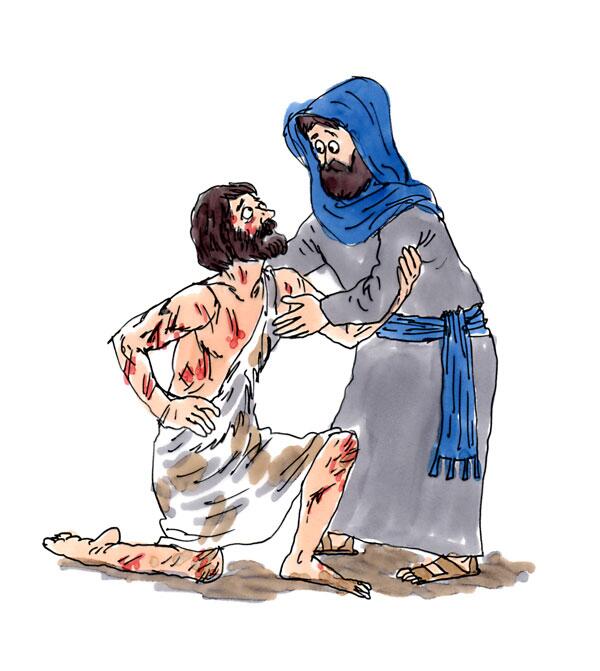
The man wanted to justify his actions, so he asked Jesus, “And who is my neighbor?” Jesus replied with a story: “A Jewish man was traveling from Jerusalem down to Jericho, and he was attacked by bandits. They stripped him of his clothes, beat him up, and left him half dead beside the road. “By chance a priest came along. But when he saw the man lying there, he crossed to the other side of the road and passed him by. A Temple assistant walked over and looked at him lying there, but he also passed by on the other side. “Then a despised Samaritan came along, and when he saw the man, he felt compassion for him. Going over to him, the Samaritan soothed his wounds with olive oil and wine and bandaged them. Then he put the man on his own donkey and took him to an inn, where he took care of him. The next day he handed the innkeeper two silver coins, telling him, ‘Take care of this man. If his bill runs higher than this, I’ll pay you the next time I’m here.’ “Now which of these three would you say was a neighbor to the man who was attacked by bandits?” Jesus asked. The man replied, “The one who showed him mercy.” Then Jesus said, “Yes, now go and do the same.” ~ (Luke 10:29-37)

sechumanistflower

Dear seclaris humanis atheisis:

Ok, so then what is your “idea” of Whom or what God is and how did you come to that conclusion?  You haven’t rejected God, but you call God a “hypothetical being?” You said you were a secular humanist and that you didn’t believe in God or that you even needed to. This is very confusing. Even though God created this earth, He knows about every person, everything, and even every sparrow that falls from the sky. Where is your real argument? What lies at the depth of your antagonism with the idea of God or the idea of God being creator?

I would like to pose something to you. So, you say you have not rejected God. Ok. But you say you have a problem believing in the “Christian” God. Now, I feel some of the reasons why you do not believe in the Christian God are from your presuppositions. This is because your presuppositions will not allow you to examine without bias the evidence that is presented to you for God’s existence. Your presupposition is that there is no Christian God; therefore, no matter what I might present to you to show His existence, you must interpret it in a manner consistent with your presupposition: namely, that there is no “Christian” God. If I were to have a video tape of God coming down from heaven, you’d say it was a special effect. If I had a thousand eye-witnesses saying they saw Him, you’d say it was mass-hysteria. If I had Old Testament prophecies fulfilled in the New Testament, you’d say they were forged, dated incorrectly, or not real prophecies.

So, I cannot prove anything to you since your presupposition won’t allow it. They are limited. Your presupposition cannot allow you to rightly determine God’s existence from evidence — providing that there were factual proofs of His existence. Don’t you see? If I DID have incontrovertible proof, your presupposition would force you to interpret the facts consistently with your presupposition and you would not be able to see the proof. If you truly would like to seek the answer, what kind of evidence would you accept that would prove the Christian God’s existence? I must see what your presuppositions are and work either with them or against them. What are your thoughts?

So, your answer is that Christianity is a myth. Yet, you still approach me with your presuppositions. I asked you to provide me with “the kind of evidence” you would accept. You’ve only provided me with your presupposition of “myth.”

I will pray that God reveals to me the answers you need…answers that I will not have to manufacture…but will be the evidence you need.

The first step on your quest is unconditional surrender to the absolute authority of Holy Scripture; the Bible is your only hope. It is your only hope for eternity. It is also the only hope for your scientific and philosophic endeavor in this life. God has revealed Himself through nature and history. The world’s wisdom has been made foolishness with God. It is God’s plan that is being realized in and through what man does as well as in and through man’s environment. Whatsoever comes to pass comes to pass in accordance with the one all comprehensive plan or counsel of God. All the facts that confront you as you look about yourself and as you look within yourself are therefore revelational of God. The human mind as knowing no less than the trees that are known is revelational of God. For what happens according to the plan of God happens in accordance with the nature of God’s being. Nothing could exist, either as directly made by God or as made by man, the creature of God. The subject of knowledge and the object of knowledge alike are revelational of God. The apostle Paul says in the first chapter of Romans that all men know God. They cannot help but know God. Therefore they cannot help but know that they themselves are creatures of God. Human self-consciousness involves God-consciousness. Human self-consciousness would be self-consciousness in a vacuum unless it implied consciousness of God. You have the sense of deity ineradicably impressed upon you.

Therefore your freedom is the freedom of God’s creature. It is freedom to do that which is in accord with or to do that which is against the revealed will of God, but in either case that which is in accord with the plan of God. I want to place a special emphasis upon the fact that even the evil that man does by virtue of his sinful will is still in accord with the plan of God and as such is revelatory of God. Man, not God, is the responsible author of sin. But man could not sin if his sinning were not, in spite of himself, revelatory of God. Man does not sin in a vacuum. He could not sin in a vacuum. The possibility of sin presupposes the all-comprehensive plan of God. God reveals his holiness in his wrath upon the sinner. God is angry with the wicked every day. “For the wrath of God is revealed from heaven against all ungodliness and unrighteousness of men, who hold down truth in unrighteousness” (Rom 1:18). Paul tells us that the sinner’s conscience excuses or accuses him according as he obeys or disobeys the revealed will of God (Rom 2:14-15). Man’s self-consciousness is moral self-consciousness. And as self-consciousness in general involves consciousness of God, so man’s moral self-consciousness involves consciousness of covenant relationship to God. To know himself at all man must know himself to be a covenant being. He knows he is either keeping or breaking the covenant.

You cannot look in any direction without seeing the face and the claims of God. You walk under the brilliant spotlight of the revelational claims of God. It is the basic revelational character of all created being that constitutes the foundation of truth for man. Man is inherently enveloped in and by truth. But truth is not an abstraction. Truth is truth about God and the universe. Thus man is naturally confronted by truth. When he speaks untruth he speaks that which he knows to be untruth. When philosophers think out systems of philosophy that are not based upon the Creator-creature distinction they know, in the depth of their hearts, that they are doing this in order to suppress the truth about themselves. Knowing God to be their Creator they do not glorify him as such. From the beginning of history, even before the entrance of sin, supernatural thought-communication on the part of God to man was added to God’s revelation to man in his own constitution and in the universe about him. There are two forms of revelation, revelation in the facts of the created universe whether within or about man and revelation by way of God’s directly speaking to man, are mutually involved in one another. Just as two rafters of a house need to support one another, so these two forms of revelation need to support one another. I don’t know how, but what you have experienced in your past up to now has determined that the God of the Bible must be limited in order to make room for the freedom of man. The attitude toward the revelation of God is determined by the assumption of human freedom as a measure of independence from God. Therefore, there is no real ground for saying that the revelation of God is really ultimately the revelation of God, the self-contained and self-sufficient God of which the Bible speaks. You cannot successfully seek for truth if first you have cut yourself off from truth. It is like today…a very sunny day, and while standing in the light of the sun, you take your eyes out, and then doubt whether the sun exists.

God will provide the shock and awe, and I really don’t think you’re going to appreciate that too much when the time comes. You already have been given overwhelming truth. You have to want to be healed….

I didn’t say God couldn’t shake you to your core….I’m saying you probably won’t like it when it occurs. Not probably…but most likely you will not like it when it occurs. God will shake things up in your life – or leave you to your own devices. Which one He decides upon, I just don’t know. I will help the human race by proclaiming the freeing Gospel of Jesus Christ.  I want to ask you, what part of your “Christian” upbringing did you in?

Hey, you know there is no proof, nor convincing, except that “Someone” rocks your world in a manner that will shake you all up inside. The statement you made is very plain about water boiling but to you, regarding faith, grace & works, you have nothing to do with it nor do you truly understand it from a Christian’s spiritual viewpoint. I say this because you do not believe or profess to be a Christian.  If you can, pray and ask God to speak to you about what I’ve shared, and then give me your thoughts.

Jesus Christ came into this world to open the eyes of the blind, quench the thirst of the weary wanderer, and give the bread of Life to those who seek to be filled. Jesus Christ can fulfill every need you have, and heal every hurt you’ve acquired over the years. Acknowledge your sinfulness, turn away from it, and place your trust in God through Jesus Christ — He will give you true enlightenment.

May God bless you with Himself!

+Gary

sideshow

The Sons of Thunder Ministries  –  John Crowder’s Mystical School, is coming to St. Cloud, MN in January and is laden with false teaching, mysticism, lies and deception.

After reading from John Crowders website – www.thenewmystics.com – I discovered all these Gnostic, new age teachings, that are Antinomian in content, and express forms of witchcraft, posing as Christian ministers using unbiblical forms of teaching claimed being from early Christianity or Eastern Orthodoxy:

Deeper courses in contemplative, supernatural Christianity Operate in Trances, Raptures & Ecstatic Prayer
Experience Physical Phenomena of Mysticism
Get Activated in Creative Miracles, Signs & Wonders
Understand & Access New Creation Realities
Gain A Historical Grid of Miracle Workers & Mystics
Be Activated in the Seer Realm, Prophecy, Spirit Travel
Receive Open Heavens & Revelatory Understanding
Access and Manifest the Glory Realm

As I read through this all on his website all I can say is where is Jesus Christ in all of this? Where is the truth of the Gospel in this? When I read about “deeper”, “creative” “signs and wonders”, “new creation realities”, etc., I am reminded of Lucifer; He wanted to be greater than God, and to exercise authority over God. He wanted to be greater than the Almighty, CREATOR, LORD of all. Who did Satan think he was? He was banished from the presence of God and cast into the earth as the prince of the powers of the air. Then Satan tempted Eve, and fed her a lie that “you can really be “like” god” John Crowder is saying the same things. These are deceiving teachings! Satan has and will continue to comes as an angel of light, “appearing” to be the “next thing” thing we need.

Beware of this false teacher. There are demons at work in this man, and I would not get any closer than a ten foot pole from him. He is deceiving many, just as Scripture states, he preaches and teaches “another gospel.” It is NOT the Gospel of the Apostles.

This is a warning. Read the Word of God. Most of what is mentioned above are considered abominations to God, and incurred God’s wrath, these kinds of “ministers” and what they “perform” are specifically written of in the OT. The New Testament makes mention of these false teachers and prophets also, and some of them are smitten by God because of their behavior.

Therefore, as one who has been charged to contend for the faith once for all delivered unto the saints, it is with a heavy heart that i must warn everyone I can about this non-Christian heretic posing as a minister of the Gospel – John Crowder’s is not the Gospel, it is a false gospel with a little “g”.

For more information on these and other heresies, please read:

https://purifyingfires.wordpress.com/2013/02/28/antinomians/

https://purifyingfires.wordpress.com/2013/05/24/the-definition-of-orthodoxy/