WHETHER ONE MAY FLEE FROM A DEADLY PLAGUE
1527
Translated by Carl J. Schindler
INTRODUCTION
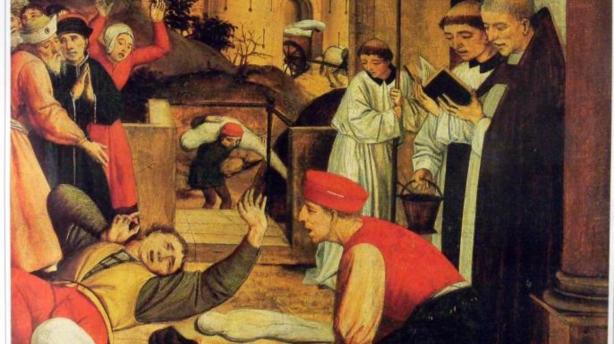
The Black Death, which from 1347 to 1350 swept out of China or India to the Crimea and thence into Europe and as far as Iceland, killed one-fourth of the population of Europe. This traumatic experience left a deep emotional imprint on the religious life, outlook, art, literature, folk customs, and superstitions of medieval Europe. Four great epidemics swept Germany in the fifteenth century and further ones occurred in the sixteenth.
The bubonic plague, as we know it, is spread by infected rats and other vermin. It is communicated to human beings by fleas, through infection in cuts and abrasions of the skin, even (as Luther surmised in the writing that follows) by breathing the air which has been polluted when the sick cough up germs, and by contact with the clothing and excrement of the ill. The sickness, after a very short incubation period, manifests itself as a fever accompanied by rapid pulse and sometimes by spells of delirium, speech disorders, and loss of consciousness. On the second day boils as large as hen’s eggs appear on the neck, legs, or in the armpits. If the boils penetrate the lymph glands, they infect the bloodstream and lead to death within three or four days. In cases where the germs enter the bloodstream and multiply there, death can occur in a moment to an apparently healthy person. At the height of an epidemic, the mortality rate can range from 30 to 90 percent and even higher.
On August 2, 1527, this dread plague struck Wittenberg. Fearing for the safety of Luther and the other professors at the university, Elector John, on August 10, ordered Luther to leave for Jena. Five days later the university moved to Jena, then to Schlieben near Wittenberg, where it remained until April of the following year. Unmoved by the elector’s letter or by the pleas of his friends, Luther, along with Bugenhagen, stayed to minister to the sick and frightened people. By August 19 there were eighteen deaths; the wife of the mayor, Tilo Dene, died almost in Luther’s arms; his own wife was pregnant and two women were sick in his own house; his little son Hans refused to eat for three days; chaplain George Rörer’s wife, also pregnant, took sick and lost both her baby and her life; Bugenhagen and his family then moved into Luther’s house for mutual encouragement. Writing to Amsdorf, Luther spoke about his Anfechtungen and about the hospital in his house, closing his letter by saying, “So there are battles without and terrors within and really grim ones; Christ is punishing us. It is a comfort that we can confront Satan’s fury with the word of God, which we have, and which saves souls even if that one should devour our bodies. Commend us to the brethren and yourself to pray for us that we may endure bravely under the hand of the Lord and overcome the power and cunning of Satan, be it through dying or living. Amen. At Wittenberg on All Saints’ Day in the tenth year after the trampling down of the papal bull, in remembrance of which we, comforted .in both respects, have drunk a toast.”1 By the end of November the plague had definitely receded and in December Luther’s wife was happily delivered of her child, Elizabeth.
The plague also appeared in Breslau in Silesia, on August 10, 1527, and continued until November 19 of that year. A question had been raised among the clergy of that city whether it was proper for a Christian to flee from such deadly peril. Through Johann Hess, the recognized leader of the Reformation in Silesia, they wrote to Luther asking his advice, and when a first letter brought no answer, they wrote again. Luther was not inclined to answer immediately, in part because of illness and severe spells of depression which struck him July 6. Near the end of July, he began an answer to be published in the form of an open letter. Changes in handwriting and the kind of paper used (the original printer’s manuscript has been preserved) indicate that the writing was interrupted twice. In the meantime, the plague struck Wittenberg, and the people around Luther heard how a Dominican in Leipzig had, early in September, mocked the way the Wittenbergers had run away from the plague. These events stimulated Luther to finish the letter, which was completed not later than the first part of November.
In this open letter to Hess, Luther declares that the Christian pastor, lake a good shepherd and not a hireling, is commanded by Christ to stay despite the danger of death because he is needed by his flock for comfort and strength in the hour of death. Similarly, city officials and all who are bound by responsibilities to their neighbors are not free to flee. Even servants should not flee unless given permission by their masters, nor even a neighbor unless there is someone else to take his place in caring for the sick. If not bound by such responsibilities to one’s neighbor, one may flee rather than tempt God by exposing oneself to contagion. Luther goes on to suggest the establishment of public hospitals rather than using private homes for that purpose. He has a word for those who are horrified at having to nurse the sick, explaining that this feeling is a weapon of the devil and that many who nurse the sick with love and devotion are protected against the plague. But if they should succumb, God, Himself would be their nurse and physician. On the other hand, he warns against the over-bold who scorn ordinary precautions against contagion, thus tempting God, who has created medicine and given us the intelligence to care for our bodily health. Furthermore, such recklessness endangers others with whom one comes in contact. Use medicine, take what helps you, fumigate the house, yard, and streets, avoid unnecessary contact with the sick and their houses, Luther exhorts. He warns against those who, reportedly, when they get sick deliberately spread contagion out of spite; these should be arrested and executed. Luther suggests that another means to combat the plague would be to establish quiet, well-kept cemeteries outside the city to avoid contamination in the crowded town. He urges that the pastor be called promptly in case of sickness and not when it is too late and the ill person is unconscious. Furthermore, daily services should be conducted with the ministry of the word, as Luther did in Wittenberg. While enlarging on his opinion, Luther was careful not to take from his friends the personal responsibility of making their own decisions in the light of their accountability to God.
The fourteen-page pamphlet was published by Hans Lufft in 1527 and was reprinted in nineteen subsequent editions. It enjoyed a wide circulation, particularly in times of pestilence. An English translation by Theodore G. Tappert of a substantial part of this open letter was published in 1955 in Luther: Letters of Spiritual Counsel, pp. 230–244. The translation which follows is based on the printed text of the original manuscript text, Ob man vor dem Sterben fliehen möge in WA 23, (323) 339–379.
WHETHER ONE MAY FLEE FROM A DEADLY PLAGUE
To the Reverend Doctor Johann Hess, pastor at Breslau, and to his fellow-servants of the gospel of Jesus Christ
Martinus Luther
Grace and peace from God our Father and our Lord Jesus Christ. Your letter, sent to me at Wittenberg, was received some time ago. You wish to know whether it is proper for a Christian to run away from a deadly plague. I should have answered long ago, but God has for some time disciplined and scourged me so severely that I have been unable to do much reading or writing.1 Furthermore, it occurred to me that God, the merciful Father, has endowed you so richly with wisdom and truth in Christ that you yourself should be well qualified to decide this matter or even weightier problems in his Spirit and grace without our assistance.
But now that you keep on writing to me and have, so to speak, humbled yourself in requesting our view on this matter so that, as St. Paul repeatedly teaches, we may always agree with one another and be of one mind [I Cor. 1:10; II Cor. 13:11; Phil. 2:2]. Therefore we here give you our opinion as far as God grants us to understand and perceive. This we would humbly submit to your judgment and to that of all devout Christians for them, as is proper, to come to their own decision and conclusion. Since the rumor of death is to be heard in these and many other parts also, we have permitted these instructions of ours to be printed because others might also want to make use of them.
To begin with, some people are of the firm opinion that one need not and should not run away from a deadly plague. Rather, since death is God’s punishment, which he sends upon us for our sins, we must submit to God and with a true and firm faith patiently await our punishment. They look upon running away as an outright wrong and as lack of belief in God. Others take the position that one may properly flee, particularly ff one holds no public office.
I cannot censure the former for their excellent decision. They uphold a good cause, namely, a strong faith in God, and deserve commendation because they desire every Christian to hold to a strong, firm faith. It takes more than a milk2 faith to await a death before which most of the saints themselves have been and still are in dread. Who would not acclaim these earnest people to whom death is a little thing? They willingly accept God’s chastisement, doing so without tempting God, as we shall hear later on.
Since it is generally true of Christians that few are strong and many are weak, one simply cannot place the same burden upon everyone. A person who has a strong faith can drink poison and suffer no harm, Mark 16 [:18], while one who has a weak faith would thereby drink to his death. Peter could walk upon the water because he was strong in faith. When he began to doubt and his faith weakened, he sank and almost drowned.3 When a strong man travels with a weak man, he must restrain himself so as not to walk at a speed proportionate to his strength lest he set a killing pace for his weak companion. Christ does not want his weak ones to be abandoned, as St. Paul teaches in Romans 15 [:1] and I Corinthians 12 [:22 ff.]. To put it briefly and concisely, running away from death may happen in one of two ways. First, it may happen in disobedience to God’s word and command. For instance, in the case of a man who is imprisoned for the sake of God’s word and who, to escape death, denies and repudiates God’s word. In such a situation everyone has Christ’s plain mandate and command not to flee but rather to suffer death, as he says, “Whoever denies me before men, I will also deny before my Father who is in heaven” and “Do not fear those who kill the body but cannot kill the soul,” Matthew 10 [:28, 33].
Those who are engaged in a spiritual ministry such as preachers and pastors must likewise remain steadfast before the peril of death.4 We have a plain command from Christ, “A good shepherd lays down his life for the sheep, but the hireling sees the wolf coming and flees” [John 10:11]. For when people are dying, they most need a spiritual ministry which strengthens and comforts their consciences by word and sacrament and in faith overcomes death. However, where enough preachers are available in one locality and they agree to encourage the other clergy to leave in order not to expose themselves needlessly to danger, I do not consider such conduct sinful because spiritual services are provided for and because they would have been ready and willing to stay ff it had been necessary. We read that St. Athanasius5 fled from his church that his life might be spared because many others were there to administer his office. Similarly, the brethren in Damascus lowered Paul in a basket over the wall to make it possible for him to escape, Acts 9 [:25]. And also in Acts 19 [:30] Paul allowed himself to be kept from risking danger in the marketplace because it was not essential for him to do so.
Accordingly, all those in public office such as mayors, judges, and the like are under obligation to remain. This, too, is God’s word, which institutes secular authority and commands that town and country be ruled, protected, and preserved, as St. Paul teaches in Romans 13 [:4], “The governing authorities are God’s ministers for your own good.” To abandon an entire community which one has been called to govern and to leave it without official or government, exposed to all kinds of danger such as fires, murder, riots, and every imaginable disaster is a great sin. It is the kind of disaster the devil would like to instigate wherever there is no law and order. St. Paul says, “Anyone who does not provide for his own family denies the faith and is worse than an unbeliever” [I Tim. 5:8]. On the other hand, if in great weakness they flee but provide capable substitutes to make sure that the community is well-governed and protected, as we previously indicated, and ff they continually and carefully supervise them [i.e., the substitutes], all that would be proper.
What applies to these two offices [church and state] should also apply to persons who stand in a relationship of service or duty toward one another. A servant should not leave his master nor a maid her mistress except with the knowledge and permission of master or mistress. Again, a master should not desert his servant or a lady her maid unless suitable provision for their care has been made somewhere. In all these matters it is a divine command that servants and maids should render obedience and by the same token masters and ladies should take care of their servants.6 Likewise, fathers and mothers are bound by God’s law to serve and help their children, and children their fathers and mothers. Likewise, paid public servants such as city physicians, city clerks, and constables, or whatever their titles, should not flee unless they furnish capable substitutes who are acceptable to their employer.
In the case of children who are orphaned, guardians or close friends are under obligation either to stay with them or to arrange diligently for other nursing care for their sick friends. Yes, no one should dare leave his neighbor unless there are others who will take care of the sick in their stead and nurse them. In such cases we must respect the word of Christ, “I was sick and you did not visit me …” [Matt. 25:41–46]. According to this passage, we are bound to each other in such a way that no one may forsake the other in his distress but is obliged to assist and help him as he himself would like to be helped.7
Where no such emergency exists and where enough people are available for nursing and taking care of the sick, and where, voluntarily or by orders, those who are weak in faith make provision so that there is no need for additional helpers, or where the sick do not want them and have refused their services, I judge that they have an equal choice either to flee or to remain. If someone is sufficiently bold and strong in his faith, let him stay in God’s name; that is certainly no sin. If someone is weak and fearful, let him flee in God’s name as long as he does not neglect his duty toward his neighbor but has made adequate provision for others to provide nursing care. To flee from death and to save one’s life is a natural tendency, implanted by God and not forbidden unless it be against God and neighbor, as St. Paul says in Ephesians 4 [5:29], “No man ever hates his own flesh, but nourishes and cherishes it.” It is even commanded that every man should as much as possible preserve body and life and not neglect them, as St. Paul says in I Corinthians 12 [:21–26] that God has so ordered the members of the body that each one cares and works for the other.
It is not forbidden but rather commanded that by the sweat of our brow we should seek our daily food, clothing, and all we need and avoid destruction and disaster whenever we can, as long as we do so without detracting from our love and duty toward our neighbor. How much more appropriate it is, therefore, to seek to preserve life and avoid death ff this can be done without harm to our neighbor, inasmuch as life is more than food and clothing, as Christ himself says in Matthew 5 [6:25]. If someone is so strong in faith, however, that he can willingly suffer nakedness, hunger, and want without tempting God and not trying to escape, although he could do so, let him continue that way, but let him not condemn those who will not or cannot do the same.
Examples in Holy Scripture abundantly prove that to flee from death is not wrong in itself. Abraham was a great saint, but he feared death and escaped it by pretending that his wife, Sarah, was his sister.8 Because he did so without neglecting or adversely affecting his neighbor, it was not counted as a sin against him. His son, Isaac, did likewise.9 Jacob also fled from his brother Esau to avoid death at his hands.10 Likewise, David fled from Saul, and from Absalom.11 The prophet Uriah escaped from King Jehoiakim and fled into Egypt.12 The valiant prophet, Elijah, I Kings 19 [:3], had destroyed all the prophets of Baal by his great faith, but afterward, when Queen Jezebel threatened him, he became afraid and fled into the desert. Before that, Moses fled into the land of Midian when the king searched for him in Egypt.13 Many others have done likewise. All of them fled from death when it was possible and saved their lives, yet without depriving their neighbors of anything but first meeting their obligations toward them.
Yes, you may reply, but these examples do not refer to dying by pestilence but to death under persecution. Answer: Death is death, no matter how it occurs. According to Holy Scripture God sent his four scourges: pestilence, famine, sword, and wild beasts.14 If it is permissible to flee from one or the other in clear conscience, why not from all four? Our examples demonstrate how the holy fathers escaped from the sword; it is quite evident that Abraham, Isaac, and Jacob fled from the other scourge, namely, hunger and death, when they went to Egypt to escape famine, as we are told in Genesis [40–47]. Likewise, why should one not run away from wild beasts? I hear people say, “If war or the Turks come, one should not flee from his village or town but stay and await God’s punishment by the sword.” That is quite true; let him who has a strong faith wait for his death, but he should not condemn those who take flight.
By such reasoning, when a house is on fire, no one should run outside or rush to help because such a fire is also a punishment from God. Anyone who falls into deep water dare not save himself by swimming but must surrender to the water as to a divine punishment. Very well, do so if you can but do not tempt God, and allow others to do as much as they are capable of doing. Likewise, if someone breaks a leg, is wounded or bitten, he should not seek medical aid but say, “It is God’s punishment. I shall bear it until it heals by itself.” Freezing weather and winter are also God’s punishment and can cause death. Why run to get inside or near a fire? Be strong and stay outside until it becomes warm again. We should then need no apothecaries or drugs or physicians because all illnesses are a punishment from God. Hunger and thirst are also great punishments and torture. Why do you eat and drink instead of letting yourself be punished until hunger and thirst stop of themselves? Ultimately such talk will lead to the point where we abbreviate the Lord’s Prayer and no longer pray, “deliver us from evil, Amen,” since we would have to stop praying to be saved from hell and stop seeking to escape it. It, too, is God’s punishment as is every kind of evil. Where would all this end?
From what has been said we derive this guidance: We must pray against every form of evil and guard against it to the best of our ability in order not to act contrary to God, as was previously explained. If it be God’s will that evil come upon us and destroy us, none of our precautions will help us. Everybody must take this to heart: first of all, if he feels bound to remain where death rages in order to serve his neighbor, let him commend himself to God and say, “Lord, I am in thy hands; thou hast kept me here; thy will be done. I am thy lowly creature. Thou canst kill me or preserve me in this pestilence in the same way as if I were in fire, water, drought, or any other danger.” If a man is free, however, and can escape, let him commend himself and say, “Lord God, I am weak and fearful. Therefore I am running away from evil and am doing what I can to protect myself against it. I am nevertheless in thy hands in this danger as in any other which might overtake me. Thy will be done. My flight alone will not succeed of itself because calamity and harm are everywhere. Moreover, the devil never sleeps. He is a murderer from the beginning [John 8:44] and tries everywhere to instigate murder and misfortune.”15
In the same way, we must and we owe it to our neighbor to accord him the same treatment in other troubles and perils, also. If his house is on fire, love compels me to run to help him extinguish the flames. If there are enough other people around to put the fire out, I may either go home or remain to help. If he falls into the water or into a pit I dare not turn away but must hurry to help him as best I can. If there are others to do it, I am released. If I see that he is hungry or thirsty, I cannot ignore him but must offer food and drink, not considering whether I would risk impoverishing myself by doing so. A man who will not help or support others unless he can do so without affecting his safety or his property will never help his neighbor. He will always reckon with the possibility that doing so will bring some disadvantage and damage, danger and loss. No neighbor can live alongside another without risk to his safety, property, wife, or child. He must run the risk that fire or some other accident will start in the neighbor’s house and destroy him bodily or deprive him of his goods, wife, children, and all he has.
Anyone who does not do that for his neighbor, but forsakes him and leaves him to his misfortune, becomes a murderer in the sight of God, as St. John states in his epistles, “Whoever does not love his brother is a murderer,” and again, “If anyone has the world’s goods, and sees his brother in need [yet closes his heart against him], how does God’s love abide in him?” [I John 3:15, 17]. That is also one of the sins which God attributed to the city of Sodom when he speaks through the prophet Ezekiel [16:49], “Behold, this was the guilt of your sister Sodom: she and her daughters had pride, surfeit of food, and prosperous ease, but did not aid the poor and needy.” Christ, therefore, will condemn them as murderers on the Last Day when he will say, “I was sick and you did not visit me” [Matt. 25:43]. If that shall be the judgment upon those who have failed to visit the sick and needy or to offer them relief, what will become of those who abandoned them and let them lie there like dogs and pigs? Yes, how will they fare who rob the poor of the little they have and plague them in all kinds of ways? That is what the tyrants do to the poor who accept the gospel. But let that be; they have their condemnation.
It would be well, where there is such an efficient government in cities and states, to maintain municipal homes and hospitals staffed with people to take care of the sick so that patients from private homes can be sent there—as was the intent and purpose of our forefathers with so many pious bequests, hospices, hospitals, and infirmaries so that it should not be necessary for every citizen to maintain a hospital in his own home. That would indeed be a fine, commendable, and Christian arrangement to which everyone should offer generous help and contributions, particularly the government. Where there are no such institutions—and they exist in only a few places—we must give hospital care and be nurses for one another in any extremity or risk the loss of salvation and the grace of God. Thus it is written in God’s word and command, “Love your neighbor as yourself,” and in Matthew 7 [:12], “So whatever you wish that men would do to you, do so to them.”
Now if a deadly epidemic strikes, we should stay where we are, make our preparations, and take courage in the fact that we are mutually bound together (as previously indicated) so that we cannot desert one another or flee from one another. First, we can be sure that God’s punishment has come upon us, not only to chastise us for our sins but also to test our faith and love—our faith in that we may see and experience how we should act toward God; our love in that we may recognize how we should act toward our neighbor. I am of the opinion that all the epidemics, like any plague, are spread among the people by evil spirits who poison the air or exhale a pestilential breath which puts a deadly poison into the flesh. Nevertheless, this is God’s decree and punishment to which we must patiently submit and serve our neighbor, risking our lives in this manner as St. John teaches, “If Christ laid down his life for us, we ought to lay down our lives for the brethren” [I John 3:16].
When anyone is overcome by horror and repugnance in the presence of a sick person he should take courage and strength in the firm assurance that it is the devil who stirs up such abhorrence, fear, and loathing in his heart. He is such a bitter, knavish devil that he not only unceasingly tries to slay and kill, but also takes delight in making us deathly afraid, worried, and apprehensive so that we should regard dying as horrible and have no rest or peace all through our life. And so the devil would excrete us out of this life as he tries to make us despair of God, become unwilling and unprepared to die, and, under the stormy and dark sky of fear and anxiety, make us forget and lose Christ, our light and life, and desert our neighbor in his troubles. We would sin thereby against God and man; that would be the devil’s glory and delight. Because we know that it is the devil’s game to induce such fear and dread, we should, in turn, minimize it, take such courage as to spite and annoy him, and send those terrors right back to him. And we should arm ourselves with this answer to the devil:
“Get away, you devil, with your terrors! Just because you hate it, I’ll spite you by going the more quickly to help my sick neighbor. I’ll pay no attention to you: I’ve got two heavy blows to use against you: the first one is that I know that helping my neighbor is a deed well-pleasing to God and all the angels; by this deed, I do God’s will and render true service and obedience to him. All the more so because if you hate it so and are so strongly opposed to it, it must be particularly acceptable to God. I’d do this readily and gladly if I could please only one angel who might look with delight on it. But now that it pleases my Lord Jesus Christ and the whole heavenly host because it is the will and command of God, my Father, then how could any fear of you cause me to spoil such joy in heaven or such delight for my Lord? Or how could I, by flattering you, give you and your devils in hell reason to mock and laugh at me? No, you’ll not have the last word! If Christ shed his blood for me and died for me, why should I not expose myself to some small dangers for his sake and disregard this feeble plague? If you can terrorize, Christ can strengthen me. If you can kill, Christ can give life. If you have poison in your fangs, Christ has far greater medicine. Should not my dear Christ, with his precepts, his kindness, and all his encouragement, be more important in my spirit than you, roguish devil, with your false terrors in my weak flesh? God forbid! Get away, devil. Here is Christ and here am I, his servant in this work. Let Christ prevail! Amen.”
The second blow against the devil is God’s mighty promise by which he encourages those who minister to the needy. He says in Psalm 41 [:1–3], “Blessed is he who considers the poor. The Lord will deliver him in the day of trouble. The Lord will protect him and keep him alive; the Lord will bless him on earth and not give him up to the will of his enemies. The Lord will sustain him on his sickbed. In his illness, he will heal all his infirmities.” Are not these glorious and mighty promises of God heaped up upon those who minister to the needy? What should terrorize us or frighten us away from such great and divine comfort? The service we can render to the needy is indeed such a small thing in comparison with God’s promises and rewards that St. Paul says to Timothy, “Godliness is of value in every way, and it holds promise both for the present life and for the life to come” [I Tim. 4:8]. Godliness is nothing else but service to God. Service to God is indeed service to our neighbor. It is proved by experience that those who nurse the sick with love, devotion, and sincerity are generally protected. Though they are poisoned, they are not harmed. As the psalm says, “in his illness, you heal all his infirmities” [Ps. 41:3], that is, you change his bed of sickness into a bed of health. A person who attends a patient because of greed, or with the expectation of an inheritance or some personal advantage in such services, should not be surprised if eventually he is infected, disfigured, or even dies before he comes into possession of that estate or inheritance.
But whoever serves the sick for the sake of God’s gracious promise, though he may accept a suitable reward to which he is entitled, inasmuch as every laborer is worthy of his hire—whoever does so has the great assurance that he shall, in turn, be cared for. God himself shall be his attendant and his physician, too. What an attendant he is! What a physician! Friend, what are all the physicians, apothecaries, and attendants in comparison to God? Should that not encourage one to go and serve a sick person, even though he might have as many contagious boils on him as hairs on his body, and though he might be bent double carrying a hundred plague-ridden bodies! What do all kinds of pestilence or devils mean over against God, who binds and obliges himself to be our attendant and physician? Shame and more shame on you, you out-and-out unbeliever, for despising such great comfort and letting yourself become more frightened by some small boil or some uncertain danger than emboldened by such sure and faithful promises of God! What would it avail you if all physicians and the entire world were at your service, but God were not present? Again, what harm could overtake you if the whole world were to desert you and no physician would remain with you, but God would abide with you with his assurance? Do you not know that you are surrounded as by thousands of angels who watch over you in such a way that you can indeed trample upon the plague, as it is written in Psalm 91 [:11–13], “He has given His angels charge of you to guard you in all your ways. On their hands, they will bear you up lest you dash your foot against a stone. You will tread upon the lion and the adder, and trample the young lion and the serpent underfoot.”
Therefore, dear friends, let us not become so desperate as to desert our own whom we are duty-bound to help and flee in such a cowardly way from the terror of the devil or allow him the joy of mocking us and vexing and distressing God and all his angels. For it is certainly true that he who despises such great promises and commands of God and leaves his own people destitute violates all of God’s laws and is guilty of the murder of his neighbor whom he abandons. I fear that in such a case God’s promise will be reversed and changed into horrible threats and the psalm [41] will then read this way against them: “Accursed is he who does not provide for the needy but escapes and forsakes them. The Lord, in turn, will not spare him in evil days but will flee from him and desert him, The Lord will not preserve him and keep him alive and will not prosper him on earth but will deliver him into the hands of his enemies. The Lord will not refresh him on his sickbed nor take him from the couch of his illness.” For “the measure you give will be the measure you get” [Matt. 7:2]. Nothing else can come of it. It is terrible to hear this, more terrible to be waiting for this to happen, most terrible to experience it. What else can happen if God withdraws his hand and forsakes us except sheer devilment and every kind of evil? It cannot be otherwise if, against God’s command, one abandons his neighbor. This fate will surely overtake anyone of this sort unless he sincerely repents.
This I well know, that if it were Christ or his mother who were laid low by illness, everybody would be so solicitous and would gladly become a servant or helper. Everyone would want to be bold and fearless; nobody would flee but everyone would come running. And yet they don’t hear what Christ himself says, “As you did to one of the least, you did it to me” [Matt. 25:40]. When he speaks of the greatest commandment he says, “The other commandment is like unto it, you shall love your neighbor as yourself” [Matt. 22:39]. There you hear that the command to love your neighbor is equal to the greatest commandment to love God and that what you do or fail to do for your neighbor means doing the same to God. If you wish to serve Christ and to wait on him, very well, you have your sick neighbor close at hand. Go to him and serve him, and you will surely find Christ in him, not outwardly but in his word. If you do not wish or care to serve your neighbor you can be sure that if Christ lay there instead you would not do so either and would let him lie there. Those are nothing but illusions on your part which puff you up with vain pride, namely, that you would really serve Christ if he were there in person. Those are nothing but lies; whoever wants to serve Christ in person would surely serve his neighbor as well. This is said as an admonition and encouragement against fear and a disgraceful flight to which the devil would tempt us so that we would disregard God’s command in our dealings with our neighbor and so we would fall into sin on the left hand.
Others sin on the right hand. They are much too rash and reckless, tempting God and disregarding everything which might counteract death and the plague. They disdain the use of medicines; they do not avoid places and persons infected by the plague, but lightheartedly make sport of it and wish to prove how independent they are. They say that it is God’s punishment; if he wants to protect them he can do so without medicines or our carefulness. This is not trusting God but tempting him. God has created medicines and provided us with intelligence to guard and take good care of the body so that we can live in good health.
If one makes no use of intelligence or medicine when he could do so without detriment to his neighbor, such a person injures his body and must beware lest he become a suicide in God’s eyes. By the same reasoning a person might forego eating and drinking, clothing and shelter, and boldly proclaim his faith that if God wanted to preserve him from starvation and cold, he could do so without food and clothing. Actually, that would be suicide. It is even more shameful for a person to pay no heed to his own body and to fail to protect it against the plague the best he is able, and then to infect and poison others who might have remained alive if he had taken care of his body as he should have. He is thus responsible before God for his neighbor’s death and is a murderer many times over. Indeed, such people behave as though a house were burning in the city and nobody were trying to put the fire out. Instead, they give leeway to the flames so that the whole city is consumed, saying that if God so willed, he could save the city without water to quench the fire.
No, my dear friends, that is no good. Use medicine; take potions which can help you; fumigate house, yard, and street; shun persons and places wherever your neighbor does not need your presence or has recovered, and act like a man who wants to help put out the burning city. What else is the epidemic but a fire which instead of consuming wood and straw devours life and body? You ought to think this way: “Very well, by God’s decree, the enemy has sent us poison and deadly offal. Therefore I shall ask God mercifully to protect us. Then I shall fumigate, help purify the air, administer medicine, and take it. I shall avoid places and persons where my presence is not needed in order not to become contaminated and thus perchance infect and pollute others, and so cause their death as a result of my negligence. If God should wish to take me, he will surely find me and I have done what he has expected of me and so I am not responsible for either my own death or the death of others. If my neighbor needs me, however, I shall not avoid place or person but will go freely, as stated above. See, this is such a God-fearing faith because it is neither brash nor foolhardy and does not tempt God.
Moreover, he who has contracted the disease and recovered should keep away from others and not admit them into his presence unless it be necessary. Though one should aid him in his time of need, as previously pointed out, he, in turn, should, after his recovery, so act toward others that no one becomes unnecessarily endangered on his account and so cause another’s death. “Whoever loves danger,” says the wise man, “will perish by it” [Ecclus. 3:26]. If the people in a city were to show themselves bold in their faith when a neighbor’s need so demands, and cautious when no emergency exists, and if everyone would help ward off contagion as best he can, then the death toll would indeed be moderate. But if some are too panicky and desert their neighbors in their plight, and if some are so foolish as not to take precautions but aggravate the contagion, then the devil has a heyday and many will die. On both counts this is a grievous offense to God and to man—here it is tempting God; there it is bringing man into despair. Then the one who flees, the devil will pursue; the one who stays behind, the devil will hold captive so that no one escapes him.
Some are even worse than that. They keep it secret that they have the disease and go among others in the belief that by contaminating and poisoning others they can rid themselves of the plague and so recover. With this idea they enter streets and homes, trying to saddle children or servants with the disease and thus save themselves. I certainly believe that this is the devil’s doing, who helps turn the wheel of fate to make this happen. I have been told that some are so incredibly vicious that they circulate among people and enter homes because they are sorry that the plague has not reached that far and wish to carry it in, as though it were a prank like putting lice into fur garments or flies into someone’s living room. I do not know whether I should believe this; if it is true, I do not know whether we Germans are not really devils instead of human beings. It must be admitted that there are some extremely coarse and wicked people. The devil is never idle. My advice is that if any such persons are discovered, the judge should take them by the ear and turn them over to Master Jack, the hangman, as outright and deliberate murderers. What else are such people but assassins in our town? Here and there an assassin will jab a knife through someone and no one can find the culprit. So these folk infect a child here, a woman there, and can never be caught. They go on laughing as though they had accomplished something. Where this is the case, it would be better to live among wild beasts than with such murderers. I do not know how to preach to such killers. They pay no heed. I appeal to the authorities to take charge and turn them over to the help and advice not of physicians, but of Master Jack, the hangman.
If in the Old Testament God himself ordered lepers to be banished from the community and compelled to live outside the city to prevent contamination [Leviticus 13–14], we must do the same with this dangerous pestilence so that anyone who becomes infected will stay away from other persons, or allow himself to be taken away and given speedy help with medicine. Under such circumstances, it is our duty to assist such a person and not forsake him in his plight, as I have repeatedly pointed out before. Then the poison is stopped in time, which benefits not only the individual but also the whole community, which might be contaminated if one person is permitted to infect others. Our plague here in Wittenberg has been caused by nothing but filth. The air, thank God, is still clean and pure, but some few have been contaminated because of the laziness or recklessness of some. So the devil enjoys himself at the terror and flight which he causes among us. May God thwart him! Amen.
This is what we think and conclude on this subject of fleeing from death by the plague. If you are of a different opinion, may God enlighten you. Amen.16
Because this letter will go out in print for people to read, I regard it useful to add some brief instructions on how one should care and provide for the soul in time of death. We have done this orally from the pulpit and still do so every day in fulfillment of the ministry to which we have been called as pastors.
First, one must admonish the people to attend church and listen to the sermon so that they learn through God’s word how to live and how to die. It must be noted that those who are so uncouth and wicked as to despise God’s word while they are in good health should be left unattended when they are sick unless they demonstrate their remorse and repentance with great earnestness, tears, and lamentation. A person who wants to live like a heathen or a dog and does not publicly repent should not expect us to administer the sacrament to him or have us count him a Christian. Let him die as he has lived because we shall not throw pearls before swine nor give to dogs what is holy [Matt. 7:6]. Sad to say, there are many churlish, hardened ruffians who do not care for their souls when they live or when they die. They simply lie down and die like unthinking hulks.
Second, everyone should prepare in time and get ready for death by going to confession and taking the sacrament once every week or fortnight. He should become reconciled with his neighbor and make his will so that if the Lord knocks and he departs before a pastor or chaplain can arrive, he has provided for his soul, has left nothing undone, and has committed himself to God. When there are many fatalities and only two or three pastors on duty, it is impossible to visit everyone, to give instruction, and to teach each one what a Christian ought to know in the anguish of death. Those who have been careless and negligent in these matters must account for themselves. That is their own fault. After all, we cannot set up a private pulpit and altar daily at their bedside simply because they have despised the public pulpit and altar to which God has summoned and called them.
Third, if someone wants the chaplain or pastor to come, let the sick person send word in time to call him and let him do so early enough while he is still in his right mind before the illness overwhelms the patient. The reason I say this is that some are so negligent that they make no request and send no message until the soul is perched for flight on the tip of their tongues17 and they are no longer rational or able to speak. Then we are told, “Dear Sir, say the very best you can to him,” etc. But earlier, when the illness first began, they wanted no visit from the pastor but would say, “Oh, there’s no need. I hope he’ll get better.” What should a diligent pastor do with such people who neglect both body and soul? They live and die like beasts in the field. They want us to teach them the gospel at the last minute and administer the sacrament to them as they were accustomed to it under the papacy when nobody asked whether they believed or understood the gospel but just stuffed the sacrament down their throats as if into a bread bag.
This won’t do. If someone cannot talk or indicate by a sign that he believes, understands, and desires the sacrament—particularly if he has willfully neglected it—we will not give it to him just anytime he asks for it. We have been commanded not to offer the holy sacrament to unbelievers but rather to believers who can state and confess their faith. Let the others alone in their unbelief; we are guiltless because we have not been slothful in preaching, teaching, exhortation, consolation, visitation, or in anything else that pertains to our ministry and office. This, in brief, is our instruction and what we practice here. We do not write this for you in Breslau, because Christ is with you and without our aid he will amply instruct you and supply your needs with his own ointment. To him be praise and honor together with God the Father and the Holy Spirit, world without end. Amen.18
Because we have come upon the subject of death, I cannot refrain from saying something about burials. First of all, I leave it to the doctors of medicine and others with greater experience than mine in such matters to decide whether it is dangerous to maintain cemeteries within the city limits. I do not know and do not claim to understand whether vapors and mists arise out of graves to pollute the air. If this were so my previously stated warnings constitute ample reason to locate cemeteries outside the city. As we have learned, all of us have the responsibility of warding off this poison to the best of our ability because God has commanded us to care for the body, to protect and nurse it so that we are not exposed needlessly. In an emergency, however, we must be bold enough to risk our health if that is necessary. Thus we should be ready for both—to live and to die according to God’s will. For “none of us lives to himself and none of us dies to himself,” as St. Paul says, Romans 15 [14:7].
It is very well known that the custom in antiquity, both among Jews and pagans, among saints and sinners, was to bury the dead outside the city. Those people were just as prudent as we claim to be ourselves. This is also evident in St. Luke’s Gospel when Christ raised from the dead the widow’s son at the gates of Nain (for the text [Luke 7:12] states, “He was being carried out of the city to the grave and a large crowd from the city was with her”). In that country, it was the practice to bury the dead outside the town.
Christ’s tomb, also, was prepared outside the city. Abraham, too, bought a burial plot in the field of Ephron near the double cave19 where all the patriarchs wished to be buried. The Latin, therefore, employs the term efferi, that is, “to carry out,” by which we mean “carry to the grave.” They not only carried the dead out but also burned them to powder to keep the air as pure as possible.
My advice, therefore, is to follow these examples and to bury the dead outside the town. Not only necessity but piety and decency should induce us to provide a public burial ground outside the town, that is, our town of Wittenberg.
A cemetery rightfully ought to be a fine quiet place, removed from all other localities, to which one can go and reverently meditate upon death, the Last Judgment, the resurrection, and say one’s prayers. Such a place should properly be a decent, hallowed place, to be entered with trepidation and reverence because doubtlessly some saints rest there. It might even be arranged to have religious pictures and portraits painted on the walls.
But our cemetery, what is it like? Four or five alleys, two or three marketplaces, with the result that no place in the whole town is busier or noisier than the cemetery. People and cattle roam over it at any time, night and day. Everyone has a door or pathway to it from his house and all sorts of things take place there, probably even some that are not fit to be mentioned. This totally destroys respect and reverence for the graves, and people think no more about walking across it than if it were a burial ground for executed criminals. Not even the Turk would dishonor the place the way we do. And yet a cemetery should inspire us to devout thoughts, to the contemplation of death and the resurrection, and to respect for the saints who rest there. How can that be done at such a commonplace through which everyone must walk and into which every man’s door opens? If a cemetery is to have some dignity, I would rather be put to rest in the Elbe or in the forest. If a graveyard were located at a quiet, remote spot where no one could make a path through it, it would be a spiritual, proper, and holy sight and could be so arranged that it would inspire devotion in those who go there. That would be my advice. Follow it, who so wishes. If anyone knows better, let him go ahead. I am no man’s master.
In closing, we admonish and plead with you in Christ’s name to help us with your prayers to God so that we may do battle with word and precept against the real and spiritual pestilence of Satan in his wickedness with which he now poisons and defiles the world. That is, particularly against those who blaspheme the sacrament, though there are other sectarians also. Satan is infuriated and perhaps he feels that the day of Christ is at hand. That is why he raves so fiercely and tries through the enthusiasts20 to rob us of the Savior, Jesus Christ. Under the papacy, Satan was simply “flesh” so that even a monk’s cap had to be regarded as sacred. Now he is nothing more than sheer “spirit” and Christ’s flesh and word are no longer supposed to mean anything. They made an answer to my treatise21 long ago, but I am surprised that it has not yet reached me at Wittenberg.22 [When it does] I shall, God willing, answer them once again and let the matter drop. I can see that they will only become worse. They are like a bedbug which itself has a foul smell, but the harder you rub to crush it, the more it stinks. I hope that I’ve written enough in this pamphlet for those who can be saved so that—God be praised—many may thereby be snatched from their jaws and many more may be strengthened and confirmed in the truth. May Christ our Lord and Savior preserve us all in pure faith and fervent love, unspotted and pure until his day. Amen. Pray for me, a poor sinner.
[1]
[1]Luther, M. (1999, c1968). Vol. 43: Luther’s Works, vol. 43: Devotional Writings II (J. J. Pelikan, H. C. Oswald & H. T. Lehmann, Ed.). Luther’s Works (Vol. 43, Page 113-139). Philadelphia: Fortress Press.







 In The Hands of the Refiner