Shout With The Voice Of Triumph, Part 2
“Sing, O ye heavens; for the LORD hath done it: shout, ye lower parts of the earth: break forth into singing, ye mountains, O forest, and every tree therein: for the LORD hath redeemed Jacob, and glorified himself in Israel” (Isaiah 44:23).
The Shout That Leaves No Doubt
When God says He is going to do something, you can be confident that it is going to happen! With this confidence, we are able to shout the shout that leaves no doubt.
It doesn’t matter what obstacles or problems you are facing. You can shout with no doubt about what God is going to do for you as His child.
In Psalm 27:5,6, we read:
“For in the day of trouble, He will conceal me in His tabernacle; in the secret place of His tent He will hide me; He will lift me up on a rock. And now my head will be lifted up above my enemies around me; and I will offer in His tent sacrifices with shouts of joy; I will sing, yes, I will sing praises to the LORD” (NASB).
You may be saying, “Preacher, I don’t feel like shouting.” Shout anyway. We are a kingdom of priests. We are priests unto God, and we are called to offer sacrifice to Him.
When you go into a church and hear all the people shouting, that’s a sacrifice. This is one way in which the world outside of the church can know that something is taking place on the inside. We have something to shout about!
David said in Psalm 5:11:
“But let all those that put their trust in thee rejoice: let them ever shout for joy, because thou defendest them: let them also that love thy name be joyful in thee.”
Even though you are saved and washed in the blood, you may be going through a trial or a test in your life. Don’t let the devil steal your joy. You may not be able to rub two nickels together, but the devil can’t touch what you’ve got under that fifth rib. You are a child of God.
You know what my Bible says in Psalm 34:19?
“Many are the afflictions of the righteous: but the LORD delivereth him out of them all.”
Many are the afflictions of the righteous. Not the backslider, but the righteous. And the phrase that makes me want to shout is, “but the Lord delivers him out of them all!”
It doesn’t matter what you may be going through. God has called you to be more than a conqueror. He has promised to bring you out of every bad situation that you may find yourself in. That should make you want to shout unto God with the voice of triumph!
If God Said It, It’s Already Done
In Ezra 3:11, we read:
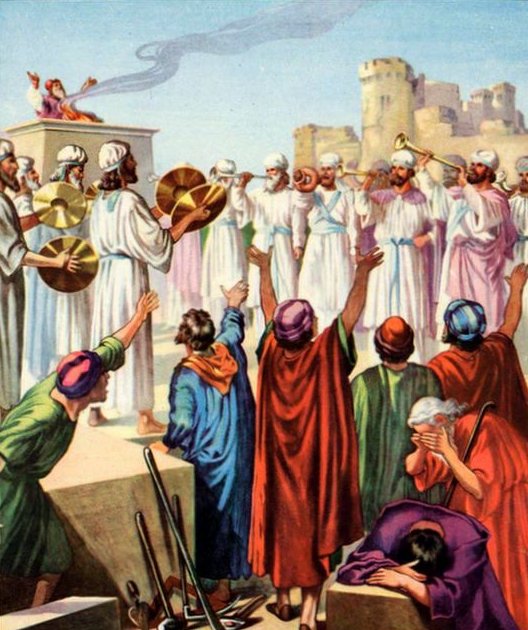
“And they sang together by course in praising and giving thanks unto the LORD; because he is good, for his mercy endureth for ever toward Israel. And all the people shouted with a great shout, when they praised the LORD, because the foundation of the house of the LORD was laid.”
The people had just returned from years of captivity in Babylon. All hope seemed to be gone. The great temple of the Lord that Solomon had built had been destroyed. The great empire had been reduced to a minuscule remnant.
But here they were, back in the land that God had given to their fathers. The foundation for the new temple had just been laid. God was beginning the restoration that He had promised through His prophets. Many years had gone by, but God was right on time.
They began shouting the shout that leaves no doubt. They still had a long way to go. The temple would not be completed for several more years, and they were still a small remnant of the once vast empire, but God promised them in Haggai 2:9:
“The glory of this latter house shall be greater than of the former, saith the LORD of hosts: and in this place will I give thee peace, saith the Lord of hosts.”
Confidence filled their lungs as they witnessed the Word of God being confirmed before their eyes. God said He was going to do it, and He did!
Three On-Fire Jews
I love the story of Shadrach, Meshach, and Abednego recorded in the third chapter of the book of Daniel. They refused to bow down and engage in idol worship. While many people are bowing down to false gods today, God is looking for somebody who will not bow their knee to Baal, but who will serve Him in the beauty of holiness.
Old King Nebuchadnezzer got word that these three young men weren’t bowing down to worship the image that he had built. Somebody got jealous.
Even though they were in captivity, they had found favor with Nebuchadnezzer, who elevated them to important positions in his government. When God starts blessing you, some of your best friends are going to get jealous.
Nebuchadnezzer was overcome with rage, and he said to Shadrach, Meshach, and Abednego, “You’ll either bow down to my god, or you’ll burn.”
Those boys said, “You’ve got it all wrong, King. If we bow down to your god, we will burn. We’ll burn in Hell! If we have to choose the furnace, we choose yours. Either God will deliver us from your fiery furnace, or He won’t.”
This is what you call covering all the bases. Either God’s going to do it, or He’s not going to do it!
As soon as they spoke those words, God said to Jesus, “Get down there and get in that fire.”
Nebuchadnezzer’s rage intensified, and he said to his servants, “Heat the furnace seven times hotter. Tie them up and throw them in.”
The men who threw them into the flames could not stand the intensity of the heat, but not a hair on those boys’ heads was singed. They still had their clothing on. The only things missing were the bonds that tied them.
Nebuchadnezzer looked into the furnace and counted four people. He went back to his men and said, “How many did we throw into that fire?”
They told him, “Three.”
He said, “I see four, and the fourth one is like unto the Son of God.”
Now think about this: three people were thrown into the fire, and three came out. What happened to the fourth one?
I’m here to tell you, He’s still in the fire. Why? Because when you get into the fire, He’s already there to see that you get deliverance. No matter what your predicament may be, God has a way out for you.
You Don’t Have Any Trouble
If you have ever heard my radio program, you’ve heard me say, “You don’t have any trouble. All you need is faith in God.” Now, that’s a borrowed statement; that’s not original with me.
I was preaching in Buffalo, New York. There was a gentleman who came into that meeting and said, “Brother Schambach, I’d like to invite you and your entire staff home for dinner.”
I said, “We’ll be there.”
At that time, I didn’t like to eat before preaching, so it was very late after the service was over before we were able to leave for his house. He didn’t tell me earlier that he lived in Niagara Falls, so we had to travel quite a distance.
But it was well worth the time. The man’s wife had prepared a feast: a banquet that made Belshazzar’s feast look like a Girl Scout picnic. She had prime rib of beef, turkey, T-bone steaks, and fried chicken. You never invite a preacher out unless you have fried chicken. And when people invite us out to eat, I fast all day so I can tuck it away.
I filled up my plate to gospel measure. That’s the running over variety. I was so hungry that when the gentleman asked me to pray, I prayed quickly, “Lord, bless this food. Amen,” and I started digging into that food.
I was helping myself and enjoying the food when all of a sudden this man had one of those talking spells. But what he was saying was better than the food, and I pushed my plate back because I wanted to hear every word.
He said, “Brother Schambach, I thought I had it made with a great job with the U.S. Government, money in the bank, and my home almost paid for. I had never been sick a day in my life, when suddenly, I was hit with spinal meningitis that paralyzed me from head to toe.”
Now, while he was speaking, I was looking at a man who was completely well in his body, and I knew that something miraculous had happened to him. I listened intently as he continued on.
He said, “I was hospitalized for three months, and then, to make matters worse, I was stricken with very painful rheumatoid arthritis which crept into all of my joints.
“I lapsed into a coma, my bank account was reduced to zero, and I had to sell my home to get equity out of it to pay the additional doctor and hospital bills.
“They called my priest in to give me the last rites of the church, extreme unction; and even though I was in a coma, I knew my priest was giving me the last rites.”
I’ve asked several doctors about this, and they’ve told me that, even though a person is in a coma, they can still hear you, but you cannot communicate with them.
He went on, “I wanted to let the priest know that I understood that he was giving me the last rites of the church, but I couldn’t even flicker an eyelash. He finished with the rite of extreme unction, and he walked out the door.
“As soon as he closed the door, another priest came walking in right through the wall. The other priest was dressed in all black, but this priest was dressed in all white.
This priest leaned down over my bed, put his mouth to my ear, called my by my name, and he said to me, ‘YOU DON’T HAVE ANY TROUBLE. ALL YOU NEED IS FAITH IN GOD.’
“My first reaction was, ‘what kind of crazy priest is this? I don’t have any trouble? Spinal meningitis, rheumatoid arthritis, lost my home, lost my job, and the priest just walked out of the room giving me the last rites. If this isn’t trouble, what is?’
“The next words that came out of this priest’s mouth were, ‘I am Jesus of Nazareth, and I am going to heal you right now.’
“He spoke to me further saying, ‘When I turn around and walk out of here, I want you to get out of this bed. Go wash yourself and shave. Walk out of this hospital. Go to the first bookstore you can find and buy a Bible. Begin reading the Gospel of St. John, and you will find the way to eternal life.’”
I was so blessed listening to him relate this story that I couldn’t continue eating.
He looked at me and said, “Brother Schambach, He walked right through the wall. Why didn’t he use the door?”
I said, “He is the door, Mister.” Jesus said in John 10:9:
“I am the door: by me if any man enter in, he shall be saved, and shall go in and out, and find pasture.”
He’ll make an entrance right into your life. He’ll come into your automobile. He’ll come to you on the job. He comes with the answer to your problems.
Jesus is still alive. He is still performing miracles. All He’s looking for is obedience and a little bit of faith. Trust Him, and you will shout the shout that leaves no doubt!
The Shout That Brought Us Out
“Rejoice greatly, O daughter of Zion; shout, O daughter of Jerusalem: behold, thy King cometh unto thee: he is just, and having salvation..” (Zechariah 9:9).
We’ve seen the shout without the clout; the shout that brings the rout; the shout that leaves no doubt, and now we come to the shout that brought us out.
Brought us out of what? Praise God, Jesus brought us out of sin. We’ve got something to shout about!
In John 19:28-30, we read:
“After this, Jesus knowing that all things were now accomplished, that the scripture might be fulfilled, saith, I thirst. Now there was set a vessel full of vinegar, and they filled a sponge with vinegar, and put it upon a hyssop, and put it to his mouth. When Jesus therefore had received the vinegar, he said, It is finished: and he bowed his head, and gave up the ghost.”
Jesus was on Calvary, stretched out between heaven and earth with nails in His hands and in his feet. He was given vinegar to drink, in fulfillment of the prophecy in Psalm 69:21.
After this final indignity, Jesus shouted with a voice of triumph, “It is finished!” What was finished? Well, several things, actually.
The most difficult part of the work of mankind’s redemption and salvation had been completed, satisfying the justice of God and destroying the power of Satan forever.
Also, the ceremonial law had run its course, and man was no longer bound by a long list of ordinances. From this time forward, God would write His laws upon the hearts of the redeemed. All of the shadows have been eliminated by the illuminating revelation of Christ. It’s as if God were saying, “Put out the fires and stop killing the animals! It is no longer necessary!”
The Old Testament prophecies and types pointing at the Messiah and His suffering were also finished. Jesus knew that drinking the vinegar was the last prophecy that had to be fulfilled. He wasn’t complaining when He said, “I thirst.” He was crossing the last “T” of prophecy that would usher in a new era in God’s relationship with mankind.
Finally, the sufferings that Jesus had to endure, in soul and body, were now finished. All of the pain, agony, and indignities that He had gone through during His ministry had come to an end. He had accomplished what He had come to do, and now He was going to return to His Father.
Having fulfilled His destiny as the Lamb slain for the sins of the world, now He would take His place on the right side of the throne of God and intercede for mankind as the High Priest.
The Last High Priest
Let’s examine this title a little more. Do you remember when John baptized Jesus? John baptized unto repentance, but Jesus had nothing to repent of. Then why did He get baptized in water? You need to go back and read the first chapter of Luke. The father of John the Baptist was Zacharias, who was one of the priests who ministered in the temple. The priesthood was handed down through blood relationship, and he was from the family of Abiah, a son of Eleazar, who was the eldest son of Aaron.
The mother of John, Elizabeth, was also a descendant of Aaron. The blood that flowed through their veins was priestly blood, and Jesus recognized John as the true high priest.
You may be thinking, “But I thought Caiaphas was the high priest.” Caiaphas was a political appointee chosen around A.D. 18 by the Roman procurator, Valerius Gratus. The government of Rome chose him because of his ability to compel the people to abide by the laws the Romans had imposed on them.
But Jesus knew that John was performing the true duties of the high priest, admonishing the people to turn from their sins and baptizing them unto repentance. He knew that the right of baptism signified change and the passing from the old to the new. He had no need to be baptized unto repentance, but He was showing that the role of the high priest had been passed to Him. Although He would not assume that role until after His death and resurrection, this baptism by John was the ceremonial transfer of priestly succession.
John objected to baptizing Jesus because he knew that He was the spotless Lamb of God. Indeed, he told Jesus that he needed to be baptized by Him.
Jesus, knowing that He was fulfilling prophecy, told John, “Suffer it to be so now: for thus it becometh us to fulfill all righteousness” (Matthew 3:15).
So John complied and baptized Jesus. And when He came up out of the water, the heavens burst open, and God the Father spoke and said, “This is My beloved Son in Whom I am well pleased.”
Do you remember what John said about Jesus when He was coming down the road? “Behold, the Lamb of God which taketh away the sin of the world” (John 1:29).
Nobody had ever said that before. Lambs were slain for Israelis only, but here is John the Baptist, recognized by Jesus as the real high priest, saying, “Behold the Lamb who takes away the sin of the world.”
Not a lamb for a man; not a lamb for a house; not a lamb for a nation, but a lamb for the world. It’s important to realize that Jesus is not an American God; He’s not an Asian God; He’s not an African God; He’s not a European God, but He is the God of the whole world.
Jesus was crucified on the cross at Calvary on Passover. During this feast, the high priest would sacrifice a lamb without spot or blemish for the sins of the nation of Israel.
But now Jesus had become the sacrifice! Not only was He the spotless Lamb, He was the High Priest who would present the sacrifice before God.
And His sacrifice as the sinless Lamb of God was not just for the nation of Israel but for the whole world.
When He cried out, “It is finished!” the veil in the temple was rent from top to bottom. Long and thick, it was made out of pure linen, and it was rent from top to bottom. Do you know why?
Only the high priest could come near the presence of God. The veil represented man’s separation from God, but through His death and resurrection, Jesus tore down that wall of separation. Now we are part of a kingdom of priests, and we can come boldly into His presence.
Our High Priest is seated at the right hand of God, and He said, “Whatever you ask the Father in My name, He will give it to you” (John 16:23 NASB).
We are priests of the most high God. We offer sacrifices of praise. When we shout unto God with the voice of triumph, we’re fulfilling our priestly duties. We can shout the shout that brought us out because Jesus brought us out of sin and into righteousness.
The Shout That’s Going To Take Us Out
“For the Lord himself shall descend from heaven with a shout, with the voice of the archangel, and with the trump of God: and the dead in Christ shall rise first..” (I Thessalonians 4:16).
Finally, I’m waiting for the shout that’s going to take us out. Out of what? Out of New York, Los Angeles, London, Nairobi, Calcutta, Tokyo, and every other place on this planet!
I don’t think it’s going to be much longer because there are signs all around us that we are living in the last days.
Powerful earthquakes and other natural disasters are becoming more frequent. More and more nations are becoming armed to the teeth with the most lethal military weapons ever developed. Tensions are high in many areas of the globe with the potential for numerous wars and internecine skirmishes.
Unprecedented advances in computers and other sophisticated technology are laying the groundwork for an eventual one-world economic and political system.
All of the things that Jesus and the prophets told us to look for in the last days are being revealed on a daily basis. Jesus is about to come!
I’m Getting Caught Up
I don’t know about you, but I believe in the rapture of the church. I know there are some preachers who don’t believe in the rapture. They tell me the word “rapture” is not in the Bible. I tell them right back that the phrase “caught up” is.
Here’s what it says in the book of First Thessalonians, chapter 4, verses 13 through 18:
“But I would not have you to be ignorant, brethren, concerning them which are asleep, that ye sorrow not, even as others which have no hope. For if we believe that Jesus died and rose again, even so them also which sleep in Jesus will God bring with him. For this we say unto you by the word of the Lord, that we which are alive and remain unto the coming of the Lord shall not prevent them which are asleep. For the Lord Himself shall descend from heaven with a shout, with the voice of the archangel, and with the trump of God: and the dead in Christ shall rise first: Then we which are alive and remain shall be caught up together with them in the clouds, to meet the Lord in the air: and so shall we ever be with the Lord. Wherefore comfort one another with these words.”
I’m not looking for Him anymore. I’m listening for Him. I’m listening for the shout and the sound of a trumpet.
He’s coming back with a shout, and if you’re not ready, you’re going to be left behind to face seven years of tribulation. The Holy Ghost is going to be taken out of this world. If you can’t stay saved now, I know you won’t be able to stay saved then.
A friend of mine was praying, and he said, “Lord, how are you going to pull this rapture off?” God told him, “That’s easy, son. I’m just going to call the Holy Ghost home, and everybody He’s in is going to come with Him.”
Are you ready? Are your sins gone? Are you washed in the blood of the Lamb? Is your name written in the Lamb’s Book if Life? God said in Luke 10:20:
“..rejoice not, that the spirits are subject unto you; but rather rejoice, because your names are written in heaven.”
We shall not all sleep. If you want to sleep, sleep. But I’m waiting for that final shout. The shout that’s going to take us out of Harlem. The shout that’s going to take us out of New York. The shout that’s going to take us out of London, Jerusalem, Nairobi, Rio de Janeiro, Moscow, Sydney, Calcutta, and Tokyo.
The Bible says in Mark 13:32:
“But of that day and that hour knoweth no man, no, not the angels which are in heaven, neither the Son, but the Father.”
Well, I’m going to make an announcement. I know the day, and I know the hour that He’s coming! It’s going to be the day of the Lord, and He’s coming back in the hour that you think not.
I want to go on radio and television, and I want to shout it from the highest mountain, “Jesus is coming!”
We’re so close. Jesus is about to come, and He’s coming back for a bride that is holy, without spot or wrinkle. He’s not going to marry up with a bride that’s flirting with the devil. He’s going to marry up with a chaste virgin. Those who have been washed in the blood of the Lamb.
You might tell me, “I shook the preacher’s hand and had my name put on the church book.” You might as well have put your name on a barn door and shook a donkey’s tail. It’ll get you into heaven just as quick.
He said, “He that comes to me, I will in no wise cast out.” It’s either Heaven or Hell. It’s either Christ or the devil. You’re either saved, or you’re lost. You can’t put this decision off.
How To Get Ready
If you want to be ready for the soon coming of Jesus Christ, get on your knees right now. Ask God to forgive you of your sins and to cleanse you of all unrighteousness. Ask Him to give you a clean heart and to make you a new creation. Ask Jesus to be your Lord and Savior and to fill you with the Holy Ghost so that you may live the life He wants you to live.
Start reading the Word of God daily, beginning with the book of John. Talk to God often, confessing your sins and asking for His help and guidance in your life. Make it an everyday part of your life so that you will grow strong in the Spirit.
Find a Spirit-filled, Bible-believing church, get baptized, and get involved with other Christians as God leads you into the work He has called you to do.
Then your spiritual ears will be opened, and some day soon you will hear the trumpet of God sounding and the shout that is going to take us out!
by R.W. Schambach



 In The Hands of the Refiner