
"When they saw Him, they worshiped Him; but some doubted." Matthew 28:17
Our soul possesses the amazing ability to sense God. This sense of God, at times clearly felt although still immature in youth, is strengthened with proper spiritual upbringing and defines itself in a conscious faith–in the conviction that there is one God, the Creator of all, Who is solicitous toward men and all of nature.
If a person’s faith is alive and well, it is not restricted to a cold knowledge that God exists, but finds expression in striving after a relationship with Him. A believing soul is drawn towards God just as a plant is drawn to the sun. In turn, an active relationship with God further strengthens a person’s faith, so that his faith becomes for him a source of guidance, founded on personal experience. In some people, who are particularly gifted, faith grows into an illumining inspiration that transports them from the world of vanity and sin into the transcendent world of eternal truth.
The significance of faith in a person’s development lies in the fact that it gives proper direction to all his powers–to his intellect, his feelings and will; it likewise brings harmony to his inner world, For example, it gives the intellect clarity and the correct world view, it gives the will support and purpose, it cleanses and refines the senses. Faith directs a person away from base earthly interests and leads him into a realm of higher, holy experiences.
Faith and Will
Behold I stand at the door and knock. If any man hears My voice, and opens the door, I will come in to him, and will sup with him, and he with Me (Rev. 3:20). These words of the Savior tell us that God offers each person the gift of faith. Man is free either to accept or to reject this gift.
The Lord pities those people whose doubt stems from spiritual weakness or inexperience rather than obstinacy. He helps those who seek the truth and suffer from doubt to acquire faith. For example, Christ had pity on the despairing father of the possessed youth, who cried out: Lord, I believe, help Thou mine unbelief! (Mark 9:24), and healed his sick son. He likewise had compassion on Apostle Peter who took fright at the storm and began to sink. Giving Apostle Peter His hand, the Lord gently rebuked him, saying: O thou of little faith wherefore didst thou doubt (Matt. 14:31). Nor did the Lord reject "doubting” Thomas, who desired personal assurance of the miracle of the Resurrection. Having satisfied Thomas by His appearance, however, the Lord did not praise him for believing on the basis of this material proof, but said to him, you believe because you have seen; blessed are those who do not see and believe. In other words, faith based on external experience has little value; this is actually not faith but ordinary knowledge. True faith is born of inner experience; it demands responsiveness and effort, and this is why it is worthy of praise.
We see the opposite of this searching faith in the Jewish scribes and Pharisees of Christ’s time. They obstinately refused to believe in Jesus Christ as the God-sent Messiah. Neither the fulfillment in Christ of the ancient prophecies, nor His countless miracles and rising of the dead, nor signs in nature, nor even the miracle of the Resurrection shook their unbelief. On the contrary, with each new miracle they became still more embittered and hostile toward Him.
Even if Christ was unable to inspire faith in those who did not want to believe, is it any wonder that in our time there are conscious and adamant atheists? They claim that they do not believe because they see no miracles. But the real reason for their unbelief lies not in a lack of miracles–these occur daily–but in a negative turning of the will. They simply don’t want God to exist.
The problem of unbelief is closely tied to the sinful spoilage of human nature. The fact is that faith demands a certain kind of behavior, a certain way of life. It puts a check on a person’s greed; it calls him to overcome his egoism, to exercise temperance, to do well, even to sacrifice himself. When a man prefers his passions over the will of God, and places his own good over the good of his neighbor, then he will do everything he can to repudiate whatever is beneficial to faith. The Savior indicated that an evil will is the chief cause of unbelief when He said: For everyone practicing evil hates the light and does not come to the light, lest his deeds should be exposed. (John 3:20).
But if a man is capable of crushing faith in himself, he is also capable of strengthening it. Turning again to the Gospel, we find here striking examples of burning faith. There are the cases of the Roman centurion, the Canaanite woman, the woman with an issue of blood, the blind men of Jericho, and many others. The Lord called His listeners to imitate the faith of these people. Consequently, it lies within our power, with God’s help, to gather and direct our Spiritual powers towards a greater faith. Faith, like every good, demands effort. That is why a reward is promised for it: He who believes and is baptized will be saved; but he who does not believe will be condemned. (Mark 16:16).
Faith–the Key to God’s Treasury
Faith draws a person into a living relationship with God in heartfelt, concentrated prayer. During such prayer a person comes into contact with God’s almighty power, and then, according to the word of the Savior, everything becomes possible to him who believes: And whatever things you ask in prayer, believing, you will receive, and, Because of your unbelief; for assuredly, I say to you, if you have faith as a mustard seed, you will say to this mountain, “Move from here to there, and it will move; and nothing will be impossible for you.” (Matt. 21:22,
17:20). In other words, even the least faith can work wonders, provided it is complete and vigorous, like a seed.
One ought to be careful how one uses the mighty power of faith. In praying one should be less concerned about pressing one’s own desire and more about acquiring wisdom from God to know what to ask. After all, prayer is not only our speaking to God, but a conversation with Him and a conversation requires that one know how to listen. Turning to the Gospel accounts, we see that those people whose faith was particularly outstanding–as, for example, the Roman centurion, the Canaanite, the friends of the paralytic, and others–were strangers to all exaltation or pathos. On the contrary, they were very humble (Matt. 8:10, 13; 22:9). The combination of strong faith and a humble opinion of oneself are not accidental. A deeply believing person feels, more than anyone else, the greatness and almightiness of God. And the more clearly he feels this, the more keenly he is aware of his own poverty. The great wonderworkers as, for example, the prophets Moses and Elisha, the Apostles Peter and Paul and those like them were always distinguished by profound humility.
Faith–Active Love
What correspondence exists between faith and good works? The question is often asked, is faith alone sufficient for salvation, or is good works also necessary? The question is improperly expressed, because it originates in a warped understanding of faith. True faith extends not only over the mind but overall the powers of the soul, including the will. Protestantism has narrowed the understanding of faith, limiting it to a rational acceptance of the Gospel teaching, and declares: "Only believe, and you will be saved!" The error of Protestants, just as the Old Testament Jews, consists in the formal, legalistic understanding of salvation. The Jews taught justification by works of the law independent of faith, while today’s Protestants teach justification by faith alone, independent of good works. Christianity, however, teaches concerning spiritual rebirth: If any man be in Christ, he is a new creature (II Cor. 5:17). Salvation is not only the resettlement of man in paradise, but the grace-filled state of his renewed soul; in the words of the Lord, the Kingdom of God is within a man (Luke 17:21).
Spiritual rebirth is not accomplished instantaneously. Christ’s words to those who believe, Thy faith has saved thee (Matt. 9:22), refer to that crucial inner break made by those who have turned from sin onto the path of salvation. Without this initial break in the way of thinking, any further amendment or spiritual progress is impossible. Naturally, after a person has chosen the right path he must begin walking on it. The New Testament epistles all speak about working on oneself and becoming more like Christ: We are buried with Him by baptism into death: that like as Christ was raised from the dead by the glory of the Father, even so we also should walk in newness of life (Rom. 6:4). What is needed here is not abstract faith but that which acts through love (Gal. 5:6).
Apostle James firmly rises up against those who separate faith from good works, saying: If a brother or sister be naked, and destitute of daily food, And one of you say unto them, Depart in peace, be ye warmed and filled; notwithstanding ye give them not those things which are needful to the body; what doth it profit? Yea, a man may say, Thou hast faith, and I have works: show me thy faith without thy works, and I will show thee my faith by my works. Thou believest that there is one God; thou doest well; the devils also believe, and tremble. Further the Apostle gives examples of righteous men and women of old, who proved their faith by their works, and he draws the following conclusion: Seest thou how faith wrought with his works, and by works was faith made perfect?…For as the body without the spirit is dead, so faith without works is dead also (James 2:14-26).
Apostle Paul likewise does not recognize faith without its fruit: Though I have the gift of prophecy, and understanding all mysteries, and all knowledge, and though I have all faith, so that I could remove mountains, and have not love, I am nothing (I Cor. 13:2). Therefore, a correct understanding of faith dispels all doubt as to which is more important–faith or works. They are inseparable, like light and warmth.
How to Strengthen One’s Faith
We have already said that faith is a most precious gift. It gives us a correct world view, reveals the purpose of life, encourages us in hard times, gladdens the heart, empowers our prayer, and makes accessible God’s infinite mercies.
Sadly, however, a life of sufficiency and well being dispels faith. God’s goodness is forgotten. Active faith departs, and God’s great talent gets buried.
As faith grows dim a man’s inner condition becomes increasingly disordered: he loses clarity of thought and purpose of life, his spiritual strength leaves him, emptiness and ennui (Listlessness and dissatisfaction resulting from lack of interest; boredom) take possession of his heart, he becomes irritable and dissatisfied. After all, the soul cannot live without faith, just as a plant cannot live without light and moisture. No matter how intelligent and talented, in the absence of faith a person descends to the level of a dumb animal, even a beast.
In order to escape such a "shipwreck of faith" (I Tim. 1:19) one must seriously concern oneself with the renewal of one’s soul. How? We know that all talents require exercise: to preserve a sharp mind it must be engaged in mental work; fingers lose their flexibility if they are not exercised on a musical instrument; to remain limber the body requires gymnastic work-outs. If people expend so much energy and money to develop their physical abilities, should not we, Christians, work to acquire living spiritual experience?
To strengthen faith we must begin to live spiritually. Here it is necessary, first of all, to regularly read the Holy Scripture, to think about God, to take an interest in spiritual subjects. Then, one must try to serve God in concentrated heartfelt prayer, and also commune the Body and Blood of Christ Finally, one must try to live not for oneself alone but for the good of one’s neighbor, one’s church. The heart of one who loves is warmed by the grace of the Holy Spirit. Of course, in trying to lead a Christian life one cannot avoid warfare, trials and difficulties. It may even seem that the whole world is armed against the believer. It is important to remember that with God’s help all these trials will work for our spiritual growth.
Let us remember that faith is not only the fruit of our efforts; it is also the gift of the Holy Spirit. Apostle Paul testified to this in saying that the fruit of the Spirit is love, joy, peace, longsuffering, gentleness, kindness, faith (Gal. 5:22). Let us therefore ask God for faith, that great spiritual treasure, remembering the promise: Ask, and it shall be given unto you; seek, and ye shall find, knock, and it shall be opened unto you (Matt. 7:7). Faith will bring us peace of soul, joy, and a foretaste of that already accomplished victory over evil, which gave the Apostles such consolation: this is the victory that overcomes the world, even our faith (I John 5:4).
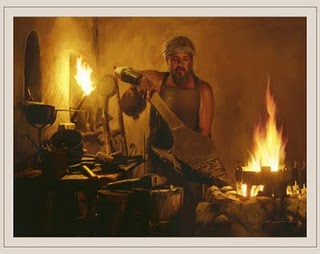
 In The Hands of the Refiner